

Most people notice less shedding first, then finer new hairs, and a visibly fuller look somewhere between month 3 and month 6. PRP (platelet-rich plasma) works on a biological schedule, because it asks resting follicles to re-enter their growth phase, and that phase takes months, not days. A treatment plan that sets the right sessions, spacing and photo checkpoints from the start makes the timeline easier to follow. At Sudbury Med Spa, PRP hair restoration begins with a free consultation and a personalized plan.
TL;DR
- Early changes, such as less shedding or finer new hairs, can appear in the first 1 to 3 months. Visible density gains usually show around months 3 to 6.
- A common starting protocol is three sessions spaced one to two months apart, followed by maintenance sessions.
- In a 2019 study, hair density peaked at 3 months and began to ease by 6 months, which is why maintenance is part of the plan.
- Women with female pattern hair loss have solid trial data behind PRP, including a randomized trial showing gains by week 24.
- Soreness, redness and swelling are typically short-lived and settle within about 24 hours.
Table of Contents
- Why PRP takes months, not weeks
- The PRP hair results timeline
- How many sessions, and how far apart?
- PRP for women with hair loss
- Does PRP hurt, and what is recovery like?
- What the latest evidence says
- How to get the most from your timeline
- Our perspective
- Start your PRP plan in Sudbury
- FAQ
- Sources
Why PRP takes months, not weeks
Hair grows in cycles. Each follicle spends years in an active growth phase, then a short transition, then a resting phase before it sheds and restarts. In pattern hair loss, follicles gradually shrink and spend less time growing, so the hairs they produce get shorter and finer.
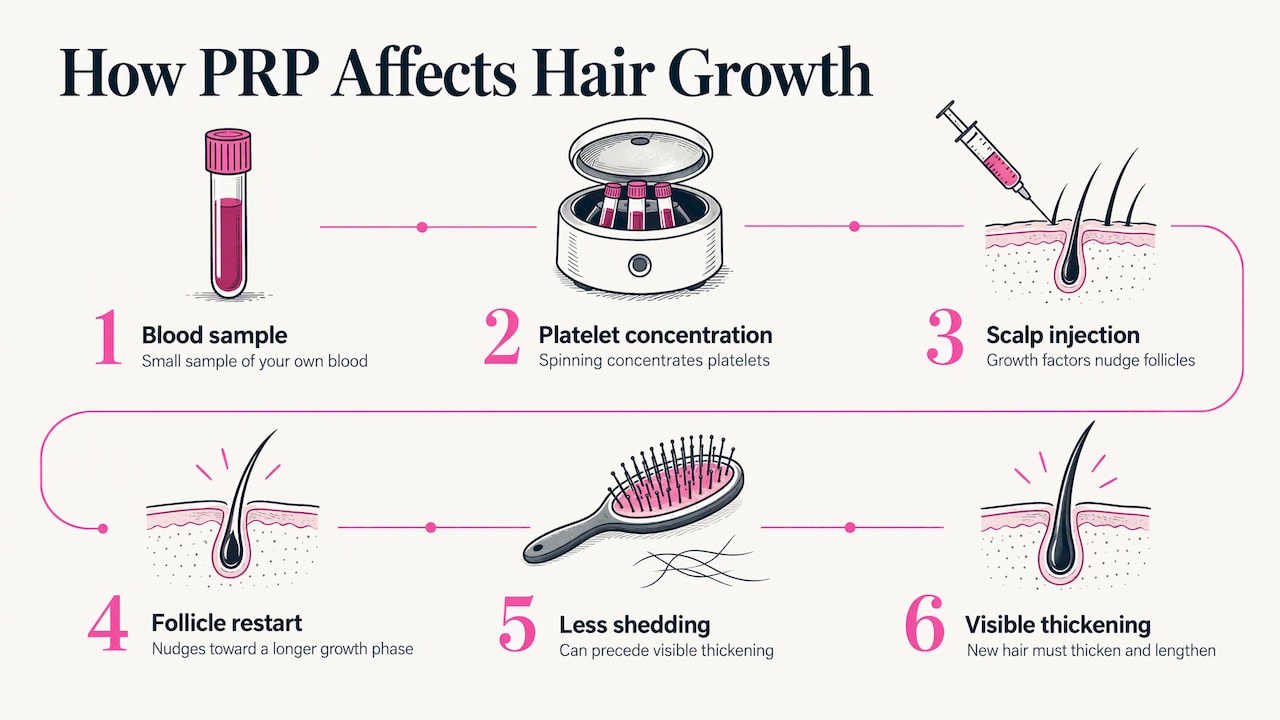
PRP is made from a small sample of your own blood, spun to concentrate platelets, then injected into the scalp. The idea is that the growth factors in those platelets nudge follicles back toward a longer, stronger growth phase. A follicle that restarts still has to grow a new hair, and a new hair has to thicken and lengthen before you can see it. That is the reason your mirror lags behind the treatment by weeks.
It also explains why the first thing many people notice is not new growth but a change in shedding. Fewer hairs in the brush or shower drain can precede any visible thickening.
The PRP hair results timeline
No two scalps follow the same curve, and the ranges below are typical patterns, not promises. Use them as checkpoints.
| Period | What you may notice |
|---|---|
| First 24 hours | Mild tenderness or redness at injection sites that settles on its own |
| Weeks 1 to 4 | Normal routine resumes. Some people see less shedding |
| Months 1 to 2 | Fine, soft new hairs may start to appear, often at the temples or crown |
| Months 3 to 4 | Hair looks thicker and denser in treated areas. Many people see their clearest improvement here |
| Months 4 to 6 | Gains consolidate, and the full first-round series is complete |
| Month 6 and beyond | Maintenance sessions help keep the gains going |
| About 12 months | Many programs judge the result against baseline photos at this point |
Weeks 1 to 4: recovery and the first signals
The first day is about the injection sites. After that, you return to normal hair care. This stage is too early for new hair, but it is when your baseline matters most. Take photos before your first session, in the same lighting, with the part in the same place and the same angles every time: top, crown, hairline and both temples.
Months 1 to 3: early changes
This is the window people ask about most when they search for when PRP starts working. Some patients see early growth or reduced shedding at two months, but for many the more convincing change arrives around months three and four. If you have had one session and see nothing at week three, you are on schedule, not behind it.
Months 3 to 6: the visible payoff
A 2019 study summarized by Healthline found that PRP increased hair density, with the effect peaking at 3 months and beginning to decrease by 6 months. That curve is the main argument for planning a maintenance schedule instead of treating PRP as a one-time event.
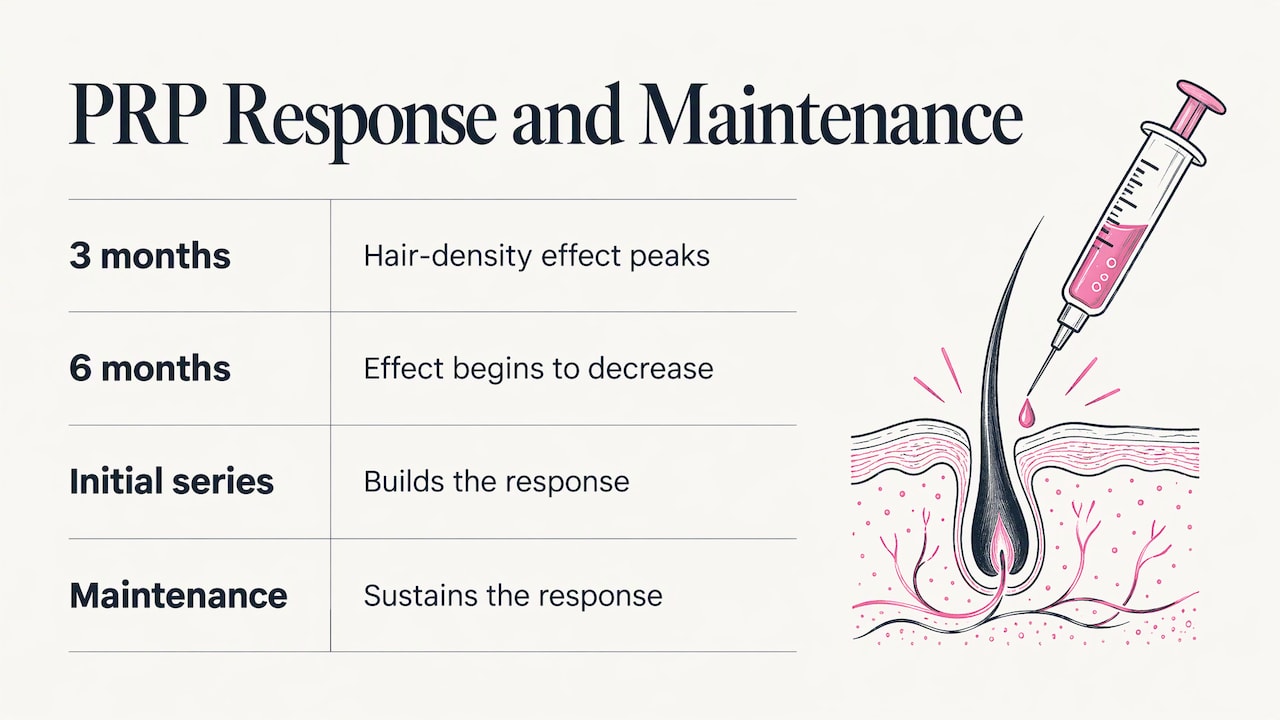
A 2024 Ohio State Health & Discovery overview from a dermatologist makes the same point: maintenance therapy follows the initial series, because the initial series builds the response and maintenance sustains it.
Months 6 to 12: maintenance and judging the result
By now you and your provider can compare your photos with your baseline and decide how often to come back. Because hair loss is ongoing, a steady schedule gives your follicles repeated support.
How many sessions, and how far apart?
There is no single universal protocol. The American Academy of Dermatology’s 2024 clinical pearls on PRP describe three treatments spaced one to two months apart, with maintenance sessions afterward. The same document notes that methods for preparing and administering PRP vary between clinics, so the details of your plan should be set by the person treating you.
In practice, a plan often looks like this:
- Consultation and baseline. Your provider reviews your pattern of loss, how long it has been going on, and your goals. You take standardized photos.
- Initial series. Typically three sessions, one to two months apart.
- Checkpoint. Around months 4 to 6, compare new photos with your baseline.
- Maintenance. Periodic sessions, with spacing chosen from how you responded.
Each appointment is relatively short, so it fits into a lunch hour or a morning before work. Your own plan can also combine PRP with other hair-supportive steps your provider recommends.
PRP for women with hair loss
Female pattern hair loss usually shows up as diffuse thinning over the top of the scalp and a widening part, while the frontal hairline stays in place. It is one of the most common reasons women look into PRP, and the research is encouraging.
- A 2024 systematic review and meta-analysis of 21 studies and 628 women found that PRP significantly increased hair density and thickness with a favorable safety profile.
- A 2020 randomized controlled trial in the Journal of the American Academy of Dermatology followed 30 women. At week 24, 57% of the PRP group had improved, against 7% of the saline group, and mean density rose by 105.9 hairs/cm² in the PRP group.
Twenty-four weeks is about five and a half months, which fits the month 3 to 6 window in the table above. For women, the practical takeaway is to plan on a series of sessions and judge by photos at around six months, not at week six.
If your thinning is tied to tight hairstyles, our page on PRP for traction alopecia explains how treatment fits in. If you have sudden, patchy or rapid loss, see your primary care provider or a dermatologist first, since several medical causes, such as thyroid or iron issues, are worth ruling out before any cosmetic plan.
Does PRP hurt, and what is recovery like?
The scalp has many nerve endings, so you will feel the injections. The AAD describes the most common side effects (pain, swelling, bleeding, lightheadedness and redness) as immediate and typically resolving within 24 hours. It also notes that vibratory devices, arriving well hydrated and eating beforehand may reduce discomfort.
The 2024 meta-analysis reported no significant difference in pain between PRP and control groups, and the adverse effects it recorded were mild and resolved on their own.
For a plain-language look at what to expect after a PRP session, including the first days of mild tenderness, that guide covers the general pattern of PRP recovery.
A few sensible habits:
- Eat and drink water before your appointment.
- Tell your provider about blood thinners, bleeding disorders, active scalp infections or skin conditions, and pregnancy or breastfeeding before booking.
- Follow the aftercare instructions you are given about washing, styling and sun exposure.
If swelling, pain or redness is getting worse after the first day, or you develop fever or signs of infection, contact your provider or a doctor promptly.
What the latest evidence says
The evidence base has grown in the past few years. A 2025 meta-analysis of 43 randomized trials with 1,877 participants found that activated PRP significantly increased hair density compared with placebo and reduced hair loss. A 2026 review in the Journal of Clinical Medicine describes PRP as having the most mature evidence among injectable hair-loss approaches.
What this means for your timeline: preparation and technique matter, so ask who prepares your PRP and how your plan is structured. A provider who tracks your progress with photos at set intervals will give you a clearer answer to “is it working?” than a feeling in the mirror.
How to get the most from your timeline
- Start with photos. A baseline is the only honest way to measure change.
- Commit to the series. One session rarely tells you anything. The first round is designed to work as a set.
- Be patient through month three. This is when the biology catches up with the treatment.
- Schedule maintenance early. Because density peaked around three months and then eased in the 2019 study above, a plan for follow-up sessions keeps momentum.
- Keep up the basics. Gentle hair care, a balanced diet and any other treatment your provider recommends all support the result.
Our perspective
Patients usually ask us one thing: “When will I see it?” The honest answer is a timeline, not a date. We build every PRP plan around checkpoints, because hair rewards patience and a clear plan.
At Sudbury Med Spa, we start with a free consultation. We look at your pattern of loss, talk through your goals, and write a personalized treatment plan so you know the number of sessions, the spacing and when we will review your progress together. Our team has completed over 15,000 treatments, and we bring that experience to every plan.
We also think PRP fits well alongside the rest of what we do. Many clients come in for skin concerns and then learn that the same approach, a personalized plan with defined steps, works for their hair too. Financing options are available, so you can spread out the cost of a full series.
The best results come from starting early, photographing consistently and staying on schedule. That is the routine we help you keep.
Chris
Start your PRP plan in Sudbury
If you are ready to begin a PRP hair series, our team can map out your sessions and checkpoints at a free consultation. Read about our PRP injections, see real outcomes on our before and after page, or explore our services to book.

FAQ
When does PRP start working for hair?
Some people notice less shedding or fine new hairs within one to three months. For most, the clearer improvement in thickness appears around months three to six. Because follicles need time to grow new hairs, results build gradually across your series.
Is PRP effective for women with female pattern hair loss?
The research is supportive. A meta-analysis of 21 studies with 628 women found significant gains in hair density and thickness, and a randomized trial showed improvement in most PRP-treated women by week 24. Your provider can tell you whether your pattern of thinning suits PRP.
Does PRP for hair hurt?
You will feel the injections, but the discomfort is brief. Soreness, redness and swelling typically fade within about 24 hours. Eating beforehand and staying hydrated can help, and your provider can adjust technique to keep you comfortable.
How many PRP sessions will I need?
A common starting point is three sessions one to two months apart, followed by maintenance. Your plan may differ depending on your hair loss pattern and how you respond. We set the schedule at your consultation and review it as your photos come in.
Sources
- Platelet-rich plasma for hair loss, Ohio State Health & Discovery
- PRP for Hair Loss: Efficacy, Safety, and Cost, Healthline
- Effectiveness of platelet-rich plasma in treating female pattern hair loss, systematic review and meta-analysis (2024)
- The effect of platelet-rich plasma on female androgenetic alopecia, JAAD (2020)
- Platelet-rich plasma for alopecia, AAD Clinical Pearls (2024)
- Platelet-Rich Plasma in the Management of Alopecia: A Meta-Analysis (2025)
- Advances in Medicalized Hair Loss Solutions: A Review (2026)


