

The most reliable way to clear age spots on the face is a light-based procedure, either intense pulsed light (IPL) or a pigment laser, because it targets the melanin in the spot itself and usually needs only a few sessions. Creams and peels can help, but they work more slowly or less predictably. Whatever you choose, the first step is making sure the spot really is an age spot. At Sudbury Med Spa we offer a free consultation, so you can have the spots looked at and get a plan before you commit to anything.
TL;DR
- Age spots (also called liver spots, sun spots or solar lentigines) are flat, tan-to-brown patches caused by years of UV exposure. They are harmless, but a new, dark, growing or bleeding spot needs a doctor’s check first.
- In a 2025 review of 41 trials, IPL lightened spots in 74.6% to 90% of patients and picosecond lasers in 67.9% to 93.02%. Both outperformed most other options.
- Creams, peels and cryotherapy can fade spots too, but results are more variable and cryotherapy carried more severe side effects in that review.
- Plan on two to three sessions for most light-based treatments, and expect spots to return without daily SPF 30+ sunscreen and shade.
- Skin tone changes which device and settings are safest, so the treatment should be matched to you, not picked from a menu.
Table of Contents
- What age spots are, and when to get a spot checked
- Age spot treatments compared
- IPL and lasers: how they remove brown spots
- Skin tone changes the plan
- Peels, microdermabrasion and cryotherapy
- What about creams?
- How to choose: a short decision guide
- Keeping age spots from coming back
- Treating age spots at Sudbury Med Spa
- FAQ
- Sources
What age spots are, and when to get a spot checked
Age spots are small, flat, tan-to-dark-brown areas of skin. Mayo Clinic describes them as ranging from freckle size to about half an inch (13 mm), caused by ultraviolet light making melanin, your skin’s pigment, clump together. They show up most on the face, hands, shoulders and arms, the places that have seen the most sun.
Three things are worth knowing:
- They are not related to your liver. MedlinePlus states that the name is misleading and that the spots do not indicate liver disease.
- They don’t fade on their own. Unlike freckles, age spots don’t fade when you stay out of the sun, according to Mayo Clinic.
- They can affect any skin tone. They are most common in people with fair complexions, but MedlinePlus notes they can occur in darker skin as well.
The medical term is solar lentigo (plural lentigines). If you searched “lentigines treatment,” you are looking at the same thing: a benign, sun-related patch. DermNet notes that these lesions need no treatment unless you want them gone for cosmetic reasons.
Spots that should be checked before any treatment
Some dark spots are not age spots. Mayo Clinic advises having a doctor evaluate a spot that is black, growing, has an irregular border, combines several colors or bleeds, because those changes can signal melanoma. MedlinePlus adds that skin cancers can look like small shiny or waxy bumps, scaly or rough patches, firm red spots or crusty, bleeding areas.
Diagnosis usually starts with a visual inspection, and a doctor may take a small skin sample (a biopsy) to tell an age spot from a skin cancer such as lentigo maligna. Treating a spot with a laser or cream before it has been identified can hide something that needs medical care. If anything on your face matches the list above, see a dermatologist or your primary care doctor first. If a spot looks like a typical age spot, that is where a consultation with us begins.
Age spot treatments compared
The American Academy of Dermatology (AAD) groups treatments into two categories: creams and lotions used daily for weeks to months, and procedures such as lasers and chemical peels that work faster but cost more and carry a higher risk of side effects. The table below puts the main options side by side using a 2025 systematic review of 41 clinical trials covering 3,234 patients.
| Treatment | Reported success range for solar lentigines | What to know |
|---|---|---|
| Picosecond laser | 67.9% to 93.02% | Short pulses that target pigment; few sessions |
| Intense pulsed light (IPL) | 74.6% to 90% | Broad light that treats many spots at once; less linked to post-inflammatory darkening |
| Q-switched laser | 36.36% to 76.6% | Targets pigment with nanosecond pulses |
| Pulsed dye laser | 27% to 57% | Less linked to post-inflammatory darkening |
| Cryotherapy (liquid nitrogen) | 37% to 71.4% | Linked to more severe side effects in the review |
| Trichloroacetic acid peel | 12% to 46% | Often needs several treatments |
| Fractional CO2 laser | 8% to 23% | Lowest range in the review |
| Prescription topical (mequinol plus tretinoin) | 56.3% to over 80% on the face | Takes months of daily use |
The review’s authors concluded that laser therapy appears more effective than other modalities, with an acceptable safety profile. Most side effects across treatments were mild and temporary. Note that these are ranges from different trials with different methods, so they show the pattern, not a promise for any one person.
IPL and lasers: how they remove brown spots
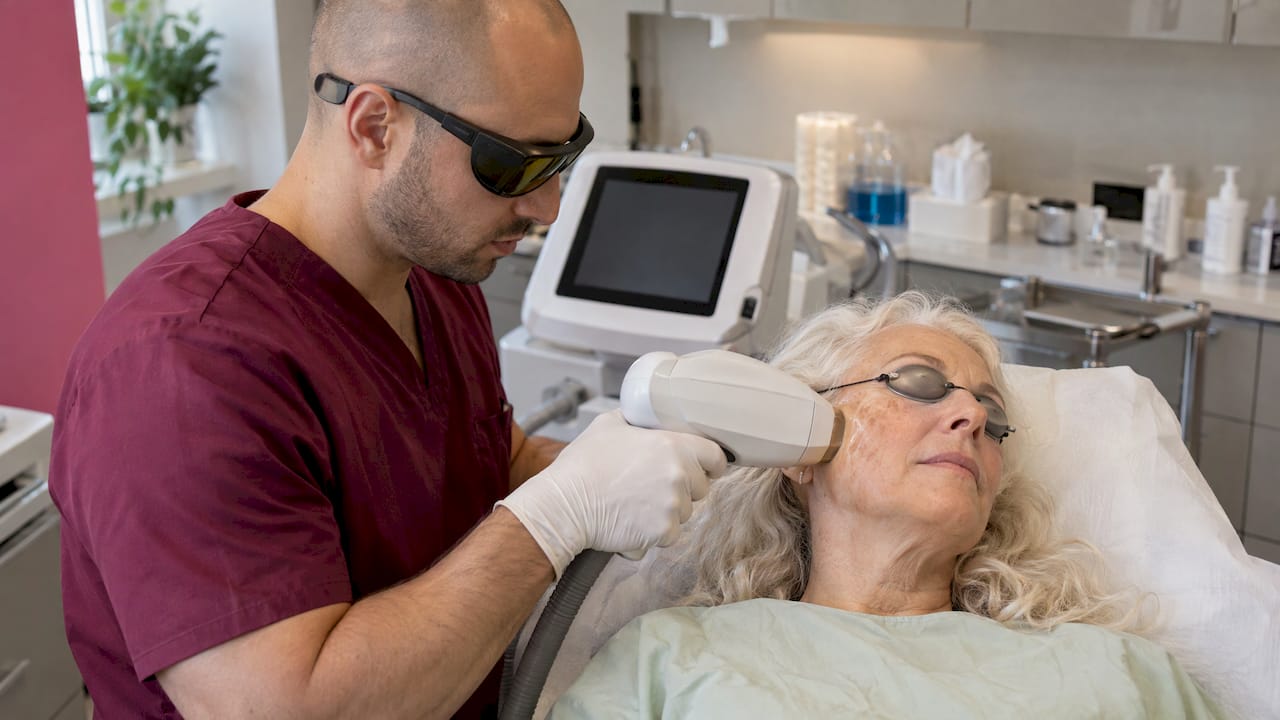
Both IPL and pigment lasers work on the same principle. The device delivers light energy that the dark pigment absorbs, and the body clears the broken-up pigment over the following days and weeks. Mayo Clinic explains that some laser and IPL therapies destroy melanin-producing cells without damaging the skin’s surface, and that they typically need two to three sessions.
IPL for scattered spots
IPL uses broad-spectrum light rather than a single wavelength. That makes it a practical choice when brown spots are spread across the cheeks, forehead and temples, and when you also want a more even tone. It is the approach many people mean when they search for dark spots laser treatment, even though technically it is a light device. In the 2025 review, IPL success ranged from 74.6% to 90%. You can read how we approach it on our intense pulsed light page, and our photorejuvenation page covers the broader skin-refreshing use of the same technology.
Picosecond and Q-switched lasers for defined spots
Picosecond lasers deliver extremely short pulses. They reached 67.9% to 93.02% in the review, the widest top-end of any option. Q-switched (nanosecond) lasers were 36.36% to 76.6%. A 2025 global consensus of pigment experts states that nanosecond, picosecond and IPL devices are effective for established, visible lentigines and can be used as first-line management, with caution in higher skin types. If you are weighing two picosecond platforms, our guide to PicoWay versus PicoSure explains how they differ.
What the evidence says about sessions and downtime
The AAD says that one or two laser treatments can treat age spots quickly, with longer-lasting results than creams. Side effects such as crusting or temporary darkening tend to fade quickly. In a 2024 study of a dual-wavelength laser in 17 women with skin types II to IV, up to three treatments spaced three to five weeks apart improved facial hyperpigmentation and skin quality at 4 and 12 weeks, with high satisfaction and only brief, self-resolving effects such as redness.
In practice, that means:
- Spots often look darker and may flake or crust for several days after treatment before they lift.
- Sessions are typically spaced a few weeks apart so the skin can heal.
- Two to three visits is a realistic plan for a face with many spots. Isolated spots may need fewer.
- Sunscreen between and after sessions is part of the treatment, not an extra.
If your concern is closer to freckles than to age spots, our article on laser freckle removal explains how many sessions to expect.
Skin tone changes the plan
Pigment-targeting light is absorbed by melanin, and that includes the melanin in your normal skin. In deeper skin tones, the wrong device or settings can leave a lighter or darker mark where the spot used to be. The consensus above says lasers and light devices can be used first-line with caution in higher skin types, and the 2025 review noted that pulsed dye and IPL lasers were less associated with post-inflammatory hyperpigmentation. If you want to read more about why skin tone and hyperpigmentation interact, that is a good place to start.
The practical point is that your Fitzpatrick skin type (the scale doctors use to describe how your skin reacts to sun) and your tanning history should shape the device, the energy and the number of sessions. That is exactly what a consultation is for.
Peels, microdermabrasion and cryotherapy
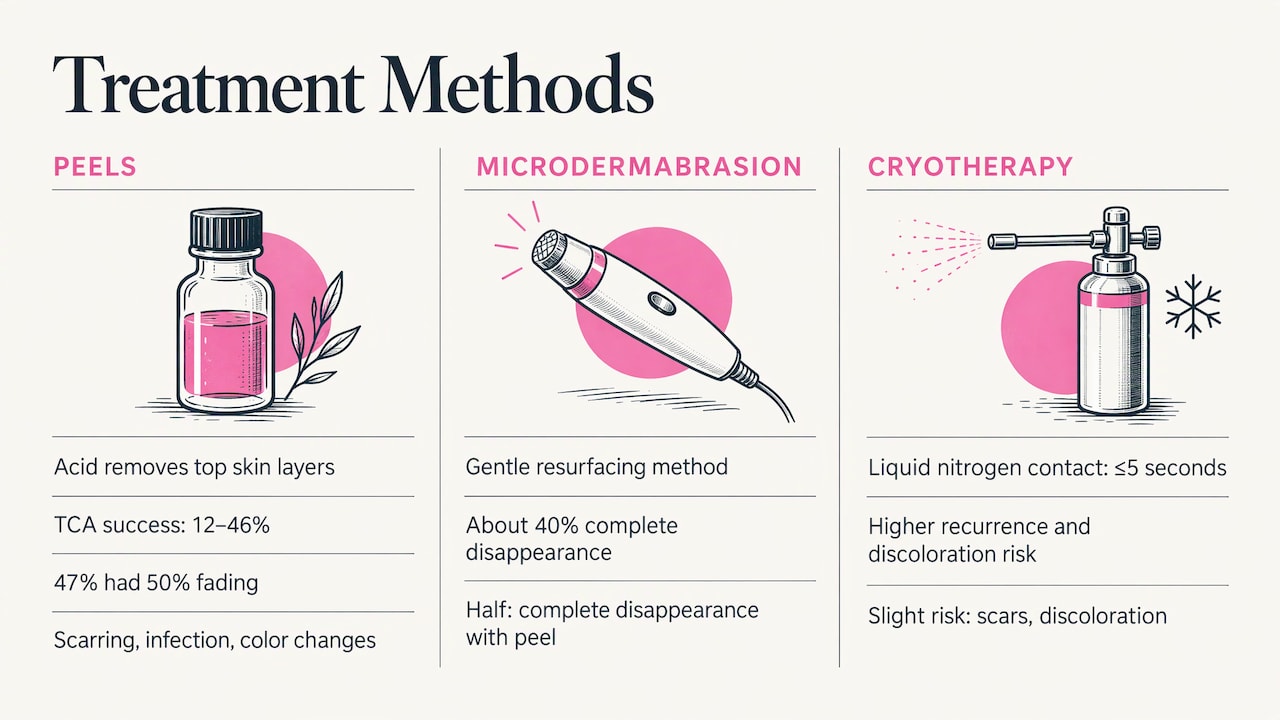
Chemical peels. A peel applies an acid solution that removes the top layers of skin. The pigment-expert consensus lists superficial and medium peels as alternatives to lasers that can be used first-line. Results vary: the 2025 review found 12% to 46% success for trichloroacetic acid peels, and Mayo Clinic notes peels may need several treatments and can cause scarring, infection or changes in skin color. In an AAD-cited study comparing a peel with cryosurgery, 47% of peel patients had 50% fading of their age spots, with faster healing after peels. We offer facial peels as part of our services.
Microdermabrasion. This is a gentle resurfacing method. The AAD reports that in one study, about 40% of patients treated every two weeks for 16 weeks saw their age spots disappear completely, and half of those who also had a chemical peel did.
Cryotherapy. A clinician touches liquid nitrogen to the spot for five seconds or less, according to Mayo Clinic, to destroy the extra pigment. It can temporarily irritate the skin and carries a slight risk of permanent scarring or discoloration. The consensus notes that higher recurrence and the risk of discoloration limit its use. For a face, where color matching matters, most people prefer a light-based option.
Combination plans. DermNet reports that combination therapy, using two or more modalities, delivers the highest resolution rates, followed by laser therapy, topical retinoids, cryotherapy and peels. This is why a plan built around your skin often outperforms a single procedure.
What about creams?
Creams are the slow lane. The AAD says they are applied once or twice daily for weeks to months. Here is what the 2025 review found for solar lentigines:
- Mequinol 2% with tretinoin 0.01%: facial efficacy between 56.3% and over 80%.
- Adapalene gel 0.1% and 0.3%: lightened lesions in 57% and 59% of patients.
- A hydroquinone 5%, tretinoin 0.03% and dexamethasone 0.03% combination: about 50% effective.
- A plant-extract cream with 2.51% arbutin: lightened skin in 56% of patients.
Two safety points matter here. First, according to Black Health, since the 2020 CARES Act reform there is no legal over-the-counter hydroquinone in the United States, so any product claiming to be one deserves caution. Second, the same article cites a 2022 review in which long hydroquinone use, at concentrations above 4% and courses longer than 3 months, was linked to a skin-darkening condition called exogenous ochronosis. Prescription topicals should be started and monitored by a licensed prescriber, who can also tell you how long to use them.
Topical retinoids also have a long-term role. The consensus says they can be proposed as first-line and as long-term maintenance for photoaging, which makes them a useful partner to a procedure rather than a replacement for one.
How to choose: a short decision guide
- Get the spot identified. Any spot that is new, dark, changing or bleeding goes to a doctor first.
- Count and map your spots. Many scattered spots point toward IPL or photorejuvenation. A few well-defined spots suit a pigment laser.
- Consider your skin tone and tanning habits. These decide the device and settings. Recent tanning raises the risk of uneven results, so say so at your consultation.
- Think about timing. Many people schedule treatment in the cooler months, when sun exposure is lower, then protect the skin carefully through the following summer.
- Plan the maintenance. Daily sunscreen, and often a retinoid, keep results in place.
Our article on sun damage face treatment goes deeper on when to start and how to pair treatments, and the post-inflammatory erythema guide explains the redness that can follow some procedures and how long it usually takes to settle.
Keeping age spots from coming back
Treatment removes the pigment that is there. It does not stop new spots. The AAD states that age spots can return after treatment, and that prevention depends on sun protection:
- Seek shade, especially in the middle of the day. iMedic suggests avoiding peak UV hours of 10 AM to 4 PM.
- Wear a wide-brimmed hat, UV-protective sunglasses and sun-protective clothing, including UPF-labeled items.
- Apply broad-spectrum, water-resistant sunscreen of SPF 30 or higher to all uncovered skin before going outside, and reapply about every two hours.
Are age spots hereditary? Partly. DermNet reports that mutations seen in both solar lentigo and seborrhoeic keratosis suggest a shared genetic basis, and iMedic lists a family history as a risk factor. Fair skin, age over 40, frequent sun exposure, past sunburns and tanning bed use raise the odds as well. You cannot change your genes, but you can control the UV exposure that switches them on.
Our perspective
People come to us holding a photo of one brown spot and asking which machine removes it. The better question is which plan fits their skin. A spot on a fair, lightly tanned cheek and a spot on a deeper skin tone are not the same job, and the research agrees: light-based devices work well, and the device and settings have to be chosen with skin type in mind.
That is why we start with a free consultation and a personalized treatment plan. We look at your spots, talk through your skin and your sun habits, and build a plan that can combine light-based treatment with other services such as facial peels or microneedling with PRP, which is where the evidence says combinations do well. We have completed over 15,000 treatments, and our team is led by our founder, Natalie NgocTrang.
Our advice is simple: treat the spots, then protect the skin you have just cleared. That is what keeps the result.
Chris
Treating age spots at Sudbury Med Spa
We offer laser therapies and light-based treatments for pigment, along with personalized facial treatments, facial peels and microneedling with PRP. Every plan begins with a free consultation, and financing options are available if you prefer to spread out the cost. Our photorejuvenation page describes the light-based approach to sun-damaged skin.

If you expect to return for several visits, our memberships are listed at $399 per year (SILVER), $499 per year (GOLD) and $599 per year (PLATINUM). You can also browse everything we offer on our services page or visit sudburymedspa.com to book your consultation.
FAQ
Can you get rid of age spots on the face?
Yes, they can be lightened or removed. The AAD says one or two laser treatments can treat age spots quickly, with longer-lasting results than creams. Spots can return with more sun exposure, so daily sunscreen is part of the plan.
Are age spots ever raised?
Typical age spots are flat. A spot that is raised, rough, scaly, shiny or crusty may be something else, and MedlinePlus lists those as possible skin cancer signs. Have any raised or changing spot examined by a doctor before treatment.
How many sessions does laser or IPL treatment take?
Mayo Clinic says laser and IPL therapies typically require two to three sessions. The number depends on how many spots you have, how dark they are and your skin type. A consultation gives you a plan specific to your face.
Is there a dark spot cream that actually works?
Some prescription ingredients do lighten spots. In the 2025 review, mequinol with tretinoin and adapalene gel were among those that worked, over weeks to months of use. Hydroquinone is no longer sold legally over the counter in the U.S., so a prescriber should guide any strong lightening cream.
Sources
- Age spots (liver spots): Symptoms and causes, Mayo Clinic
- Aging spots: MedlinePlus
- What can get rid of age spots? American Academy of Dermatology
- Treatment of Solar Lentigines: A Systematic Review (PMC, 2025)
- Global consensus on the management of melanin disorders (PMC, 2025)
- Solar lentigo, DermNet
- 589/1319 nm dual-wavelength laser study, Journal of Drugs in Dermatology (2024)
- Dark Spots on Black Skin: How to Fade Hyperpigmentation, Black Health (2026)


