


Broken capillaries on the face are tiny dilated blood vessels, usually on the cheeks, nose or chin. They are rarely dangerous, and they rarely fade on their own. Skincare can slow new ones from forming, but the visible red lines themselves are most reliably reduced with a laser or light treatment, usually over a short series of sessions. A free consultation at Sudbury Med Spa is the practical first step: we look at your skin, your history and your goals, then build a personalized plan.
TL;DR
- “Broken capillaries” are usually dilated vessels (telangiectasias) caused by sun damage, genetics, rosacea, heat and hormones, not a true burst vessel.
- Press on the mark: if it turns pale and refills, it is typically a spider vein. If it stays red or purple, it is bleeding into the skin and should be looked at.
- Laser and light-based treatment is the standard procedural option, often three to four sessions with touch-ups later.
- Daily sunscreen, gentle cleansing and avoiding heat and harsh scrubbing help prevent new ones.
- We offer free consultations, so you can get a plan for your face before you decide on anything.
Table of Contents
- What broken capillaries on the face really are
- Why they appear on your cheeks and nose
- Broken capillary, rosacea or bruise? A quick check
- How broken capillaries are treated
- Treating the cause as well as the thread
- Everyday habits that help prevent new ones
- What the Sudbury Med Spa approach looks like
- Ready to start: book a free consultation
- FAQ
- Sources
What broken capillaries on the face really are
Capillaries are the smallest blood vessels in the body. On the face, the ones close to the surface can widen and stay widened. You then see them as fine red, pink or purplish threads, often branching like a tiny spider web. The medical term is telangiectasia, and the common names are spider veins, broken veins or broken capillaries.
The name is a little misleading. In most cases nothing has burst. According to the dermatology professionals at ASCP, constant vasodilation stretches and weakens the elasticity of the capillary wall, so the vessel no longer returns to its original width. That is why the thread stays visible once it appears.
They show up most often on the cheeks and around the nose, and the same source notes they are more noticeable on lighter, thinner skin. The Australian College of Dermatologists describes them as small red spots, around 0.5 to 1 mm wide, most common on the nose, cheeks and chin, and says they are normally diagnosed from their typical appearance.
Why they appear on your cheeks and nose
There is rarely one cause. Several factors stack up over the years.
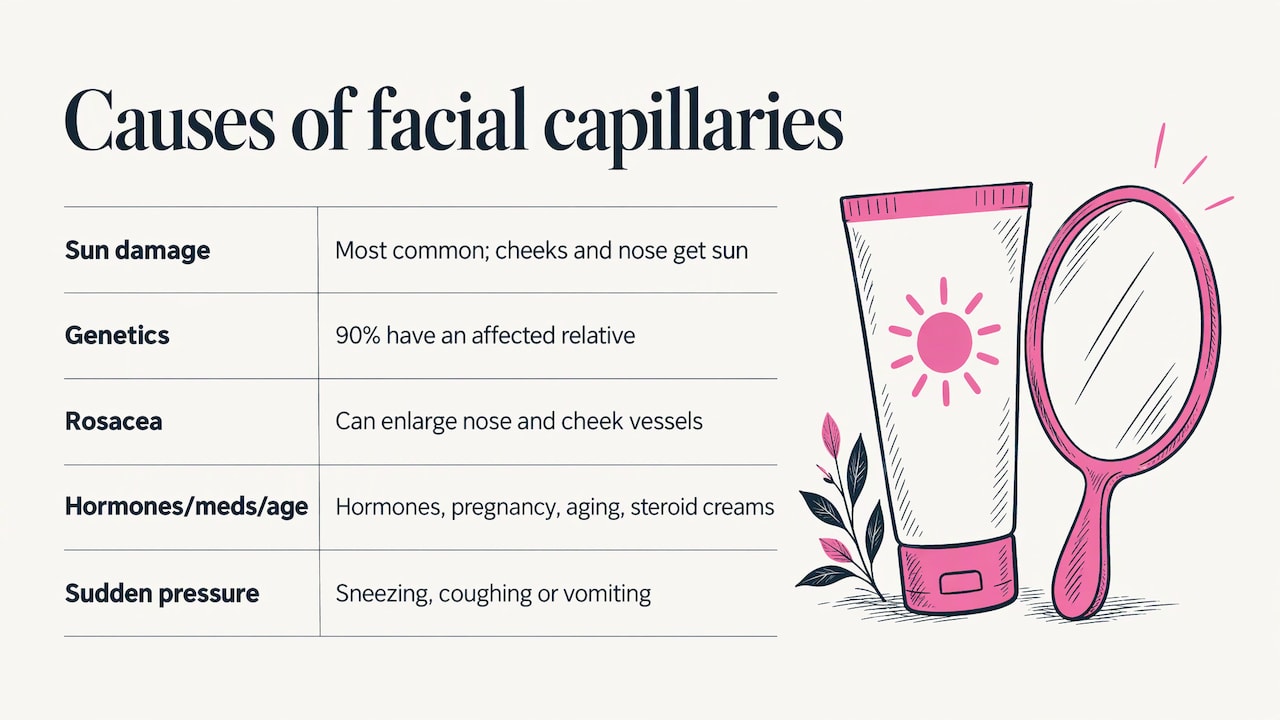
Sun damage. Cleveland Clinic names sun-damaged skin (photoaging) as the most common cause of facial spider veins. Cheeks and the nose bridge take the most sun over a lifetime, which is why they are the usual spots.
Genetics. Medical News Today reports that 90% of people with spider veins have a relative who also has them. If your parents have them, you are more likely to.
Rosacea. This common skin condition causes flushing and lasting redness. Mayo Clinic explains that in rosacea the small vessels of the nose and cheeks can break and enlarge into visible spider veins. Flare-ups can be triggered by sun or wind, hot drinks, spicy food, alcohol, temperature extremes, stress and exercise.
Hormones, medication and age. MedlinePlus lists aging, genes, pregnancy, sun exposure and long-term overuse of steroid creams among the causes. Cleveland Clinic adds hormonal changes and injury, including surgery.
Sudden pressure. Hard sneezing, coughing or vomiting can raise blood pressure in the face briefly. Medical News Today lists this as a trigger, along with alcohol and very hot or cold conditions.
Some people notice just a few threads beside the nostril. Others have a widespread blush across both cheeks. The cause behind them affects which treatment makes sense, which is one reason a skin assessment matters before any treatment starts.
Broken capillary, rosacea or bruise? A quick check
Not every red mark on the face is a spider vein. A simple test helps you sort them out.
The press test. Press a clear glass or a finger on the mark and release. Osmosis explains that spider veins and rashes turn whitish under pressure, while petechiae and purpura (flat red or purple spots from bleeding into the skin) do not.
| What you see | Press test | What it usually is |
|---|---|---|
| Thin red or blue threads, often on cheeks or nose | Pales, then refills | Telangiectasia (broken capillaries) |
| Diffuse redness, flushing, sometimes with bumps | Pales | Possible rosacea |
| Pinpoint red or purple dots | Stays | Petechiae (bleeding into skin) |
| Larger purple or blue patch after a knock | Stays | Bruise |
If you also have flushing that comes and goes, stinging, or bumps, rosacea may be part of the picture. Our guide to IPL for rosacea walks through what light-based treatment addresses.
When to see a doctor first
See a doctor or other health care provider before any cosmetic treatment in these situations:
- You notice new enlarged vessels and you are unsure why. MedlinePlus advises contacting a provider, because telangiectasias can occasionally accompany conditions such as lupus or liver disease, and tests are sometimes used to check.
- You have red or purple pinpoint spots that do not blanch. MedlinePlus says unexplained sudden bleeding into the skin, or bruising that does not go away, should be checked.
- Spots appear all over the body or the cause is unclear. Mayo Clinic advises seeing a health care team soon.
For the ordinary thread-like vessels on cheeks and nose, no workup is usually needed. The Australian College of Dermatologists says investigations are only needed when an underlying medical cause is suspected.
How broken capillaries are treated
The American Academy of Dermatology states that when rosacea has caused visible blood vessels, a treatment plan most likely includes laser or light therapy, which can reduce or get rid of those vessels.
A 2021 peer-reviewed review identifies selective photothermolysis as the standard-of-care procedural treatment for facial redness and telangiectasia. In plain terms, the device emits light that hemoglobin (the pigment in blood) absorbs. The vessel is heated and collapses, and the body gradually clears it, while the surrounding skin is largely spared.
Which light does what
Different wavelengths suit different vessels. One overview of damaged capillaries describes the main options this way:
| Technology | Typically suited to |
|---|---|
| Pulsed dye laser (585/595 nm) | Facial redness and broken capillaries |
| IPL (broad-spectrum light) | Diffuse redness and early telangiectasia, sometimes more sessions |
| KTP laser (532 nm) | Fine, superficial red vessels |
| Long-pulsed Nd:YAG (1064 nm) | Deeper vessels; lower melanin absorption, so often considered for darker skin tones |
The right device depends on vessel size, depth, your skin tone and any rosacea. That matching is what a consultation is for. If you want to understand why depth of light matters more than the brand of device, this explanation of red light versus laser depth is a useful companion to the table above.
What a course of treatment looks like
Cleveland Clinic reports that laser treatment for facial telangiectasias typically takes three to four sessions spaced three to four months apart, with touch-ups every six months to a year as needed. That is a slow, steady fade, not a one-visit fix, and new vessels can still form later if the underlying causes continue.
What to expect around a session, according to Medical News Today:
- Heat, mild irritation or inflammation afterward is possible, and so is temporary darkening or hyperpigmentation.
- Small veins can respond right away. Larger ones may darken and stay visible for one to three months before they disappear.
- Treated skin should be protected from the sun for three to four weeks.
That last point is where most results are protected or undone. Sunscreen and shade after treatment are part of the treatment plan, not an afterthought. If redness lingers after any procedure, our article on post-inflammatory erythema explains why it happens and how long it usually takes to fade.
Treating the cause as well as the thread
Because sun damage is the leading cause, treating vessels and the skin around them together makes sense. Skin with sun damage often shows uneven tone, fine lines and brown spots alongside the redness. Our page on sun damage face treatment covers how to approach that, and laser photorejuvenation is among the laser therapies we provide.
Some clients also want to improve overall skin quality at the same time. We offer microneedling with PRP and Morpheus 8 for texture and tightening, and personalized facial treatments and Hydrafacial for maintenance. Your plan can combine these in a sensible order, which is the point of a personalized approach rather than a single-device menu.
Everyday habits that help prevent new ones
Skincare cannot erase an existing vessel, but it can reduce the triggers. Medical News Today lists these prevention steps:
- Protect your face from UV with a brimmed hat, sunscreen and shade.
- Wash with warm rather than hot water, and avoid extreme heat.
- Skip harsh scrubbing and mechanical exfoliation.
- Stop smoking.
If you have rosacea, Mayo Clinic’s trigger list is a useful place to start a diary: note hot drinks, spicy food, alcohol, stress and exercise against flare-ups, and see which ones are yours.
What about vitamin C or lysine supplements? Some articles suggest them, but they are not a treatment for a vessel that has already dilated. If you take any supplement or medication regularly, mention it to your doctor and to us at your consultation, since some medicines (steroid creams, hormone medications and vasodilators) can contribute to vessels.
What the Sudbury Med Spa approach looks like
Our team, led by founder Natalie NgocTrang, has completed more than 15,000 treatments. For visible vessels and facial redness, the first step is a free consultation. We look at where the vessels are, how your skin reacts to sun and heat, and what else you want to change, then propose a personalized treatment plan. Financing options are available if you want to spread the cost across a course of visits.
Our view
People often arrive thinking a few red lines on their cheeks mean something is wrong with them. Mostly it means years of sun, a family tendency, or rosacea. The vessels themselves are treatable, and the habits around them decide how long the result lasts.
We prefer to start with the whole face, not one spot. Redness, sun spots and texture often travel together, and a plan that treats them in a sensible order gives a better-looking face than chasing single threads. That is why we build plans around the person: their skin tone, their history and what bothers them most.
A clean, comfortable room and an unhurried consultation matter more than people expect. You should leave knowing what each step is for, how many visits are likely, and how to protect the skin between them.
Chris
Ready to start: book a free consultation
If broken capillaries are bothering you, bring photos of how your skin looks on a typical day and a list of the products and medicines you use. We will assess your face, explain which light-based options fit and map out the number of sessions.

See our laser and skin services or contact Sudbury Med Spa to arrange your free consultation. If you plan to return for several treatments across the year, our SILVER, GOLD and PLATINUM memberships cost $399, $499 and $599 per year respectively.
FAQ
Can broken capillaries on the face go away on their own?
Usually not. Once a vessel has stayed dilated, it tends to remain visible. A thin, recent mark from a sneeze or strain may fade, but spider veins from sun damage, rosacea or genetics generally need a laser or light treatment to be reduced.
Does laser treatment for facial capillaries hurt?
Most people feel heat or a snapping sensation, and the skin can be pink or irritated afterward. Medical News Today notes heat, irritation and inflammation as possible effects. We talk through comfort and aftercare at your consultation.
How many sessions will I need?
Cleveland Clinic reports that three to four sessions spaced three to four months apart are typical, with touch-ups every six months to a year if needed. Your own number depends on how many vessels you have, their size and your skin.
What is the difference between a popped blood vessel and a broken capillary?
A broken capillary is usually a permanently widened vessel that looks like a fine red thread and turns pale when pressed. A true bleed into the skin shows as red or purple spots that do not pale under pressure. If you cannot explain those spots, ask a doctor to check them.
Sources
- Dilated or Broken Capillaries, ASCP Skin Care Professionals
- ACD A-Z of Skin: Telangiectases
- How To Remove Spider Veins on Your Face, Cleveland Clinic
- Broken blood vessels on face, Medical News Today
- Rosacea: Symptoms and causes, Mayo Clinic
- Telangiectasia, MedlinePlus
- Bleeding into the skin, MedlinePlus
- Petechiae, Mayo Clinic
- Petechiae: Causes and Treatment, Osmosis
- Lasers and lights for rosacea, American Academy of Dermatology
- Updates and Best Practices in the Management of Facial Erythema and Telangiectasia, PMC
- Damaged Capillaries: Causes and Treatment, Health Encyclo
- Red Light vs Laser Therapy: Depth Matters


