


Botox typically lasts about 3 to 4 months. The American Academy of Family Physicians gives that range for the clinical effect of botulinum toxin, and the American Academy of Dermatology says the same. Some people see results for 4 to 6 months, and some notice them fade closer to 2 months. Where you land depends on your muscles, the dose, the area treated and who places the injections. A personalized plan from an experienced injector is the most reliable way to land at the long end of that range, and it is how we approach every Botox visit at Sudbury Med Spa.
TL;DR
- Plan on 3 to 4 months of visible smoothing per treatment, with full results arriving at about 1 to 2 weeks.
- Your first round may fade sooner. Duration often lengthens after the second or third treatment.
- Dose, injection placement, the muscle treated, exercise habits and how expressive your face is all change the timeline.
- Most people book a touch-up every 3 to 4 months, never sooner than about 12 weeks.
- A free consultation lets you map out a schedule that fits your face and your calendar.
Table of Contents
- The Botox timeline, from injection to wearing off
- Why Botox wears off
- What changes how long your Botox lasts
- How often should you get Botox?
- If your Botox seems to wear off early
- Botox for jaw tension and other non-wrinkle uses
- Botox or filler: which lasts longer?
- Our perspective on making Botox last
- Plan your next Botox visit with us
- FAQ
- Sources
The Botox timeline, from injection to wearing off
Botox does not work the moment the needle comes out. It relaxes the muscles that crease your skin, and that takes a few days to build. Here is the usual sequence.
| Stage | What to expect |
|---|---|
| Day 1 to 3 | Some people notice the first softening. Reviews of the evidence put the median start of efficacy at 2 to 3 days. |
| Day 7 to 10 | Results are close to complete. The American Society of Plastic Surgeons says full effects take 7 to 10 days. |
| Week 2 | Full effect. The AAFP says clinical effects take about 2 weeks to fully develop, which is why a touch-up is judged at the two-week mark. |
| Month 1 to 2 | Peak smoothing, with the most natural-looking relaxed expression. |
| Month 3 to 4 | Movement gradually returns and lines start to reappear. |
| Month 4 to 6 | Full return of muscle movement for most people, though some keep a softer look longer. |
A plastic surgeon writing for the ASPS describes the same pattern: most patients in the 3 to 4 month range, some in the 4 to 6 month range and a few closer to 2 months.
The approved cosmetic uses are frown lines between the brows, horizontal forehead lines and crow’s feet, according to the AAFP. If you want to see how each area is treated, our pages on crow’s feet Botox and on targeting fine lines with Botox walk through it.
Why Botox wears off
Botox blocks the signal that tells a muscle to contract. That block is not permanent. Over weeks and months the nerve endings grow new connections to the muscle, and movement slowly returns. This is why the result is described as temporary and why repeating treatment keeps the effect going. You are not doing anything wrong when lines reappear. It is the expected end of the cycle, and it is the cue to plan your next visit.
The American Academy of Dermatology notes that another treatment is safe when lines and wrinkles return. It also says that with repeat treatment the muscle may thin, which can lead to longer-lasting results.
What changes how long your Botox lasts
No single number fits everyone. A 2020 review in the medical literature says effects commonly last 3 to 5 months depending on dose, technique, area treated and patient demographics. Here is what that means in practice.
Dose and placement
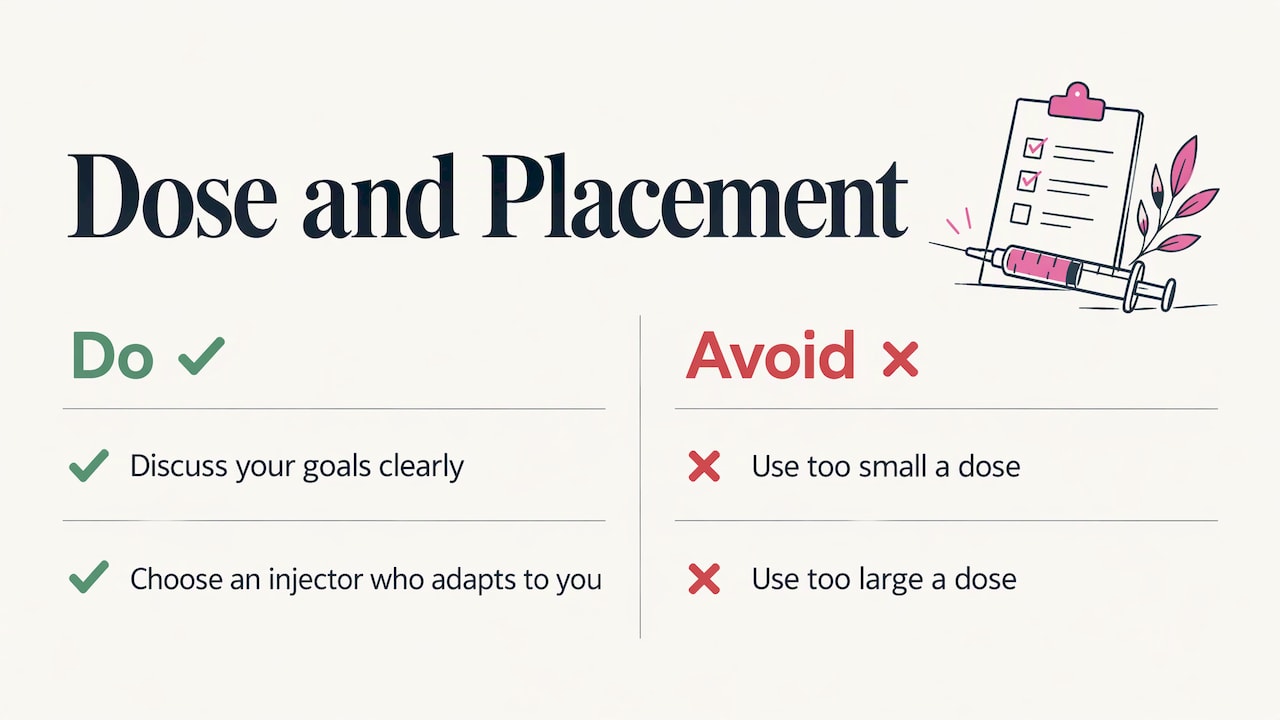
The amount of product and the exact spots where it goes shape both the strength and the length of the result. A 2018 literature review from King’s College London points out that injector skill, including dose, injection position and communication with the patient, strongly influences longevity. Too small a dose can wear off too quickly. Too large a dose can spread to nearby muscles. A clear conversation about your goals, and an injector who adjusts to your anatomy, protects you from both.
That is why we keep our approach personalized rather than one-size-fits-all. Our Botox versus Dysport guide explains why the person holding the syringe matters as much as the product.
The area being treated
Small, strong muscles and large, mobile ones behave differently. The forehead, the frown lines between the brows and the outer corners of the eyes each have their own pattern. The same review notes that duration depends on the area treated, so your forehead and crow’s feet may not fade on the same day.
Your muscles and lifestyle
A health writer quoting a clinician in Healthline says people who exercise a lot or are very expressive may feel Botox lasts closer to three months. That fits how the treatment works: a more active metabolism and more frequent muscle use can make the movement feel like it returns sooner. It does not mean you should skip exercise. It means you can schedule with that in mind.
Your treatment history
First-timers sometimes find the first round fades earlier than expected. The ASPS physician above says duration tends to lengthen after the second treatment. A 2017 review agrees that patients with multiple treatment sessions may find the effect lasts longer, possibly because the treated muscle gets weaker over time. Our first-time Botox guide shows what a first visit looks like step by step.
The product itself
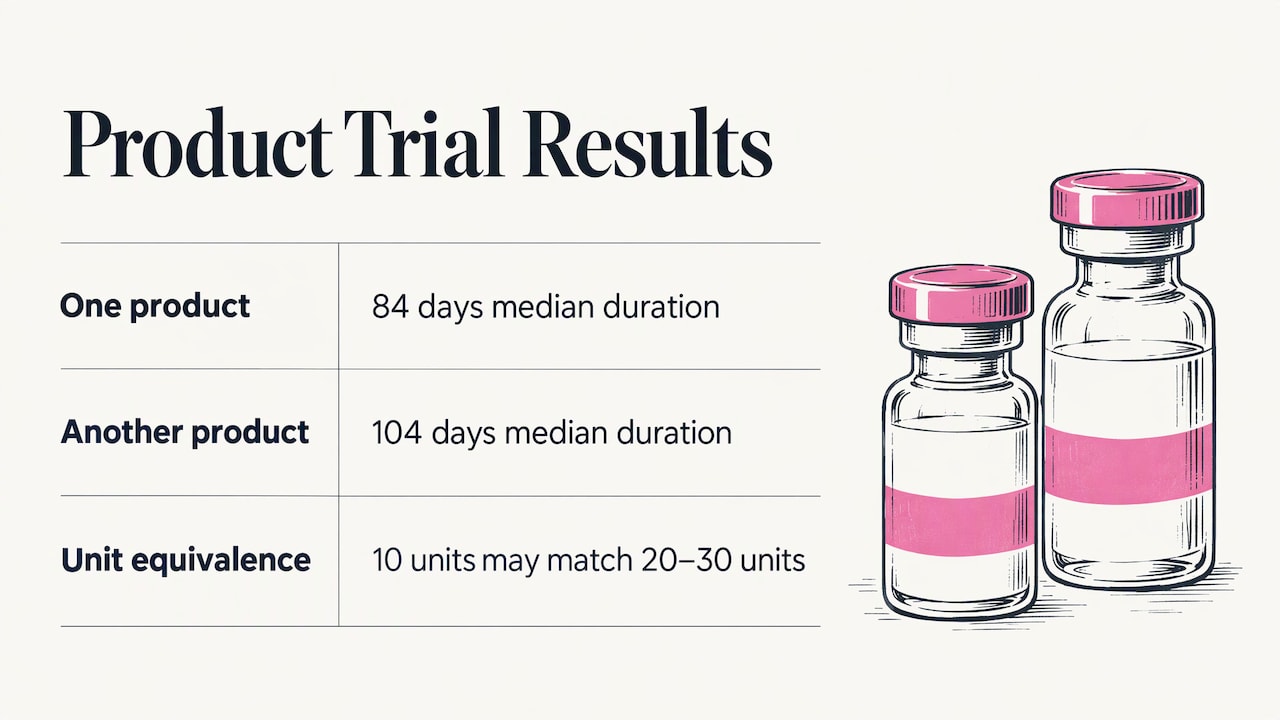
The three neurotoxins used for cosmetic purposes are not interchangeable unit for unit. The ASPS position statement notes that 10 units of one product may correspond to 20 to 30 units of another. In one split-face trial summarized in the 2020 review, the median duration was 84 days with one product and 104 days with another. Comparisons between products are individual and depend on technique, so the practical takeaway is to stay consistent with an injector who knows how your face responds.
Medications
Some medicines can strengthen the effect of botulinum toxin. The ASPS position statement says people taking aminoglycoside antibiotics, penicillamine, quinine or calcium channel blockers should be injected with caution. Tell your provider about every prescription and supplement you take before your appointment, and ask your own doctor if you are unsure about your medicines.
How often should you get Botox?
Most people repeat treatment every 3 to 4 months. The 2014 AFP article on facial wrinkle injections reports that muscle function gradually returns about three to four months after treatment, and advises treating again when you can see the muscle contracting but before lines return fully to how they looked before.
There is also a floor. Dosing guidance does not support treating more often than about every 12 weeks. The FDA-approved Xeomin label, for instance, directs that retreatment for upper facial lines be given no more frequently than every three months. Your injector will space visits accordingly.
Here is a simple way to think about scheduling:
- Treat on a rhythm. Booking every 3 to 4 months keeps results steady, so you never go back to full movement and fully formed lines.
- Wait for your two-week check. Full results take around two weeks. A touch-up before then can lead to overcorrection.
- Adjust after the first two rounds. Once your injector sees how you respond, you can often stretch the interval or fine-tune the dose.
- Plan around events. Aim for treatment about two weeks before a wedding, photo shoot or big presentation so the result is at its best.
The AAD adds that the effect is temporary, so staying on a schedule is how you maintain the look. If you prefer a lighter touch, a smaller dose that fades sooner is also a valid choice, and your injector can tailor it to you.
If your Botox seems to wear off early
When results fade at 6 weeks or 2 months, the cause is usually one of a handful of ordinary things:
- A first treatment. Early rounds often last less than later ones.
- A conservative dose. A lower dose can give a natural look but a shorter run. The King’s College review notes that reduced dosages may result in unacceptably short durations.
- A high-movement muscle. Strong or very active muscles can need a higher dose or more frequent visits.
- Placement. Small shifts in where product goes change how long it works.
If you are unhappy with how long a treatment lasted, tell your injector. A good provider uses that information to adjust the next round. The same review reports that rare cases of antibody-related resistance exist, so if results stop altogether over time, that is a reason to talk with a medical professional about next steps.
Contact your provider promptly if you ever have trouble swallowing, breathing or speaking, or notice widespread weakness after any botulinum toxin treatment. Those symptoms need urgent medical attention.
Botox for jaw tension and other non-wrinkle uses
Botox is also used for conditions such as jaw clenching and TMJ discomfort. If that is your interest, Botox for TMJ relief covers evidence and the usual 3 to 4 month window. For wrinkle treatment, the schedule above applies. Your provider will explain the difference for your goals.
Botox or filler: which lasts longer?
They do different jobs. Botox relaxes muscles to soften lines caused by movement, such as frown lines and crow’s feet. Fillers replace volume and fill folds. Dermal fillers are typically measured in many months rather than weeks, and different products last different lengths of time. We offer both, including Juvéderm, Restylane and Radiesse, so you can choose by the concern you want to address, not by the calendar. For deeper folds, take a look at our Radiesse page, or for lines around the mouth, our marionette lines filler guide.
Our perspective on making Botox last
At Sudbury Med Spa we think the question to ask is not only how long Botox lasts, but how well your plan fits you.
A single number cannot tell you that. Muscle strength, the areas you want treated, your schedule and your first reaction all matter. That is why our approach is built around personalized treatment plans and a free consultation, where we talk through your goals before any needle is involved.
Our team, led by founder Natalie NgocTrang, has completed over 15,000 treatments, and what that experience teaches is consistency. When you return to the same team on a steady rhythm, we learn how your face responds, and we can refine dose and placement visit by visit. We would rather build a routine that you can rely on than chase a number.
We also keep your comfort in mind. A clean, calm clinic and a team that explains each step make the visit easier, which makes it easier to stay on schedule.
Chris
Plan your next Botox visit with us
If you are in Sudbury or the surrounding Massachusetts area and want a Botox plan that matches your goals, our team can help. We offer free consultations, personalized treatment plans and financing options. If you plan to come in several times a year, our yearly memberships are SILVER at $399 per year, GOLD at $499 per year and PLATINUM at $599 per year. You can compare them on our membership page.

See our Botox page for what a visit involves, or look at Botox before and after results. When you are ready, book a consultation through Sudbury Med Spa.
FAQ
How long does Botox last for the first time?
Many first-timers see results for about 3 months, and sometimes a little less. A physician writing for the ASPS notes that first-timers often notice a shorter initial duration that lengthens after the second treatment. Plan a follow-up at about the 3 to 4 month point and tell your injector how it felt.
How often should I get Botox?
Most people return every 3 to 4 months. Guidance does not support treating more often than about every 12 weeks. Your injector will set the interval from how your muscles respond, and you can adjust it as you learn your pattern.
Does Botox last longer with repeat treatments?
Often it does. The American Academy of Dermatology says that with repeat treatment the muscle may thin, leading to longer-lasting results, and a 2017 review says patients with multiple sessions may find duration becomes longer. Results vary from person to person.
How long until I see Botox results?
Some people notice a change within 2 to 3 days. Full results arrive at about 7 to 10 days, and the AAFP puts full development at about 2 weeks. Hold off on any touch-up until the two-week point so your provider can judge the final result.
Sources
- Botulinum Toxin Procedures: A Practical Approach (AAFP, 2026)
- Botulinum Toxin Injection for Facial Wrinkles (AAFP, 2014)
- Botulinum toxin therapy: FAQs (American Academy of Dermatology)
- How long does Botox last? (American Society of Plastic Surgeons)
- ASPS Position Statement on Administration of Botulinum Toxin Neuromodulators
- Onset and Duration of AbobotulinumtoxinA for Aesthetic Use (PMC)
- The mechanisms of action and use of botulinum neurotoxin (PMC, 2020)
- Key Parameters for the Use of AbobotulinumtoxinA in Aesthetics (PMC, 2017)
- A review of the longevity of botulinum toxin effect (King’s Research Portal, 2018)
- FDA-approved Xeomin label (2026)
- Botox for TMJ: Evidence, Safety, and 3 to 4 Month Relief


