
Botox softens crow’s feet by relaxing the small muscle that circles your eye, so the lines that form when you smile or squint stop creasing so deeply. It is FDA-approved for this exact area, the treatment takes a few minutes, and you usually see the change within about a week. It will not erase every line, and who injects you matters as much as the product. Below is how the treatment works, what it feels like, what can go wrong, what drives the price, and when something other than Botox is the better call.
TL;DR
- Botox treats the lines caused by muscle movement around the eyes (lateral canthal lines). The FDA label covers moderate to severe lines in adults.
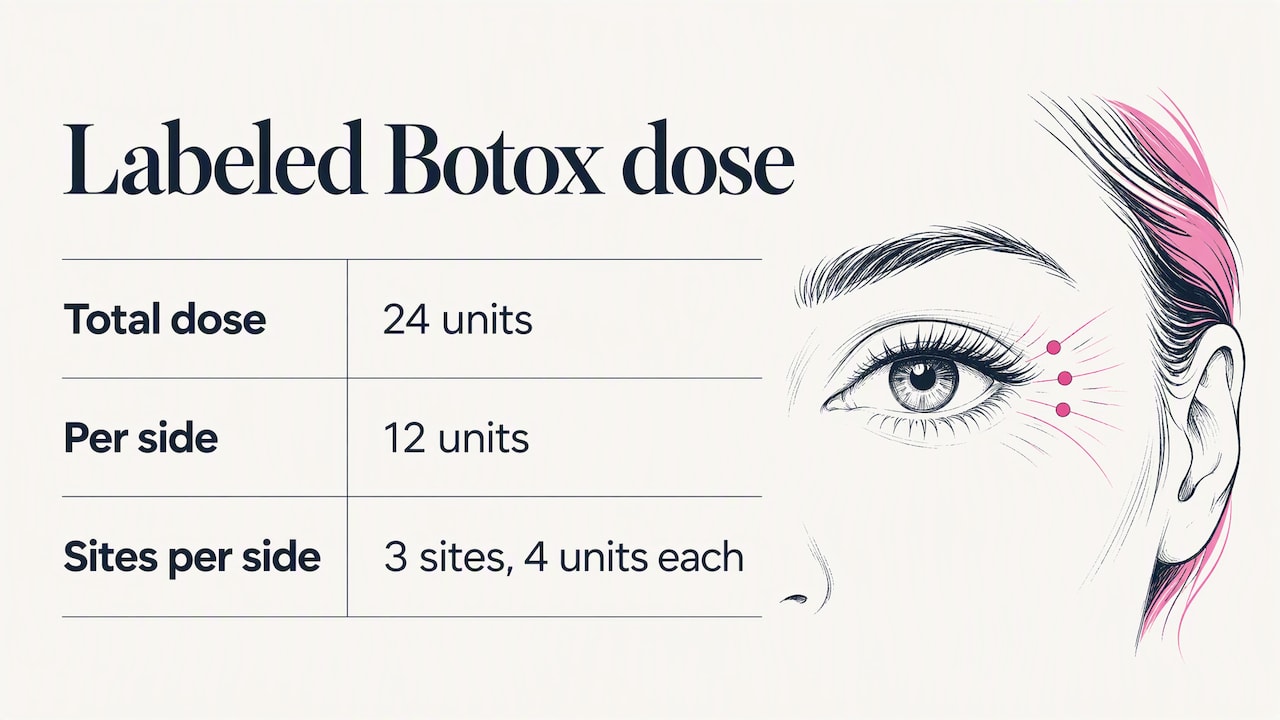
- The labeled dose is 24 units total, 12 per side, though your injector adjusts it to your anatomy and your goals.
- Expect early softening within the first week. The effect is temporary, so treatment is repeated on a schedule you and your injector set.
- Fine lines caused by thinning collagen and sun damage will not disappear with Botox alone. Skin treatments can help with those.
- Choose a licensed medical provider with proper training: the eye area is not the place to save money.
Table of Contents
- What crow’s feet are, and why Botox works on them
- Does Botox really work for eye wrinkles?
- What happens during the appointment
- How to prepare
- Aftercare: what to do and avoid
- How long results last, and how often to repeat
- Risks and side effects around the eyes
- What does crow’s feet Botox cost?
- When Botox is not enough: other ways to treat eye wrinkles
- Our perspective: natural beats frozen
- Ready to talk about your eyes?
- FAQ
- Sources
What crow’s feet are, and why Botox works on them
Crow’s feet are the fan of lines that spread from the outer corners of your eyes. Most of them start as expression lines. Every time you smile, laugh or squint, a ring-shaped muscle called the orbicularis oculi pulls the skin together. Do that thousands of times and the skin starts to hold the crease even at rest.
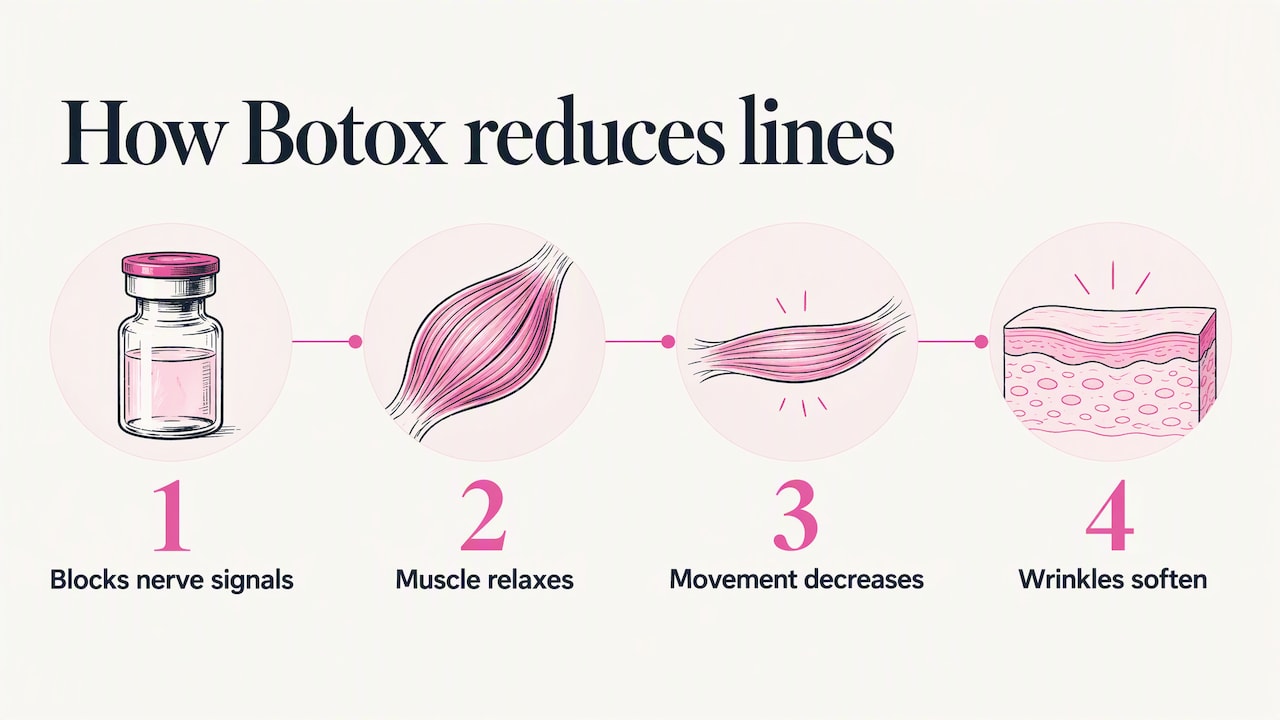
Botox works at the source. According to the American Academy of Ophthalmology, botulinum toxin blocks certain nerve signals that make muscles contract, which relaxes the muscle and reduces unwanted wrinkles. The FDA-approved label describes Botox Cosmetic as indicated in adults for the temporary improvement in the appearance of moderate to severe lateral canthal lines associated with orbicularis oculi activity. “Lateral canthal lines” is the clinical name for crow’s feet, and you will hear it at a consultation.
Two words in that description matter: temporary and appearance. Botox does not remove skin damage. It reduces the movement that deepens the lines.
Dynamic lines versus static lines
This is the single most useful distinction before you book.
- Dynamic lines show up only when you move your face. Botox is very good at these.
- Static lines are etched in at rest. Over time they come from collagen loss, sun exposure and repeated creasing.
The AAO notes that botulinum toxin can make dynamic wrinkles less noticeable, but it does not erase fine lines formed when collagen thins from aging and sun damage. If you have both types, which most people over 40 do, a good plan often combines Botox with a skin-quality treatment. More on that below.
Does Botox really work for eye wrinkles?
For expression-driven lines, yes. The American Academy of Ophthalmology says that within the first week, patients should notice muscles beginning to relax and fewer facial lines and wrinkles. In practice, many people notice the first change over several days, and the full effect settles in around the end of the second week. That is why a good clinic schedules a check-in rather than judging the result on day two.
What “works” looks like:
- Lines look softer when you smile, rather than frozen flat.
- Makeup, especially concealer and powder, stops settling into creases.
- Your eyes look less tired, because the outer corners are no longer being pulled in all day.
What it does not do:
- Fill in deep static creases.
- Tighten loose skin or fix crepey texture.
- Change under-eye bags or hollows. Those are different problems with different solutions.
Ask to see real results before you commit. We keep a Botox before-and-after gallery so you can compare what the treatment looks like on different faces and ages.
What happens during the appointment
The procedure is quick. The AAO describes it as a doctor injecting the medicine into specific facial muscles, a process that takes a few minutes. A typical visit goes like this:
- Consultation and review. Your injector looks at how your face moves when you smile fully, squint and relax. They ask about your health history, medications and goals.
- Mapping. The injector marks the pattern around the outer eye. The pattern differs from person to person, because crow’s feet fan upward, downward or straight out.
- Injections. Tiny injections go in just under the skin at several points on each side of the face. Most people describe quick pinches rather than real pain.
- Aftercare instructions. You leave with a short list of dos and don’ts, and usually a follow-up plan.
How much Botox does crow’s feet take?
The FDA label gives a reference point: the recommended dosage for lateral canthal lines is 24 units, split as 4 units into each of three sites per side, or 12 units per side. That is the labeled starting framework. Your injector may use more or fewer units, or a different injection pattern, depending on how strong your muscle is, how deep your lines are and how natural you want the result to look. Be wary of any provider who quotes a unit number before looking at your face.
How to prepare
Preparation is simple, but the details matter.
- Tell your provider everything you take. The American Academy of Dermatology asks patients to share all medicines, herbs, vitamins and minerals, including aspirin and blood thinners.
- Ask about aspirin and blood thinners. The AAO advises asking whether to stop them a few days beforehand. Never stop a prescribed blood thinner on your own: that decision belongs to the doctor who prescribed it.
- Come with bare skin. Arrive with no heavy eye makeup, so the injector can see your natural lines.
- Plan your day. Avoid scheduling a hard workout right after the visit.
Aftercare: what to do and avoid
The AAD gives two clear rules. First, do not rub or massage the treated areas, because that could help the product spread where it is not wanted. Second, wait two hours before strenuous activity that raises your heart rate.
Our practical additions, based on what clients ask us most:
- Skip facials, face massages and tight goggle or mask straps over the eye area on treatment day.
- Small bumps at the injection points usually flatten quickly, and light makeup can cover any mark.
- Keep smiling and making normal expressions. You do not need to “exercise” the muscle or keep it still.
How long results last, and how often to repeat
Botox is temporary by design. As the effect fades, the muscle regains movement and the lines return gradually. Most people book repeat visits a few times a year, and the right interval varies with muscle strength, metabolism and how much movement you want to keep. Your injector can set a schedule after seeing how your first round holds.
Two patterns are worth knowing. First, people who keep a regular schedule often find they need fewer units or can stretch visits out, because the muscle is used less. Second, waiting until the lines are fully back means you are starting from scratch each time. Rather than quoting you a number from a generic page, we assess how your own results wear off at a follow-up visit and set your interval from that.
Risks and side effects around the eyes
Botox around the eyes is routine for trained injectors, but it is a medical procedure with real risks. The AAO lists common side effects as headache, eye redness, tearing or irritation, and redness or bruising at the injection area. Less common serious effects include drooping eyelids and double vision.
In the clinical trials summarized on the FDA label, eyelid edema was reported in 1% of patients treated for lateral canthal lines.
Call your provider the same day if you notice a drooping eyelid, double vision or vision changes, or trouble with swallowing or breathing after treatment. For eye symptoms, an ophthalmologist is the specialist the AAO points to, since they know the eye and surrounding structures.
Who should not get crow’s feet Botox
The AAO says patients should be healthy and at least 18. It lists several groups who should not receive the injections: people with neuromuscular disease, those who are pregnant or nursing, and those with certain facial muscle weakness, drooping eyelids, deep facial scars, uneven facial features or skin problems near the injection area. The FDA label also lists hypersensitivity to any botulinum toxin product or its components, or infection at the injection site, as contraindications. If any of these apply, your provider should talk through alternatives with you.
Who should inject you
The American Academy of Dermatology Association states that Botox injections are a medical procedure and should be performed in a medical office by board-certified dermatologists or appropriately trained non-physician clinicians under the direct on-site supervision of a board-certified dermatologist. The same statement warns that counterfeit injectables can cause severe complications, including visual impairment, blindness, infection or stroke.
In plain terms, before you book anywhere:
- Ask who will inject you, and what their training is.
- Ask who supervises, and whether a physician is on site.
- Ask where the product comes from. A legitimate clinic answers without hesitation.
- Be suspicious of prices far below everyone else’s, pop-up events and at-home parties.
What does crow’s feet Botox cost?
The honest answer is that the price depends on you. The American Society of Plastic Surgeons says botulinum toxin cost varies with the severity of the lines, how aggressively they are treated, the amount of product used, the provider’s expertise and qualifications, the time and effort required, and the office location.
That matters when you compare quotes. A low price per unit means little if the clinic uses fewer units than you need, or if an inexperienced injector gives a result you want fixed. Compare the total for your treatment plan and what is included, such as a follow-up check.
We do not publish a single price for Botox because it depends on units and your plan. You can see our current pricing in our price booklet, or book a free consultation and get a quote for your face. If you want to spread payments out, we offer cosmetic and beauty financing.
Memberships if you plan to repeat
Because Botox is something you repeat, a membership can make sense. Our annual plans are Silver at $399 per year, Gold at $499 per year and Platinum at $599 per year. See what each tier includes on our membership page.
When Botox is not enough: other ways to treat eye wrinkles
If your lines are visible at rest, or your skin looks thin and crinkled around the eyes, neuromodulator alone will only go so far. Options your provider may combine with it:
| Concern | What helps | Notes |
|---|---|---|
| Lines that appear when you smile or squint | Botox | Relaxes the muscle that creates the crease |
| Fine lines and crepey texture | Microneedling with PRP, facial peels, laser resurfacing | Work on skin quality rather than muscle movement |
| Loose or thinning skin | Morpheus 8 radiofrequency microneedling | Targets skin tightening and texture |
| Deeper creases at rest | Dermal fillers, placed by an experienced injector | Fillers are used for volume and deeper lines, usually not for the very thin skin of crow’s feet alone |
| Dull, uneven skin | Hydrafacial, personalized facials | Improves glow, not muscle-driven lines |
We offer skin treatments including Morpheus 8 and microneedling with PRP, as well as facial treatments and Hydrafacial. A consultation is the place to sort out which one fits your skin.
Daily habits also matter. Sunscreen and not squinting into the sun without sunglasses protect the lines you already treated. For more on how we approach lines elsewhere on the face, see our guide to targeting fine lines with Botox.
Our perspective: natural beats frozen
The most common worry we hear about crow’s feet Botox is the fear of a flat, expressionless look. We take that seriously. At Sudbury Med Spa we treat the eye area conservatively and build up if you want more, because it is much easier to add a few units at a follow-up than to wait out a result you dislike.
We also think the product is only half of the decision. The injector’s understanding of anatomy, and the time they take to look at how you actually smile, decide whether the result looks like you on a good day. That is why we start with a free consultation and a personalized plan instead of a fixed unit count. If you are comparing brands of neuromodulator, our article on Botox vs Dysport and why your injector matters more explains how we think about it.
Our team, led by founder Natalie NgocTrang, has completed over 15,000 treatments, and we keep the clinic clean and calm so that a ten-minute procedure feels like a relaxed visit rather than a production. Our goal is for you to leave feeling rejuvenated, not altered.
— Chris
Ready to talk about your eyes?
If crow’s feet are what you see first in the mirror, start with a free consultation at our Sudbury clinic. We will look at your lines in motion, explain whether Botox alone or a combined plan fits, and give you a clear quote. See our Botox page for details, or browse everything on our services page.
FAQ
What is the best age to start Botox for crow’s feet?
There is no single right age. The AAO says patients should be healthy and at least 18. Most people start when lines become visible in motion and bother them, and some start earlier to soften lines before they set in. Your injector can tell you whether your lines are ready for treatment or whether you would do better waiting.
Does crow’s feet Botox hurt?
Most people describe it as quick pinches, because the needles are very small and the injections only take a few minutes. Some redness or small bumps at the injection points are common and usually settle quickly. Tell your injector if you are nervous, and they can adjust to keep you comfortable.
How soon will I see results?
The AAO says muscles begin to relax within the first week, with fewer lines and wrinkles. Many people see the first change over several days and the full effect after about two weeks. If you are planning around an event, book well ahead so there is time for a follow-up adjustment.
Is it safe to get Botox near my eyes?
When it is done by a trained, properly supervised provider using genuine product, it is a routine medical procedure. Risks include redness, bruising, headache and, less commonly, drooping eyelids or double vision. Contact your provider promptly if you notice vision changes or a drooping lid, and see an ophthalmologist for eye symptoms.
Can I get Botox for crow’s feet if I am pregnant?
No. The AAO lists pregnancy and nursing among the reasons not to receive botulinum toxin injections. Wait until you have talked with your doctor about timing, and ask us about skin treatments that suit this stage.
Sources
- Botulinum Toxin (Botox) for Facial Wrinkles, American Academy of Ophthalmology
- BOTOX Cosmetic prescribing information, FDA
- Botulinum toxin therapy: FAQs, American Academy of Dermatology
- Botulinum toxin therapy: Preparation, American Academy of Dermatology
- AADA statement on counterfeit injectables, American Academy of Dermatology Association
- Botulinum Toxin Cost, American Society of Plastic Surgeons