
Post-inflammatory erythema (PIE) is the flat red, pink or purplish mark that stays on your skin after a pimple or other inflammation has healed. It is not a scar and it is not pigment. It is leftover redness in the skin’s tiny blood vessels, and it usually fades with time, protection from the sun and a gentle routine. Some marks need professional help. Below you will find how to recognize PIE, how it differs from post-inflammatory hyperpigmentation (PIH) and melasma, how long it can last, and which treatments have evidence behind them.
TL;DR
- PIE is residual redness after acne or another inflamed skin condition. PIH is a brown or gray pigment change. Melasma is a separate, hormone- and sun-driven pigment condition.
- A flat red or pink mark that turns pale when you press on it is most likely PIE. A brown or dark mark that does not blanch points to pigment.
- PIE often fades over months, but it can last longer. Sunscreen, no picking and gentle products are the base of care.
- Light-based treatments have the best support for stubborn redness, but research has not settled on one gold-standard option.
- Redness that does not fit the pattern, keeps changing or comes with symptoms deserves an in-person skin evaluation.
Table of Contents
- What post-inflammatory erythema actually is
- How to tell PIE from PIH, melasma and scars
- How long does post-acne redness last?
- What helps at home
- Professional treatments for PIE
- When to see a dermatologist
- Our perspective
- Start with a free consultation
- FAQ
- Sources
What post-inflammatory erythema actually is
The term was introduced in 2013 by Bae-Harboe and colleagues to describe erythema that remains after inflammatory acne or another resolving skin inflammation. The word “erythema” simply means redness. “Post-inflammatory” tells you when it shows up: after the inflammation has done its work.
Here is what is going on under the surface. When a breakout, rash or scratch inflames the skin, the small blood vessels near the surface widen and can be damaged. After the active spot heals, those vessels can stay dilated for a while. That is why the mark looks red or pink rather than brown. Ranking guides on this topic describe the same mechanism: dilated or damaged vessels, not extra pigment.
Acne is the most common trigger, so you will often see it called post-acne erythema. But the same thing can follow eczema, a rash, a bug bite, shaving irritation or an aggressive peel. WebMD’s overview notes that PIE can remain after acne, eczema or other skin issues clear.
Two things PIE is not:
- An active pimple. There is no raised bump, no pus and no tenderness. The skin surface is flat.
- A scar. A true acne scar changes the texture of the skin: pits, ice-pick marks or raised tissue. PIE is a color change in smooth skin.
How to tell PIE from PIH, melasma and scars
The quickest way to sort these out is by color, cause and what the mark does under pressure.
| PIE | PIH | Melasma | Acne scar | |
|---|---|---|---|---|
| Color | Pink, red or purple | Tan, brown or gray-brown | Brown or gray-brown patches | Skin-toned, red or dark, with texture change |
| Cause | Dilated or damaged blood vessels after inflammation | Extra pigment after inflammation | Pigment driven largely by hormones and sun | Lost or excess collagen after deep inflammation |
| Where | Wherever a spot or rash was | Wherever a spot or rash was | Often symmetrical on cheeks, forehead, upper lip | Where deeper breakouts occurred |
| Press test | Often turns pale for a moment | Color stays | Color stays | Depends on type |
The research draws the same line: PIE describes residual redness, while PIH describes the pigment change that follows.
PIE vs PIH: why skin tone matters
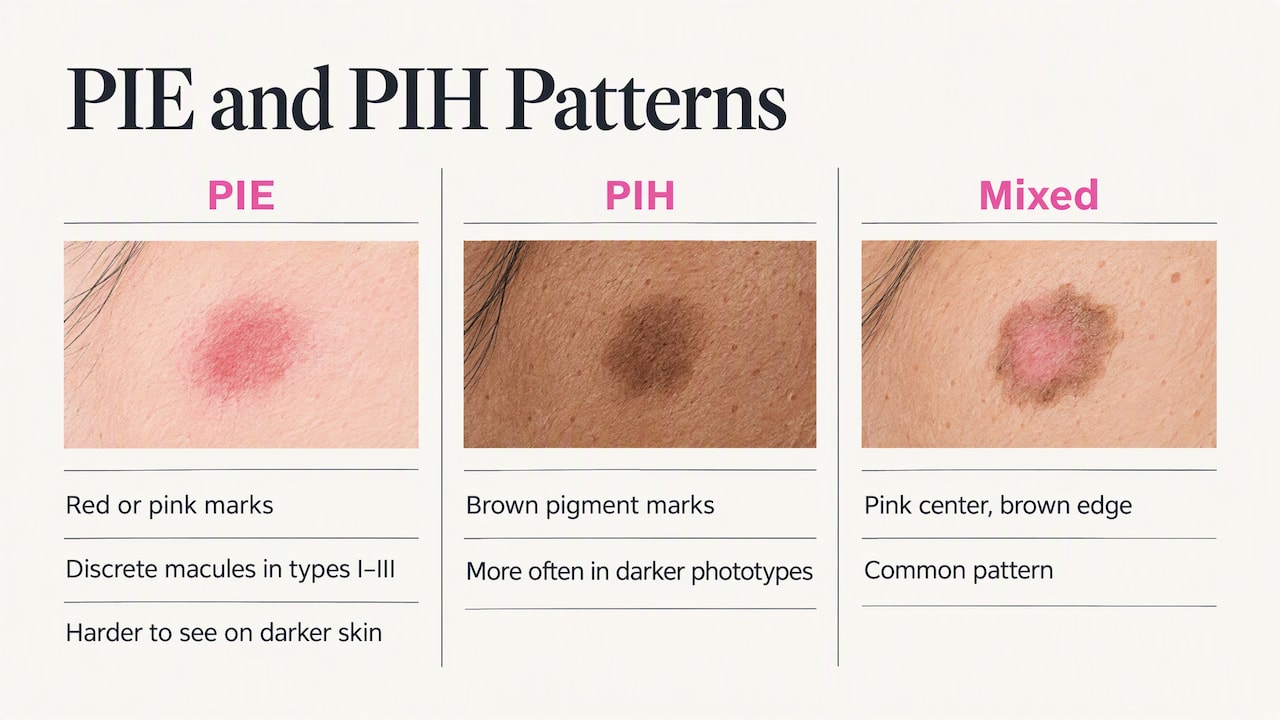
Skin tone changes what you see. In lighter skin types (I to III), post-inflammatory change often appears as discrete red macules, while in darker phototypes it more often presents as hyperpigmentation. Redness can still occur in deeper skin tones, but it is harder to see, so many people with darker skin notice only the brown marks. An American Academy of Dermatology meeting session on acne in skin of color lists post-inflammatory pigment alteration among the specific challenges in that group.
Many people have both at once: a spot that is pink in the center and brown at the edge. That mix is common, and it matters for treatment, because redness and pigment respond to different approaches.
PIH vs melasma
People often search “PIH vs melasma” because both can look like brown patches on the face. The differences are in pattern and trigger.
- PIH follows an injury. It sits exactly where a pimple, rash, burn or procedure irritated the skin. Its shape matches the original problem.
- Melasma is patchy and usually symmetrical. It tends to appear on both cheeks, the forehead or the upper lip, and it is commonly linked to hormonal shifts and sun exposure. It often returns after sun exposure.
- They can overlap. A person with melasma can also get PIH after a breakout, which makes the face look blotchy in two different ways.
Because the causes differ, so does the plan. Aggressive treatment aimed at PIH can inflame melasma and make it darker, which is why a proper diagnosis comes before any heat-based or peel-based treatment. If you cannot tell which one you have, a consultation is a better first step than guessing with products.
How long does post-acne redness last?
The honest answer is: it varies, from weeks to many months, and sometimes longer. WebMD says PIE should fade on its own and can last for months or even years, especially if left untreated. What affects it:
- How inflamed the original spot was. Deep, cystic or picked spots damage more vessels and leave longer-lasting marks.
- Sun exposure. UV keeps vessels dilated and can darken the area, turning a red problem into a brown one.
- Ongoing breakouts. New inflammation keeps restarting the clock.
- Skin type. Fair skin shows redness longest because there is little pigment to mask it.
Solid published data on exact timelines is thin. One dermatology report notes that very little data exist on PIE’s cause and effective treatment. Treat any single number you read online, including ours, as a rough expectation, not a promise.
What helps at home
At-home care will not erase deep redness overnight, but it creates the conditions for healing and prevents the common setbacks.
- Wear sunscreen every day. Use a broad-spectrum SPF 30 or higher, and reapply when outdoors. Sun exposure prolongs redness and can add pigment on top.
- Stop picking. Squeezing a spot injures the skin further and raises the chance of both PIE and scarring.
- Keep your routine gentle. Use a mild cleanser, lukewarm water and a moisturizer that supports the barrier. Over-exfoliating and harsh scrubs add inflammation to skin that is trying to calm down.
- Treat the acne itself. If you are still breaking out, new marks will keep replacing old ones. A dermatologist can set up an acne plan that fits your skin.
- Introduce actives slowly. Strong retinoids, acids or peels used too fast can irritate the skin and prolong redness. Add one product at a time and watch how your skin responds.
If your skin has been sun-stressed or irritated, soothing after-sun skin care can help calm the surface, though it will not change the vessels underneath. Sun protection is still what keeps new redness from deepening.
One caution on DIY fixes: lemon juice, baking soda, toothpaste and similar kitchen remedies burn or irritate skin. They create fresh inflammation, which is the opposite of what PIE needs.
Professional treatments for PIE
When redness lingers beyond what patience and sunscreen can handle, in-office options become worth discussing. The evidence is real but incomplete. A 2022 systematic review in the Journal of Cosmetic Dermatology found that light-based devices and certain topicals are effective, but there is no universally accepted gold-standard treatment, and it called for more randomized clinical trials.
Vascular and light-based approaches
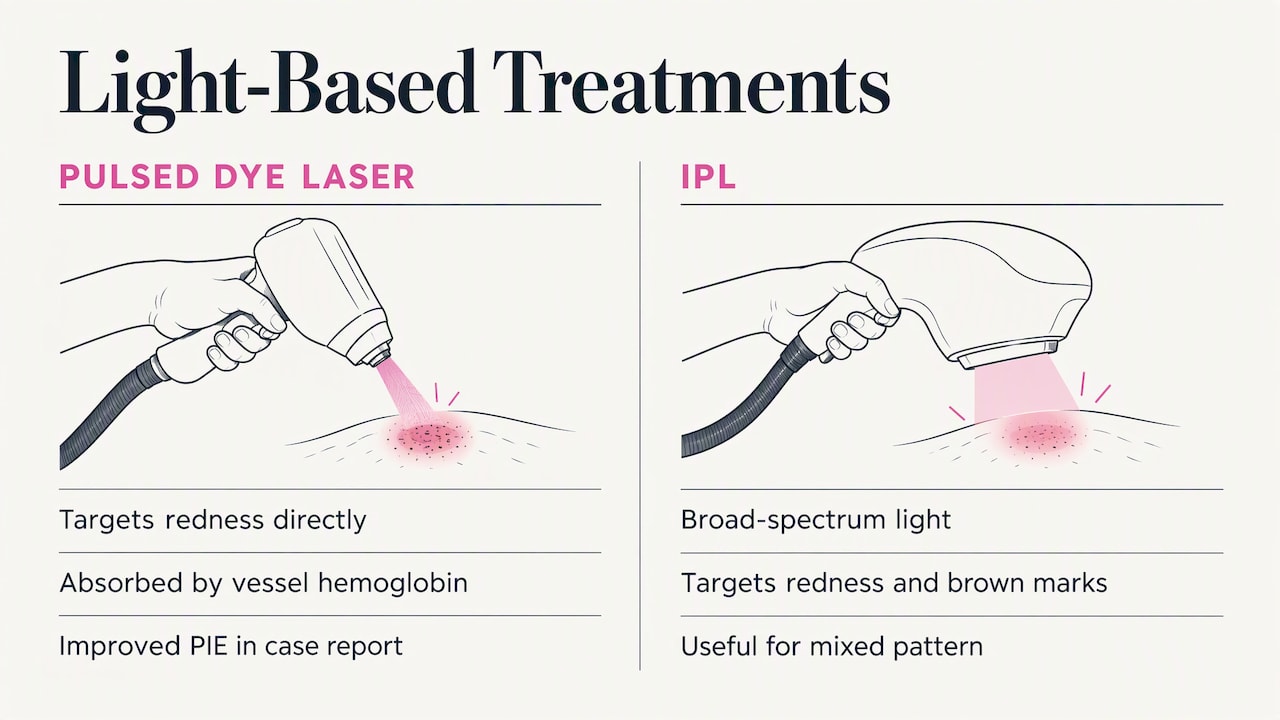
The most studied approach targets the redness directly. A pulsed dye laser works by selective photothermolysis: it is absorbed by hemoglobin in the vessels, and it improved PIE in the authors’ patients. That small case-based report is encouraging, not definitive.
Intense pulsed light (IPL) and photorejuvenation use broad-spectrum light to target redness and brown discoloration in the same session, which is useful if you have the mixed pattern described above. You can read how we approach this on our pages for intense pulsed light and photorejuvenation. Light-based treatment needs careful settings, particularly on darker skin, where heat and light can trigger pigment change. That is one reason a skin assessment comes first.
Collagen and texture treatments
If your marks come with true scarring, redness may be only part of the picture. Treatments that remodel the skin, such as laser treatment for acne scars, address texture. Microneedling with PRP is another option for skin quality and scarring, and you can see it alongside Morpheus 8 on our skin treatments page. WebMD notes that collagen-based improvement can take up to 12 months to show, so plan for a series of visits and a long view.
When brown is the bigger problem
If you mostly have brown marks, you are dealing with PIH more than PIE. Pigment-focused options include sun-damage and dark spot care. Our guide to sun damage face treatment explains what works and when to start, and you can look at dark spot removal results for examples of this kind of work.
What to avoid
- Aggressive peels or lasers on active, inflamed acne.
- Tanning or unprotected sun in the weeks before and after any procedure.
- Treating several areas with brand-new products on the same day.
- Any provider who promises the redness will be gone in a set number of sessions without examining your skin.
When to see a dermatologist
PIE is harmless, but redness is not always PIE. Get an in-person evaluation from a board-certified dermatologist if:
- The redness is not tied to an earlier pimple or rash and keeps appearing in the same spot.
- It is spreading, itchy, painful, scaly or flaking.
- It sits on the central face with flushing or visible small vessels, which may be a different condition such as rosacea.
- A mark has changed shape, color or borders, or bleeds. Any changing mole or lesion needs a medical exam, not a cosmetic one.
- Acne is still active, cystic or scarring. Treating the cause protects your skin from new marks.
- You have a history of dark marks and are considering lasers or peels.
A medical spa works best alongside, not instead of, this kind of diagnosis. If something looks medical, we would rather you see a dermatologist first.
Our perspective
People come to us with the same worry: “Is this permanent?” In most cases it is not, and that is worth hearing first. What we see is that the biggest delays come from irritation, not from the original breakout: over-scrubbing, picking, skipping sunscreen or stacking strong products.
We also think the label matters less than the plan. Red, brown or both, the right approach depends on your skin tone, your sun exposure and how long the mark has been there. That is why we start with a free consultation and build a personalized treatment plan rather than selling one device for every face. Light-based options can be a good fit for lingering marks, and we will tell you plainly when patience, a medical visit or a different treatment would serve you better. The research is honest that no single treatment is the standard for PIE, and we think a patient should hear that too.
— Chris
Start with a free consultation
If your marks have stayed longer than you would like, we can look at your skin, work out whether you have PIE, PIH or a mix, and talk through options with no obligation. Our team, led by founder Natalie NgocTrang, has completed over 15,000 treatments. You can browse the laser and skin services we offer, or look at our memberships, which cost $399 per year for Silver, $499 per year for Gold and $599 per year for Platinum. Financing options are available too. Visit Sudbury Med Spa to book.
FAQ
Does erythema mean inflammation?
Not exactly. Erythema means redness caused by more blood flow in the skin’s small vessels, and active inflammation is one common cause. In post-inflammatory erythema, the inflammation has already settled, but the dilated vessels leave redness behind.
How do I know if it is PIE or a scar?
Run a finger over it. PIE is flat and smooth, and it may briefly turn pale when pressed. A scar changes the texture: it may be indented or raised. Some people have both, which is why an in-person look helps.
Can PIE turn into PIH?
Yes, it can. Sun exposure and irritation can add pigment to a red mark, and some people show both colors at once. Daily sunscreen and avoiding picking are the best ways to lower that risk.
Does inflammatory acne ever go away?
Yes. Acne can be controlled with the right treatment, often from a dermatologist, and many people see it ease over time. The marks it leaves behind, including PIE, can then fade, so treating active acne is the first step in preventing new ones.
Sources
- Easy as PIE (Postinflammatory Erythema), Journal of Clinical and Aesthetic Dermatology
- Post-acne erythema treatment: a systematic review, Journal of Cosmetic Dermatology
- Acne/Skin of Color, AAD Meetings
- Postinflammatory erythema, MDedge Dermatology
- What Should You Know About Post-Inflammatory Erythema?, WebMD