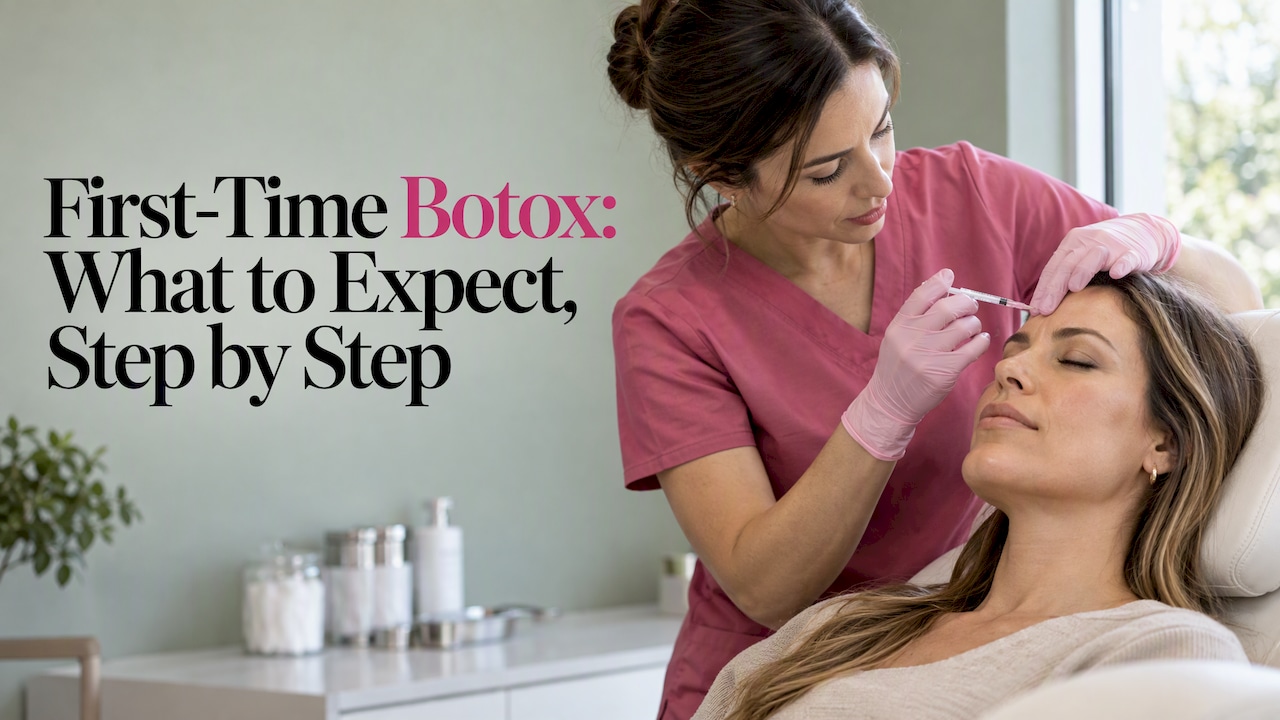

Your first Botox appointment is short, uses very small needles, and needs no time off. A clinician injects tiny amounts of purified botulinum toxin into specific muscles, and the lines they cause soften over the next days. What decides how it goes is mostly what happens before you sit down: who injects you, what you tell them, and how clearly you describe what you want. This guide walks through preparation, the visit itself, aftercare, the timeline of results, and the questions worth asking.
TL;DR
- Botox relaxes the muscles behind expression lines. It does not erase every line, and a good plan aims for a natural look, not a frozen one.
- Before you book, tell the clinician about your medical history, medicines, vitamins and past cosmetic treatments, and ask who will actually do the injections.
- Don’t rub or massage the treated areas afterward, and wait at least two hours before strenuous exercise.
- Results start to show within days and settle over about two weeks. Plan a follow-up visit rather than expecting a one-time fix.
- Choose a medical setting with qualified clinicians. Injections given at parties, homes or non-medical venues are a real safety risk.
Table of Contents
- What Botox actually does
- Is Botox right for you? Candidates and warning signs
- Choosing who injects you
- How to prepare for your first appointment
- What happens during the appointment
- Aftercare: what to do and what to skip
- When results appear, and how long they last
- What Botox can and can’t do
- Our perspective: start small, and start with a plan
- Booking your first Botox visit in Sudbury
- FAQ
- Sources
What Botox actually does
Botox is a purified form of botulinum toxin. According to the American Academy of Dermatology, a dermatologist injects very small amounts into targeted muscles. The dose is enough to weaken and relax those muscles without affecting the ones around them, which is how patients keep natural facial expressions.
That matters for a beginner because it explains both the strengths and the limits. Botox works best on lines created by repeated movement: frown lines between the brows, forehead lines, and crow’s feet at the corners of the eyes. It does not add volume, and it does not tighten skin that has lost elasticity. For those concerns, a different tool such as a filler or a skin-tightening treatment may fit better, and a consultation is the place to sort that out.
If you want to see how the movement-line approach works on specific areas, we have written about targeting fine lines with Botox, crow’s feet treatment and bunny lines on the nose.
Is Botox right for you? Candidates and warning signs
Most healthy adults with movement-related lines can be considered, but not everyone should have it. The FDA labeling for Botox Cosmetic lists the people who should not receive it: anyone with a known hypersensitivity to any botulinum toxin product or its components, and anyone with an infection at the planned injection site. The same label states that safety and effectiveness have not been established in patients under 18.
Tell your clinician if you are pregnant or breastfeeding, have a neuromuscular condition, or take blood thinners or other medicines that affect bruising. Don’t treat that list as complete. It is the reason a real consultation exists: your clinician screens for what applies to you specifically, and any concern about a medicine or condition should go to the prescribing doctor or the injecting clinician before you book.
After treatment, call the clinic promptly if you notice trouble swallowing or breathing, widespread weakness, or signs of a severe allergic reaction. Those are rare, but they are the symptoms the product’s safety information tells patients to take seriously.
Choosing who injects you
This is the decision that matters most. The AAD warns that injections given in non-medical settings, including salons, spas, parties or homes, can be extremely dangerous. Botox is a prescription medicine and an injection is a medical procedure. In Massachusetts, injecting it is a medical act, so look for a clinic where licensed medical professionals are responsible for your care.
The AAD suggests choosing a board-certified dermatologist who can assess your skin, age and health and help you understand realistic results. Whoever you pick, ask these questions:
- Who will give my injections, and what are their credentials and experience?
- How many first-time patients do you treat?
- What results should I realistically expect for my face?
- What are my personal risks of complications?
- What happens if I’m unhappy, or something looks uneven?
The AAD’s preparation guidance says to ask about the clinician’s experience, who gives the injections, expected results and your risk of complications. A clinic that welcomes these questions is a good sign. One that dodges them is not.
Something we say to every patient: the injector matters more than the brand on the vial. We explain why in our piece on Botox versus Dysport and why your injector matters.
How to prepare for your first appointment
Preparation is mostly information, not rituals.
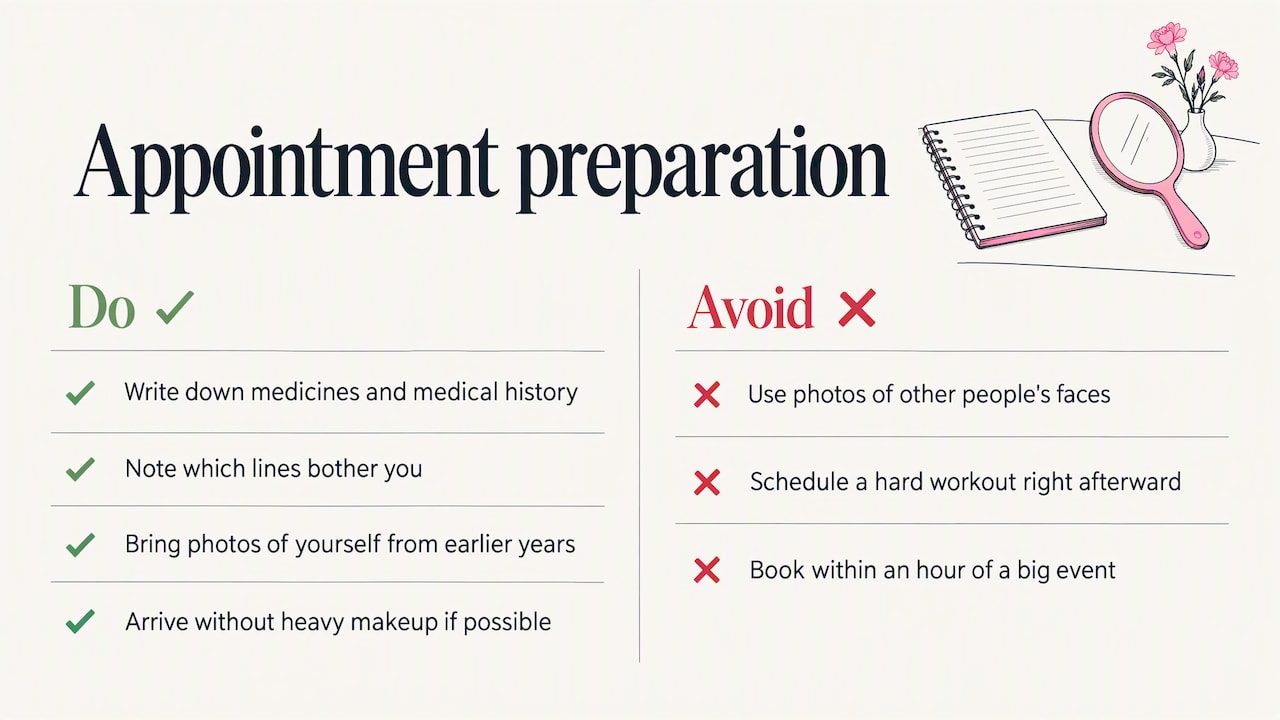
Write down your history. The AAD advises discussing your medical history, including medicines, herbs, vitamins, minerals, surgeries and past cosmetic treatments. Supplements count. Some people forget the fish oil or vitamin E that they take daily.
Decide what bothers you. Look in the mirror while you frown, raise your brows and squint. Note which lines you actually dislike. “I want to look rested” is a fine goal, and so is “I only want my 11s softened.”
Bring photos. Pictures of yourself from a few years ago help your clinician see what your face looked like with softer lines. Skip photos of other people’s faces: your anatomy is yours.
Come with a clean, makeup-free face if you can. Clinics usually cleanse the skin anyway, but arriving without heavy makeup makes the visit easier.
Plan the day. There is no downtime in the sense of needing leave from work, but avoid scheduling a hard workout right after, and don’t book it an hour before a big event. Give yourself about two weeks before something photographed, so the full effect has settled and any small touch-up can be done.
What happens during the appointment
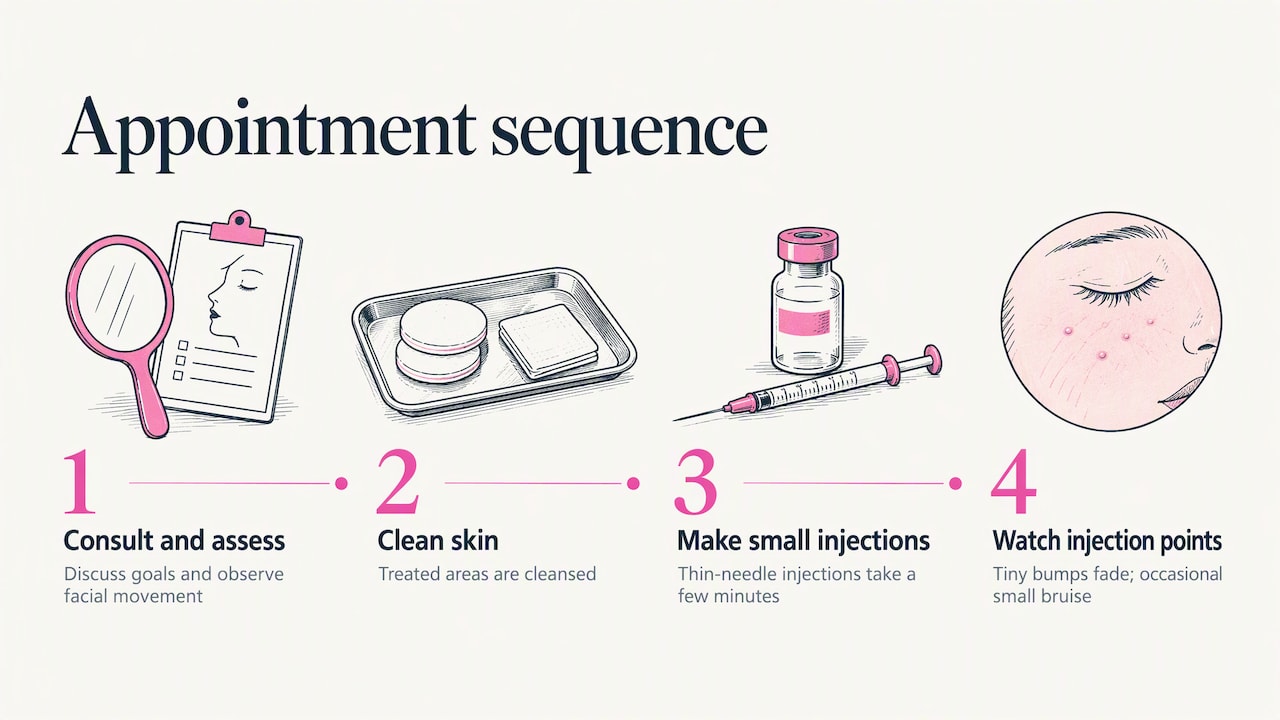
Expect a conversation first. A good visit begins with questions about your history and goals, a look at how your face moves, and a proposed plan: which areas, roughly how much product, and what to expect.
The injections themselves are quick. The treated areas are cleaned, and the clinician places a series of small injections with a very thin needle. The American Board of Cosmetic Surgery notes that some patients prefer a topical numbing cream, though many find it unnecessary because the needles are so small. Most people describe the feeling as a brief pinch or sting. If you are nervous about needles, say so, and ask about numbing or cooling options.
The whole visit, including the consultation, commonly fits within an hour for a first-timer, with the injection itself taking only a few minutes. Because Botox is non-surgical, there are no incisions, no stitches and no scarring. You may see tiny bumps at the injection points that fade quickly, and occasionally a small bruise.
Aftercare: what to do and what to skip
The rules are short and easy to follow.
| Do | Avoid |
|---|---|
| Keep your face relaxed and go about your day | Rubbing or massaging the injected areas |
| Wait two hours before strenuous exercise | Pressing or rubbing the areas when applying makeup |
| Follow any specific instructions your clinician gives you | Tight hats or headbands over treated areas, unless your clinician says it is fine |
| Call the clinic if something looks or feels wrong | Skipping your follow-up if you were asked to return |
The first two rows come from AAD guidance. Clinics often add their own, such as staying upright for a few hours or skipping saunas that day, so follow what your injector tells you, since they know exactly where and how much they treated.
Wondering what helps Botox “settle faster”? Nothing you do speeds it up. The product works on its own schedule, and the useful thing you can do is avoid pressure on the area and keep the aftercare instructions.
When results appear, and how long they last
Botox is not instant. The manufacturer’s patient site says you may start seeing results for forehead lines, frown lines and crow’s feet in one to two days, with full results in 30 days. Many clinics describe a slightly faster full effect, around two weeks, and a gradual start over the first several days. Individual response varies with the muscle, the dose and your own metabolism.
A realistic timeline:
- Day of treatment: Small bumps or pinpoint marks that fade within hours. No visible change in lines yet.
- Days 1 to 5: Movement begins to soften. Some areas respond sooner than others.
- Around two weeks: The full effect is usually visible. This is the time to judge the result and have any adjustment made.
- About three to four months: Many people find the effect gradually wearing off, and movement returns slowly rather than suddenly. Your own duration may be shorter or longer.
Because the effect fades, Botox is a series, not a single event. A common approach for beginners is to treat conservatively the first time, review at two weeks, and then set a schedule that suits how long your results hold. Bringing your own timeline back to your injector is the most useful thing you can do for the second visit.
One more thing about the “rule of 3” that people search for: you may see it quoted as a shorthand about product dosing or timing, and definitions vary between clinics. Don’t rely on a rule of thumb. Ask your injector how they decide dosing for your face.
What Botox can and can’t do
Botox is for dynamic lines, those that appear when you move. It can soften them and, over repeat treatments, can help prevent them from etching deeper, though results differ from person to person. It is not a facelift and does not replace skincare, sun protection or other treatments.
Dr. Lauren Fine of the AAD says there is no one-size-fits-all approach to anti-aging, and that natural-looking results often come from a plan tailored to your specific skin needs. In practice that can mean pairing Botox with a filler to restore volume, a laser or microneedling for texture, or a facial for glow. If you are curious about the filler side, our dermal filler overview explains how it differs.
The other common worry is looking “frozen.” That outcome comes from too much product or poor placement, not from Botox itself. Starting with a modest dose, and reviewing at two weeks, is how a careful injector avoids it. You can also look at Botox before and after photos to judge the natural look we aim for.
Our perspective: start small, and start with a plan
We see many first-timers who arrive with the same worry: “I don’t want to look different, I just want to look less tired.” We take that seriously. Our approach is built around personalized treatment plans, and we offer free consultations so you can ask every question above before you commit to anything.
We think the best first Botox visit is a conservative one. Treat the areas that bother you most, review at two weeks, and decide with real evidence from your own face whether to add more. Botox is one of the most precise tools in a non-surgical toolkit, and that precision is exactly why who holds the syringe matters so much.
We also like to look at the whole picture. Lines between the brows might be Botox, cheek volume might be filler, and texture might be better served by a laser or microneedling with PRP. Our team has completed over 15,000 treatments, and our founder, Natalie NgocTrang, built the practice around clean, comfortable, individualized care. Our job at your first visit is to explain, not to sell: if Botox is not the right answer for what you describe, we will tell you.
— Chris
Booking your first Botox visit in Sudbury
If you are ready to talk it through, start with a free consultation at Sudbury Med Spa. We will review your history, look at how your face moves, and map out a plan for your goals. You can read more on our Botox page, and browse the rest of our injectable and laser services. Financing options are available if you prefer to spread out the cost.

If you expect to come back regularly, ask us about our yearly memberships: SILVER is $399 per year, GOLD is $499 per year and PLATINUM is $599 per year. Botox pricing depends on the areas treated and the amount used, so we discuss it with you at your consultation rather than quoting a flat figure.
FAQ
What are the best tips for a first-time Botox injection?
Choose a medical setting with a qualified injector, and bring your full medication and supplement list. Be specific about what bothers you, and ask to start conservatively with a review at two weeks. Afterward, don’t rub the area and wait two hours before hard exercise.
Does first-time Botox hurt?
Most people feel a quick pinch or sting, because the needles are very small. Some choose a topical numbing cream, although many find it unnecessary. Tell your injector if you are anxious and they can adjust the approach.
How soon will I see results, and when should I come back?
Expect a gradual change over the first days and a full effect at around two weeks, with the manufacturer citing up to 30 days for full results. Many people find the effect fades after about three to four months, so we usually schedule a check-in at two weeks and discuss timing for the next visit then.
Can I get Botox at 20 or at 40?
Any adult may be considered, since the FDA labeling says safety and effectiveness are not established under 18. Whether it makes sense depends on your lines and goals, not your birthday. A consultation will tell you whether movement lines are present or whether another treatment fits better.
Is Botox safe at a spa?
It is safe when a licensed medical professional performs it in a proper medical setting. The AAD warns against injections at salons, parties or homes. At a medical spa, ask who injects, what their credentials are, and who oversees care before you book.
Sources
- AAD: Botulinum toxin therapy FAQs
- AAD: Botulinum toxin therapy preparation
- AAD: Best questions to ask when considering a cosmetic treatment
- AAD: Start the new year off with a fresh start (and skin)
- FDA: Botox Cosmetic prescribing information
- American Board of Cosmetic Surgery: Botox-type injectables
- BOTOX Cosmetic: how it works