
Botox can reduce a gummy smile by relaxing the muscles that lift your upper lip too high when you smile, so less gum shows. It works best when the cause is an overactive lip muscle, and it is temporary: most people need a repeat visit after about four to six months. If your gummy smile comes from the shape of your jaw, your teeth or your gum tissue, Botox may not be the right tool, which is why the assessment matters more than the injection itself.
Below, we walk through who is a good candidate, where the injections go, what the appointment feels like, how long results last, what side effects to know about, and what your other options are.
TL;DR
- Botox treats a gummy smile by weakening the upper-lip elevator muscles, so the lip rises less when you smile.
- It suits people whose excess gum display comes from muscle overactivity, or borderline cases. It is not a fix for every cause.
- Appointments are short, the effect usually appears within one to two weeks, and results typically last four to six months.
- Common side effects are bruising, swelling and tenderness. Injection technique and dose matter for avoiding an uneven smile or a lip that feels heavy.
- A good first step is a consultation where someone examines your smile at rest and in motion before any treatment is planned.
Table of Contents
- What causes a gummy smile
- How Botox reduces gum show
- Who is a good candidate
- How a clinician decides where to inject
- What happens at the appointment
- When you will see results
- How long results last
- Side effects and safe use
- Other ways to treat a gummy smile
- Our perspective
- Cost and booking at Sudbury Med Spa
- Questions to bring to your consultation
- FAQ
- Sources
What causes a gummy smile
A “gummy smile” means a lot of gum shows above your upper teeth when you smile. Clinicians usually call it excessive gingival display, and a review of Botox for the problem describes the assessment as looking at skeletal, gingival and muscular factors, not just the lip (Fatani, 2023).
In plain terms, there are three broad families of causes:
- Muscular: the muscles that raise your upper lip pull it higher than average when you smile.
- Gingival (gum-related): the gums cover more of the tooth than usual, so the teeth look short, even when the lip moves normally.
- Skeletal or dental: the upper jaw sits low or grows long vertically, or the front teeth have erupted further than usual.
Many people have a mix. That is the reason one person gets a lovely result from a few units of Botox and another sees almost no change.
How Botox reduces gum show
Botox is a purified form of botulinum toxin type A. Injected into a muscle in tiny amounts, it blocks the nerve signal that tells that muscle to contract. For a gummy smile, the target is the group of muscles that lift the upper lip. With the pull weakened, your lip does not travel as high, and a little more of the upper teeth stay covered.
The treatment is intramuscular: small injections go into the upper-lip elevator muscles, and the effect is usually seen within one to two weeks (Fatani, 2023). Nothing is cut, no gum tissue is removed, and there is no recovery period in the surgical sense.
If you have had Botox for forehead lines or crow’s feet, the principle is the same. The goal is different: instead of smoothing skin, you are softening the movement that exposes the gum. Our guide to first-time Botox covers the general flow of an appointment if you have never had an injectable before.
Who is a good candidate
A systematic review of non-surgical management of the gingival smile concluded that botulinum toxin A can be considered a conservative option in borderline cases and when the gummy smile is caused by hyperactivity of the upper-lip levator muscle complex (Non-Surgical Management of the Gingival Smile, 2023).
That gives a practical checklist. Botox is more likely to help if:
- The amount of gum showing is modest, not dramatic. The studies in that review involved gum exposure greater than 2 mm.
- Your upper lip lifts noticeably high when you smile, but your teeth and jaw look proportionate.
- You want a reversible, low-commitment approach before considering anything permanent.
- You are an adult in generally good health with no reason to avoid botulinum toxin (see the safety section below).
The same review excluded patients whose gummy smile came only from altered passive eruption (gums that sit too far down the teeth), thickened gum tissue, or overeruption of the upper front teeth. Those causes are structural. A muscle relaxer will not change them much, and a dentist or orthodontist is the right person to evaluate them.
If you are not sure which group you fall into, take a few photos: one with your face relaxed and lips slightly parted, and one with a full, natural smile. Bring them to a consultation. They help your injector see what changes when you move.
How a clinician decides where to inject
Placement is the craft in this treatment. The upper lip has several small muscles that work together, and weakening the wrong one, or too much of the right one, changes how your smile looks and feels.
A good assessment looks at your face at rest, in a natural smile and in a wide smile, notes where the lip rises and which muscle fibers are doing the work, and then chooses injection points to match. According to the Fatani review, the clinician assesses the full smile and resting position, evaluates skeletal, gingival and muscular factors, and identifies the target muscle (Fatani, 2023).
The Yonsei point
You will see the term “Yonsei point” on many clinic pages. It is a triangular area formed by three muscles: the levator labii superioris, the levator labii superioris alaeque nasi and the zygomaticus minor. Many injectors place a small amount of toxin there, on each side of the nose (Fatani, 2023). The muscles most often selected for botulinum toxin A blockade in the systematic review were those same three (Non-Surgical Management of the Gingival Smile, 2023).
There is a useful caveat. A 2023 cadaver study in a White South African sample found the Yonsei point ineffective for that group and noted that anatomical differences between populations may affect its suitability (Establishing standards for Yonsei point, 2023). A 2026 review of cosmetic management also describes it as a commonly used single-point approach but reports variable outcomes, which may reflect individual differences in muscle anatomy and injection depth (Cosmetic Management of Gummy Smiles with Botulinum Toxin A, 2026).
What that means for you: a fixed template is not the goal. A skilled injector adapts the points, depth and dose to your face and may start conservatively, then adjust at a follow-up.
What happens at the appointment
The visit is simple, and most of it is conversation and assessment.
- Consultation and assessment. Your injector reviews your health history, medications and goals, then watches your smile at rest and in motion. This is the time to ask whether Botox is the right approach for your type of gummy smile.
- Photos and marking. Photos help you compare before and after. Some injectors mark the planned points.
- Cleansing. The skin around the nose and upper lip is cleaned. Some clinics apply a numbing cream or ice.
- Injections. A few tiny injections are placed into the target muscles on each side. The injection portion itself is usually only a few minutes.
- Aftercare instructions. You will be told what to avoid for the rest of the day, and when to call if something feels off.
You can generally return to normal activities right away. Small bumps at the injection sites fade quickly, and bruising, if it happens, can be covered with makeup.
When you will see results
The toxin takes time to act. Expect to notice a change within one to two weeks, not on the day of treatment (Fatani, 2023).
The systematic review found a significant reduction in gummy smile two weeks after application. Results gradually decreased over time but stayed satisfactory, without returning to starting values, at 12 weeks (Non-Surgical Management of the Gingival Smile, 2023).
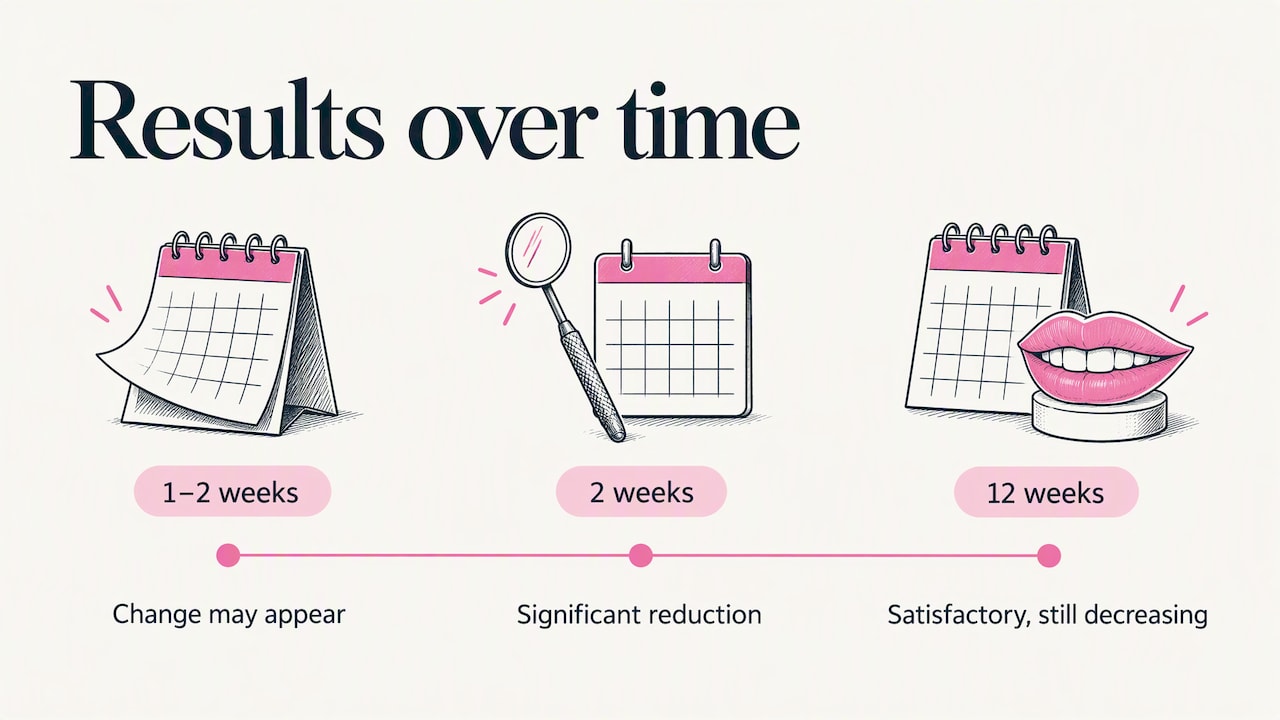
In the first week or two, your smile may feel slightly different: the lip may feel a little tighter or less mobile than usual. That usually settles as you adjust to the new pattern of movement.
How long results last
Gummy smile Botox is temporary. Results typically last between four and six months, then muscle activity returns as the effect wears off, and repeat treatments are needed to maintain the look (Fatani, 2023).
Some practical points on timing:
- Your first round may wear off sooner than later rounds, and dose and placement can be refined at each visit.
- Scheduling a repeat as the smile starts to return, instead of waiting for a full reset, keeps the look more consistent.
- If you are treating other areas too, such as fine lines or crow’s feet, your injector can often align the visits.
One reassuring detail from a pooled analysis of non-wrinkle cosmetic uses of botulinum toxin: overall patient satisfaction was 94% (95% CI, 88%–98%) across the reviewed studies (Beyond Wrinkles, 2026). That figure covers a range of non-wrinkle uses, not gummy smile alone, so treat it as a general signal and not a promise.
Side effects and safe use
Most side effects are local and mild. Reported ones include inflammation, pain, bruising, swelling and some loss of muscle strength. Poor technique can cause speech difficulties or an asymmetric smile, and an overdose can make the upper lip droop (Fatani, 2023).
This is why who injects you, and how conservatively they dose, matter so much. Questions worth asking any provider:
- Who will be doing my injections, and what is their training in facial anatomy?
- How many units do you plan to use, and will you start low and review me after two weeks?
- What should I do if my smile feels uneven or my lip feels too heavy?
The American Dental Association notes that integrating injectables requires comprehensive knowledge of neurophysiology, anatomy and safety protocols, including managing complications (ADA continuing education). Our piece on why your injector matters more than the brand makes the same point from a med spa angle.
Who should not have Botox
The FDA-approved Botox labeling lists contraindications: known hypersensitivity to any botulinum toxin product or its components, and infection at the planned injection site (FDA Botox label). The same label highlights rare but serious risks from toxin spreading beyond the injection site, including breathing, swallowing or speech difficulties, with higher risk for people who have pre-existing neuromuscular disorders or compromised respiratory function (FDA Botox label).
So before treatment, tell your injector about any neuromuscular condition, breathing problem, allergy, current infection near your mouth or nose, and every medication or supplement you take. If you have a neuromuscular disorder, talk to the doctor who manages it before booking. Call your provider promptly if you notice trouble swallowing, speaking or breathing after any botulinum toxin treatment, and seek emergency care if it is severe.
Other ways to treat a gummy smile
Botox is one tool. Other reported options include orthognathic (jaw) surgery, gingivoplasty (reshaping gum tissue) and orthodontic intrusion (moving teeth upward). The choice depends on the cause of the gummy smile, and Botox is described as a conservative option for borderline cases or upper-lip muscle hyperactivity (Non-Surgical Management of the Gingival Smile, 2023).
| Approach | Best suited to | Permanence | Commitment |
|---|---|---|---|
| Botox | Overactive upper-lip muscles, borderline cases | Temporary, repeated every few months | Low: short visit, no surgery |
| Gum reshaping (gingivoplasty) | Excess gum tissue or short-looking teeth | Long-lasting | Dental procedure and healing time |
| Orthodontic intrusion | Front teeth that have erupted too far | Long-lasting with retention | Months of orthodontic care |
| Jaw surgery (orthognathic) | Marked vertical excess of the upper jaw | Permanent | Major surgery and recovery |
Many people start with Botox because it lets them preview what a lower-lifting lip looks like with no lasting commitment. If the assessment points to a dental or skeletal cause, a dentist or orthodontist is the right next call, and a good injector will tell you so.
Our perspective
We see gummy smile as a placement and judgment problem more than a product problem. Two people can ask for the same thing and need very different plans, because the muscle, the gum and the jaw each play a part.
That is why we start with a conversation and a close look at how your smile moves, and why our consultations are free. We would rather map out what is likely to help, and what is not, than rush you into a syringe.
Our approach to injectables is personalized and conservative: small, deliberate doses, a follow-up conversation, and adjustments over time. A natural-looking smile should still look like yours.
If you have questions about what is possible, bring your photos and your goals. We will walk you through the options.
Chris
Cost and booking at Sudbury Med Spa
We do not publish a set price for Botox on our site, and gummy smile treatment is planned to the person, so the dose and number of points vary. The most reliable way to get a clear figure is a free consultation, where we examine your smile and explain the plan before you decide anything. We also offer financing options. You can see the general range of what we offer in our price booklet.
If you plan to return for Botox regularly, our annual memberships are published at $399 per year for Silver, $499 per year for Gold and $599 per year for Platinum. Check the membership page for what each tier includes.
Ready to find out whether Botox suits your smile? Read about Botox at Sudbury Med Spa, browse real Botox before-and-after results, or book a free consultation with our team.

You can also see everything we offer on our services page, from injectables to laser treatments and facials.
Questions to bring to your consultation
A short list makes the visit more productive:
- Is my gum show mainly from muscle movement, from gum tissue, or from my jaw and teeth?
- Which muscles do you plan to treat, and why those?
- What dose will you start with, and when will I be reviewed?
- What will my smile look and feel like in the first two weeks?
- How often will I likely need to repeat treatment?
- If Botox is not the best fit, what would you recommend instead?
A provider who answers these clearly, and who is comfortable saying “this may not be right for you,” is the one to trust with your smile.
FAQ
Can Botox fix a gummy smile?
Often it can reduce one, when the cause is an overactive upper-lip muscle or the case is borderline. It does not correct gum tissue, tooth position or jaw structure, so an assessment comes first. Results are temporary.
Where is Botox injected for a gummy smile?
Usually into the upper-lip elevator muscles near the nose, often around the Yonsei point, a triangle formed by three small muscles. Because anatomy varies from person to person, a skilled injector adjusts the points and depth to your face rather than following a fixed template.
How long does Botox for a gummy smile last?
Typically four to six months. You should see the effect within one to two weeks, and it fades gradually as muscle activity returns. Repeat treatments maintain the look.
Is Botox for a gummy smile safe?
For most healthy adults, side effects are mild and local, such as bruising, swelling or tenderness. Too much toxin or poor placement can cause an uneven smile or a drooping lip. Tell your injector about neuromuscular disorders, allergies, infection near the injection area and your medications, and see a physician right away for any trouble breathing or swallowing.
Sources
- An Approach for Gummy Smile Treatment Using Botulinum Toxin (Fatani, 2023)
- Non-Surgical Management of the Gingival Smile with Botulinum Toxin (2023)
- Establishing standards for Yonsei point in a White South African sample (2023)
- Cosmetic Management of Gummy Smiles with Botulinum Toxin A (2026)
- Beyond Wrinkles: A Systematic Review and Meta-analysis (2026)
- FDA prescribing information for Botox
- American Dental Association: CE Live Workshops on Botox