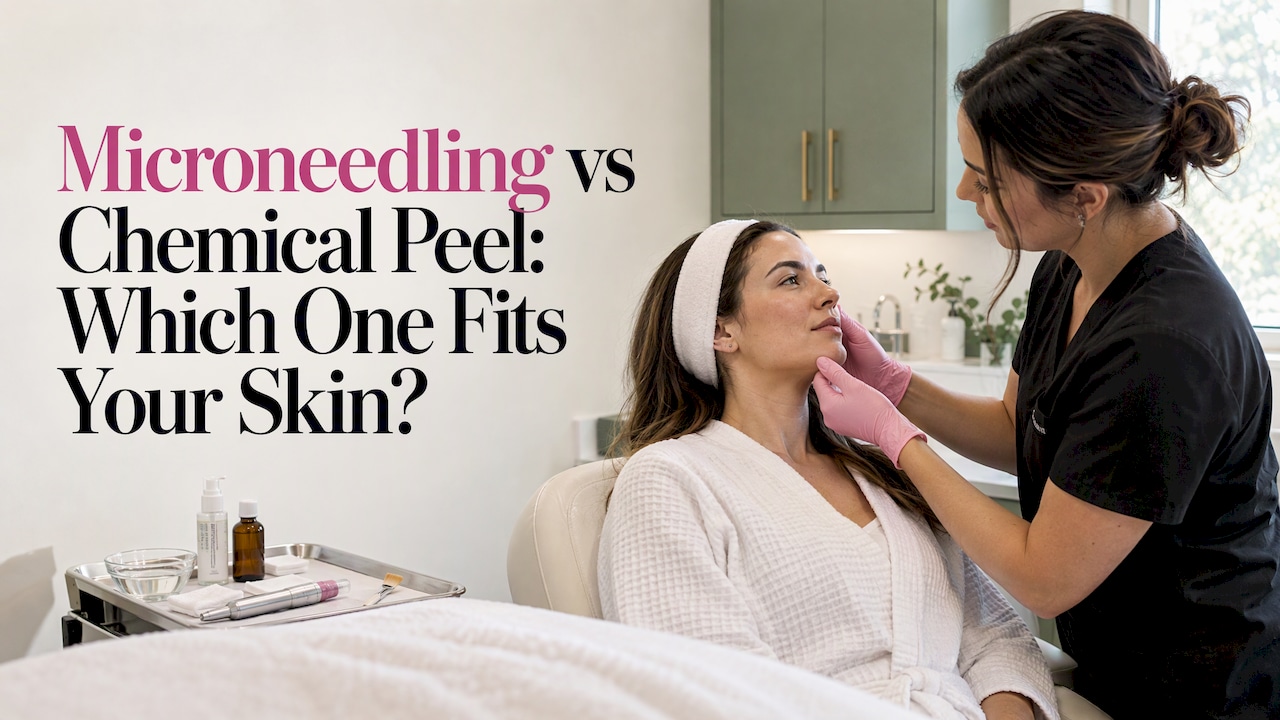

Microneedling and chemical peels both refresh the skin, but they work in opposite ways. A chemical peel uses an acid solution to remove damaged outer layers. Microneedling uses tiny needles to trigger the skin’s own repair response. As a rule of thumb, peels are often the first thing to consider for dullness, uneven tone and sun damage. Microneedling is often the first thing to consider for texture, pores and acne scars. Many people end up doing both, on a schedule a provider sets.
Below, we break down how each treatment works, what it can address, what recovery looks like, and how to decide.
TL;DR
- Peels work from the surface down. A chemical peel removes part or all of the outer skin layer, then the skin regenerates. It is commonly chosen for tone, dullness, acne and pigment.
- Microneedling works from within. It creates controlled micro-injuries so the skin rebuilds itself. It is commonly chosen for acne scars, fine lines and texture.
- Downtime is usually short for both. Redness, tightness and dryness are common, and microneedling reactions typically fade within a few days to a week.
- Combining can make sense. One randomized trial found the combination gave the best measured results for atrophic post-acne scars.
- Your provider matters. Both treatments need someone trained, especially if you have darker skin, a history of keloids or take isotretinoin.
Table of Contents
- How a chemical peel works
- How microneedling works
- Side-by-side comparison
- Which concerns suit which treatment
- Downtime, comfort and side effects
- Who should wait or choose carefully
- How long results last
- Can you combine them?
- Our perspective
- Explore both options with our team
- How to decide: a short checklist
- FAQ
- Sources
How a chemical peel works
A chemical peel applies an acid or other chemical agent to the skin to cause a controlled injury to part or all of the epidermis, and sometimes the dermis. The skin then regenerates and remodels, which can improve its appearance and texture.
Peels are classed as superficial, medium-depth or deep, depending on how far they penetrate. Penetration depends on the agent’s concentration, pH and type, and also on skin thickness and other treatment factors. That is why two people can have the same “peel” and very different experiences.
In practice:
- Superficial peels are the lightweight option. They are often described as lunchtime treatments with mild flaking.
- Medium and deep peels reach further, take longer to heal and carry more restrictions.
Dermatologists have performed chemical peels for more than 50 years, with an excellent safety record, which is a good reason to book with a trained professional rather than relying on home kits.
How microneedling works
Microneedling uses a device with fine needles that make very small punctures in the skin. Unlike a peel, it does not remove layers of skin. The tiny channels prompt the skin to produce new collagen and rebuild itself from within, which is why people tend to see gradual change over a series of sessions.
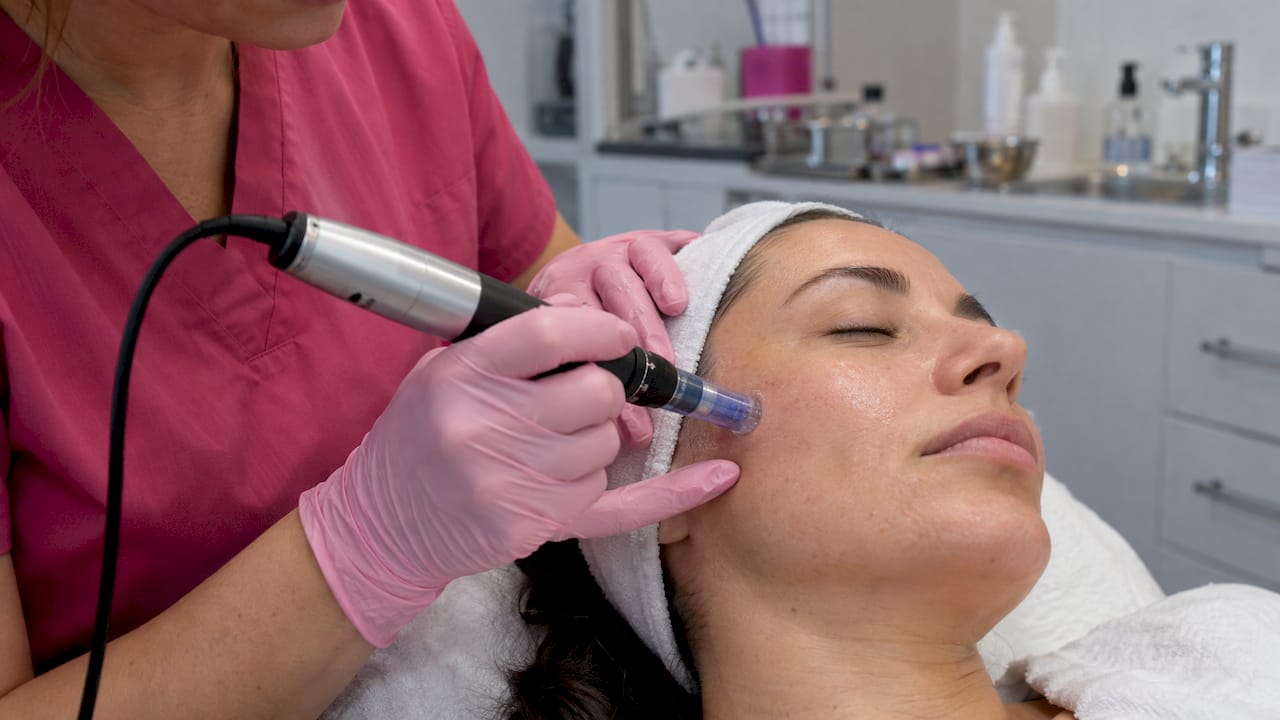
The FDA has legally authorized microneedling devices to improve the appearance of facial acne scars, facial wrinkles and abdominal scars in patients aged 22 or older. The FDA also recommends choosing a health care provider trained to perform the procedure, and its device review notes that a qualified clinician should assess skin thickness in each treatment area to avoid injuring underlying nerves and blood vessels.
There are variations. Microneedling can be paired with platelet-rich plasma (PRP), where a small amount of your own blood is processed and applied to the skin. Radiofrequency (RF) microneedling adds heat energy through the needles. If you are curious about that version, our guide to RF microneedling vs microneedling explains the difference.
Side-by-side comparison
| Chemical peel | Microneedling | |
|---|---|---|
| Basic action | Removes damaged outer skin with a chemical agent | Creates micro-channels that trigger collagen production |
| Works on | Surface and upper layers | Deeper structure, plus the surface |
| Commonly chosen for | Uneven tone, dullness, sun damage, acne, melasma | Acne scars, texture, pores, fine lines |
| Typical after-effects | Redness, flaking, peeling, tightness | Redness, dryness, tightness, occasional bruising |
| Strength is adjustable by | Agent, concentration, pH, number of layers | Needle depth, device, number of passes |
| Usually done as | A single treatment or a series | A series, with occasional maintenance |
This table is a general guide. A provider looking at your skin in person will tell you which column your concerns fall under.
Which concerns suit which treatment
Uneven tone, sun damage and pigmentation
Peels have the stronger track record here. A review of current practice notes that chemical peels can address acne, photoageing and pigmentary disorders such as melasma. Because a peel removes pigmented surface cells and speeds up turnover, patients with brown spots or a dull, sallow look often start there.
If your main issue is sun-related, our page on sun damage face treatment covers what works and when to begin. For redness that lingers after breakouts, see post-inflammatory erythema.
Some people also explore light-based support for pigment, and red light therapy and hyperpigmentation is a topic that stresses side effects and the value of treatment by an experienced skin professional, a point that applies to peels and microneedling alike.
Acne scars and texture
Microneedling is the treatment most often associated with scar texture, and it is the one with FDA-authorized devices for facial acne scars. Rolling or shallow atrophic scars are the kind people most often bring to a microneedling consultation. Peels can also soften texture, and microneedling may be combined with glycolic acid to manage acne scars.
One head-to-head study compared microneedling against glycolic acid peels for scarring, and the full text is available through this comparison of microneedling and glycolic acid peels. Results in studies depend on the scar type, protocol and number of sessions, so treat any single trial as a pointer, not a promise.
Fine lines and early aging
For fine lines, microneedling’s collagen-building approach is a natural fit, and the FDA clearance includes facial wrinkles. Superficial peels can add brightness and smoothness on top. Lines caused by repeated muscle movement, such as frown lines, are a different matter: those are usually handled with neuromodulators like Botox, sometimes alongside a skin-quality treatment.
Acne itself
Active breakouts are where peels often come first, because acids can help clear pores and speed turnover. Microneedling is more commonly used once active acne has calmed and what remains is scarring. Your provider may sequence them: peels or a skincare program for breakouts, then microneedling for marks and texture.
Downtime, comfort and side effects
Microneedling
The FDA lists the common risks as dryness, tightness, redness and bruising, with pigmentation changes and infection less common. According to the American Academy of Dermatology, reactions usually disappear within a few days to a week. A numbing cream is typically applied beforehand, so most people describe the sensation as pressure and a mild scratching feeling.
Chemical peels
Side effects can include persistent redness, temporary darkening or lightening of the skin, and very rarely scarring. Recovery length depends mainly on peel depth. A superficial peel often means a few days of flaking or tightness. Medium and deep peels involve a longer, more visible healing period, and your provider should walk you through it before you commit.
A practical rule for both: plan around social events, avoid picking at flaking skin, and use daily sunscreen while the skin heals.
Who should wait or choose carefully
This is where the details of your health and history matter more than any comparison chart.
- Isotretinoin. Microneedling should not be performed on people taking isotretinoin. For medium-depth and deep peels, contraindications include isotretinoin within the previous six months, along with active infection and allergy to a peeling ingredient.
- Keloids or poor healing. The AAD says microneedling should not be done on people who heal poorly or have a keloid or history of keloids, or who have a skin infection.
- Darker skin tones. The AAD says microneedling is safe for all skin tones, but treatment by someone without medical training and in-depth skin knowledge raises the risk of side effects. For peels, the AAD advises people with skin of color to see a dermatologist experienced in treating darker skin tones.
- Age. The FDA authorization for microneedling devices applies to patients 22 or older.
Tell your provider about any prescription retinoids, recent sun exposure, cold sores and past reactions to skincare. If you have a medical condition or take medication that affects healing, check with your dermatologist or primary care clinician before booking either treatment.
How long results last
Neither treatment is a one-time fix. Peel results fade as the skin keeps aging and sun exposure continues, so many people repeat them seasonally or as part of a series.
Microneedling results are also not permanent. They fade as the body loses collagen, and a dermatologist may recommend a maintenance session once a year. Sunscreen, a good retinoid routine (once your provider clears it) and avoiding smoking all help you keep what you gain.
Can you combine them?
Yes, and it is often the smartest plan for stubborn concerns. A randomized controlled trial found that combining microneedling and chemical peeling produced the best objectively measured effects for atrophic post-acne scars.
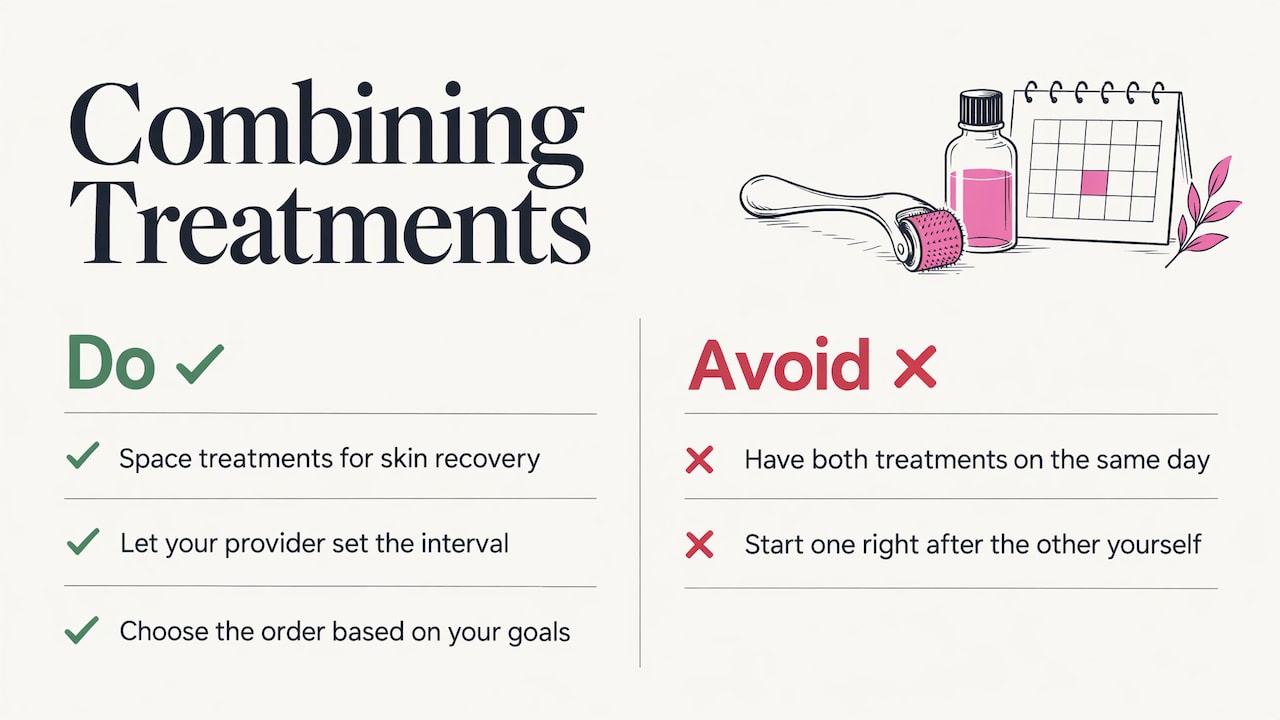
Combining does not mean doing both on the same day. The treatments are typically spaced out so the skin can recover in between, and the order depends on your goals. A common pattern is to treat tone and surface issues with peels, then add microneedling for structure and texture, or the reverse for scarring. Your provider sets the interval based on how your skin responded to the first treatment, so do not start one on your own right after the other.
Our perspective
Most people who come to us asking “peel or microneedling?” really have two questions: what bothers them most, and how much downtime they are comfortable with. We start with the first one.
When the concern is tone, dullness or sun spots, we usually talk about facial peels. When it is texture, pores or scars, we usually talk about microneedling, with or without PRP, or Morpheus 8 when RF energy makes sense. For many clients the best answer is a custom plan that uses both over several months.
That is why we begin with a free consultation and look at your skin in person before recommending anything. Skin tone, history of healing, medications and your calendar all shape the plan. Our team has completed more than 15,000 treatments, and we design each plan around the individual, not a template.
Chris
Explore both options with our team
Sudbury Med Spa offers facial peels, microneedling with PRP and Morpheus 8, along with Hydrafacial and personalized facial treatments. Your first step is a free consultation, where we assess your skin and build a plan around your goals. Financing options are available, and our annual memberships are $399 (Silver), $499 (Gold) and $599 (Platinum) per year; see the membership details for what each includes.

To see the full treatment menu, visit our services page.
How to decide: a short checklist
- Name your top concern. Tone and dullness point toward a peel. Scars and texture point toward microneedling.
- Be honest about downtime. Decide how many days of redness or flaking you can plan around.
- Check the safety list. Isotretinoin, keloids, active infection or a recent sunburn all change the answer.
- Consider your skin tone. Choose a provider with specific experience treating your skin type.
- Think in a series. Both treatments usually work best as a planned course, not a single visit.
- Ask about combining. If one treatment will not cover everything, ask how a staged plan would look.
FAQ
Is microneedling better than a chemical peel?
Neither is better across the board. Microneedling is commonly chosen for acne scars and texture, while peels are commonly chosen for tone, sun damage and pigmentation. The right pick depends on your main concern, skin tone and downtime tolerance, and a consultation can narrow it down.
How long is chemical peel recovery?
It depends on the depth. Superficial peels usually mean a short period of redness and flaking, while medium and deep peels take longer to heal. Side effects can include persistent redness or temporary darkening or lightening of the skin, so follow your provider’s aftercare closely.
Are microneedling results permanent?
No. Results fade as the body loses collagen over time. A dermatologist may recommend a maintenance session about once a year, and daily sunscreen helps protect your results.
Can I have microneedling and a chemical peel together?
They can be combined as part of one plan, and a randomized trial found the combination gave the best measured results for atrophic post-acne scars. They are normally spaced apart rather than done the same day, with timing set by your provider.
Is microneedling safe for darker skin?
The AAD says microneedling is safe for all skin tones, but the risk of side effects rises when it is done by someone without medical training and in-depth skin knowledge. Choose a provider who regularly treats your skin type.
Sources
- Chemical peels: A review of current practice (Australasian Journal of Dermatology)
- A Comparison of Microneedling versus Glycolic Acid Chemical Peels
- Microneedling Devices (FDA)
- SkinPen Precision System device review (FDA)
- Microneedling can fade scars, uneven skin tone, and more (AAD)
- Chemical peels: FAQs (AAD)
- Randomized controlled trial on combining microneedling and chemical peeling