
Traditional microneedling uses fine needles to create tiny controlled injuries that prompt your skin to rebuild. RF microneedling does the same, then sends radiofrequency energy through the needles to heat the deeper layers of skin. In short: choose traditional microneedling for texture, scars and overall glow with minimal downtime. Consider RF microneedling when loosening skin, early sagging or deeper scarring is what bothers you. Both are medical-grade procedures that belong in trained hands, and the FDA issued a safety communication on RF microneedling in October 2025, so who performs it matters as much as which one you pick.
TL;DR
- Traditional microneedling is mechanical only: needles trigger the skin’s wound-healing response. It suits fine lines, acne scars, stretch marks and uneven texture, with downtime that usually ends within a few days to a week.
- RF microneedling adds heat delivered by insulated needles into the dermis, aiming for stronger tightening than needling alone.
- The FDA’s October 2025 safety communication reports burns, scarring, fat loss and nerve damage with certain uses of RF microneedling. Choose a medical setting and an experienced provider, and never do it at home.
- Skin tone, history of keloids, active infection and a weakened immune system all change who is a good candidate. A consultation should settle this before any needle touches you.
Table of Contents
- How traditional microneedling works
- How RF microneedling works
- Side by side: the real differences
- Which concerns point to which treatment
- Sessions, results and recovery
- Safety: what the FDA said and what it means for you
- What each treatment costs
- Our perspective
- Explore microneedling and RF options at Sudbury Med Spa
- Making the choice
- FAQ
- Sources
How traditional microneedling works
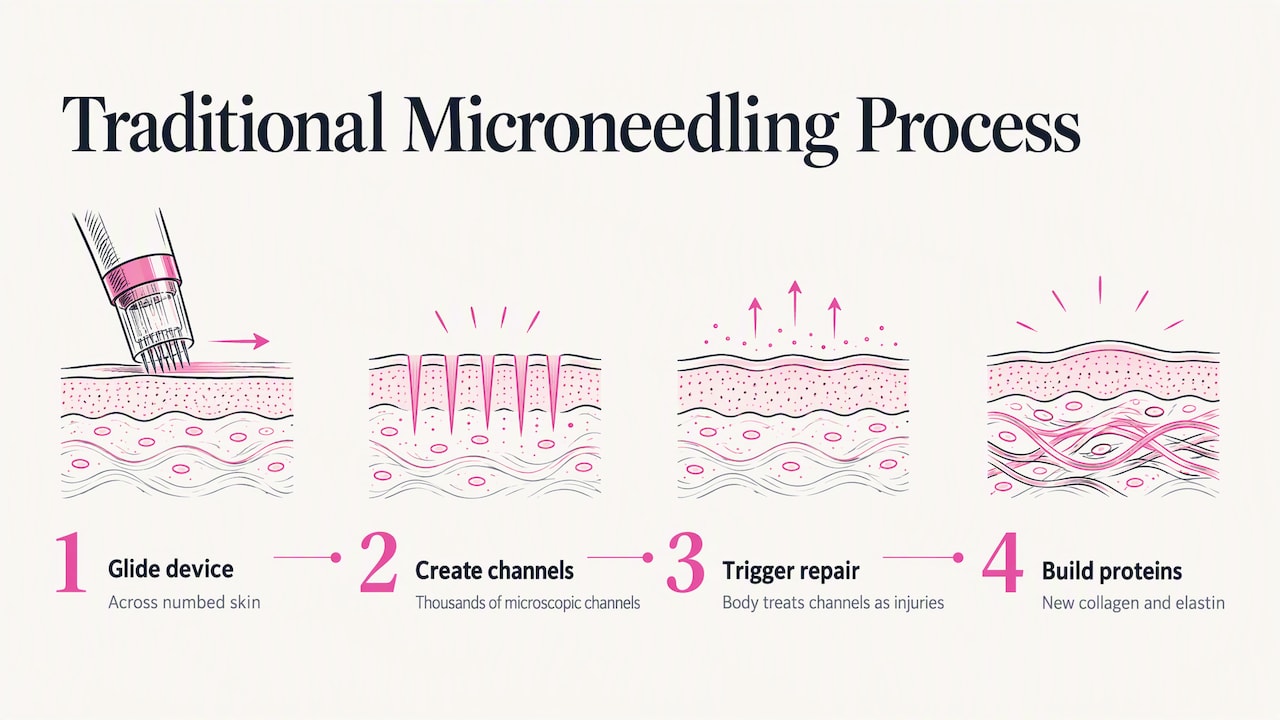
A microneedling device holds a cluster of very fine needles. The provider glides it across numbed skin, and each pass makes thousands of microscopic channels. Your body reads those channels as minor injuries and responds by making new collagen and elastin. That is the whole mechanism: purely mechanical, no added energy.
The American Academy of Dermatology says microneedling can address fine lines, wrinkles, acne scars, stretch marks and uneven skin texture and tone. Because the healing response is gradual, results build over weeks as new collagen forms, which is why providers usually plan a series of sessions rather than one.
The channels also let topical products reach deeper than they normally would, which is why many clinics pair needling with a serum or with platelet-rich plasma (PRP), a concentrate made from your own blood.
How RF microneedling works
RF microneedling starts with the same needling step. The difference is that the needles are insulated along most of their length and deliver radiofrequency energy at the tip, deep in the dermis. A 2023 review in the peer-reviewed literature describes this as adding thermal injury to the mechanical wound-healing cascade, producing a more intense, localized heating effect meant to improve tightening beyond what mechanical injury alone achieves.
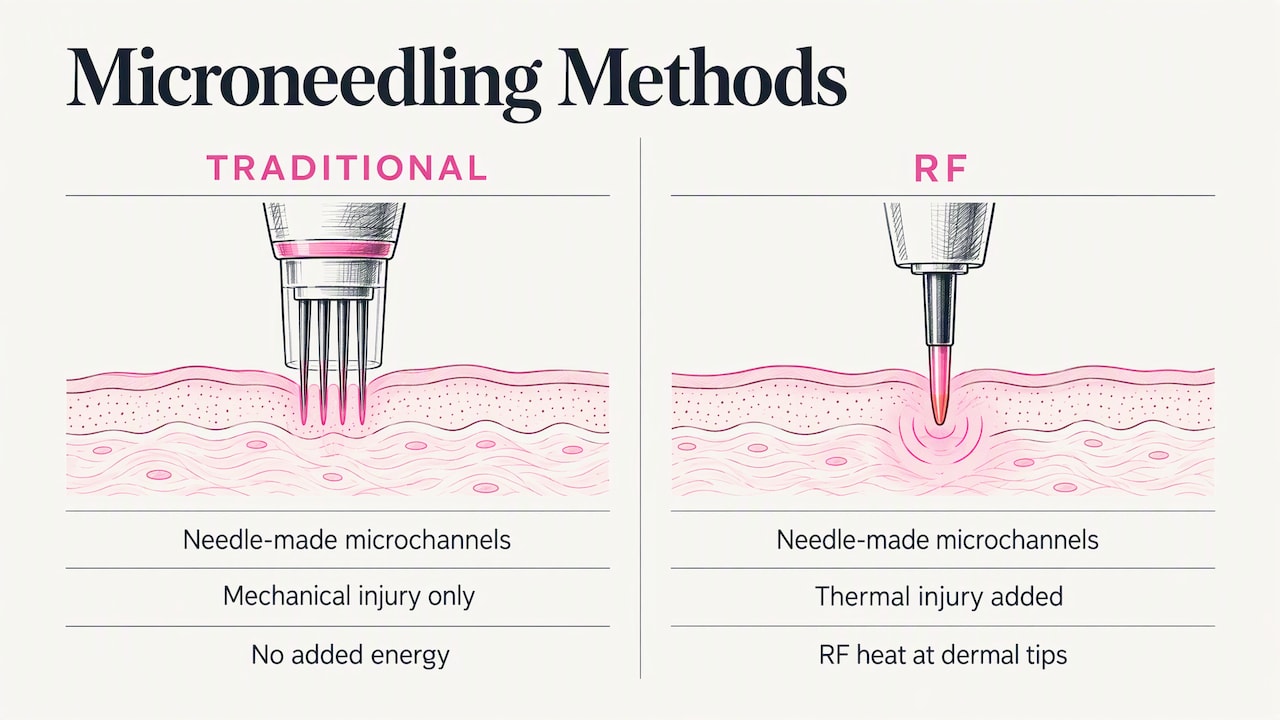
Heat is the key variable. The same review notes that skin hydration, collagen content and thickness affect how RF energy travels through tissue, so two people on the same setting can respond differently. That is also why settings, depth and the number of passes are decisions for an experienced clinician, not a number on a menu.
Side by side: the real differences
| Traditional microneedling | RF microneedling | |
|---|---|---|
| Energy used | Mechanical needling only | Needling plus radiofrequency heat |
| Best known for | Texture, fine lines, acne scars, stretch marks | Skin laxity, early sagging, deeper textural concerns |
| Depth of effect | Controlled by needle depth | Needle depth plus thermal zone in the dermis |
| Typical downtime | Redness and mild swelling, usually a few days to a week | Often a little longer and more noticeable, depending on settings |
| Main safety concern | Infection, pigmentation changes, irritation | The same, plus heat-related injury if misused |
| Can PRP be added? | Yes, commonly | Sometimes, at the provider’s discretion |
| Typical cost | Lower | Higher |
The downtime and cost rows are general patterns, not guarantees. They shift with the device, the area treated and how aggressively your provider sets it.
Which concerns point to which treatment
When traditional microneedling is a good fit
Traditional microneedling tends to make sense when your main goals are:
- Softening shallow acne scars
- Smoothing rough or uneven texture
- Refining fine lines
- Improving the look of stretch marks
- Evening out tone with a gentle, low-downtime option
It is also the simpler place to start if you have never had a professional skin procedure and want to see how your skin responds.
When RF microneedling is worth considering
The added heat is aimed at tissue that has lost firmness. That includes mild to moderate laxity along the jawline, softening around the cheeks and neck, and deeper scarring where needling alone may not go far enough. The AAD notes that RF microneedling adds heat that can increase collagen production and improve results compared with needling alone.
Keep expectations realistic. Neither treatment lifts skin the way surgery does. If you have significant sagging, a good consultation should tell you so rather than sell you a series of sessions that cannot deliver it.
When neither is the right first step
Some concerns call for a different tool. Persistent redness or rosacea-type flushing, for example, is often managed with topical options first, such as azelaic acid for rosacea, under the guidance of a trained clinician. Deep folds from volume loss usually respond better to filler, and dark spots may be a job for light-based treatment. A provider who offers several technologies is more likely to match the tool to your skin than to push the one device they own.
Sessions, results and recovery
Both treatments work by prompting collagen, and collagen takes time. Expect to see subtle change in the weeks after a session, with the full effect building over the following months. Providers commonly plan a series spaced several weeks apart, then occasional maintenance. The exact number depends on your concern, your skin and the device, so treat any number quoted in an ad as a starting point for a conversation.
Recovery for traditional microneedling is light. The AAD says redness, discomfort, burning or swelling usually disappears in a few days to a week. RF sessions can leave skin looking and feeling warmer and more swollen for longer, especially at stronger settings.
A few habits protect your result with either treatment:
- Skip sun exposure and use a broad-spectrum sunscreen after treatment.
- Follow your provider’s aftercare instructions on products. Treated skin is more reactive.
- Avoid picking at flaking or scabbing skin.
- Tell your provider about any active breakouts, cold sores or medications before you book.
Safety: what the FDA said and what it means for you
This is the part most comparison pages skim, and it is the reason the question “why do some plastic surgeons not like RF microneedling?” gets asked.
In October 2025 the FDA published a safety communication on certain uses of RF microneedling. It reports serious complications including burns, scarring, fat loss, disfigurement and nerve damage, some requiring surgical intervention. It also states plainly that RF microneedling is a medical procedure and should not be done at home.
Context matters. A Healio interview with dermatology experts says serious complications are rare and almost always tied to nonmedical settings or improper technique. The American Med Spa Association likewise urges practitioners to treat RF microneedling as a medical treatment with proper training, supervision and safety protocols.
The FDA’s general page on microneedling devices lists the more common risks of any microneedling: dryness, redness, itching, bruising, pigmentation changes and infection. Most side effects resolve, though some can be permanent.
Questions to ask before you book
- Who will perform the treatment, and what is their training on this specific device?
- Is a medical professional involved in oversight at the practice?
- What settings and depth would you use for my skin type and area?
- What happens if I have a complication, and who do I call?
- Do you offer other options if I turn out not to be a good candidate?
If a clinic cannot answer these clearly, keep looking.
Skin tone and candidacy
RF microneedling is described as safe for all skin tones, but the AAD notes more research is needed on results for darker skin tones. Healio’s experts add that darker skin may be at higher risk of post-inflammatory hyperpigmentation if settings are too aggressive. That is not a reason to avoid treatment. It is a reason to choose a provider who adjusts depth and energy conservatively and who explains how they do it.
The AAD also says microneedling may not be suitable if you have a history of keloids, a weakened immune system or a skin infection. Say so at your consultation.
What about at-home rollers and pens?
Home devices are not a cheaper version of the clinic treatment. The AAD explains that at-home products are not meant to puncture the skin and give less noticeable results, and that piercing skin or overuse can cause infection, scarring, irritation or damage. With RF, the FDA’s guidance against home use is explicit.
What each treatment costs
RF microneedling is priced higher than traditional microneedling because the devices and disposable tips cost more and the procedure usually calls for more provider time. Beyond that, pricing varies widely by clinic, region, area treated and whether PRP or a serum is added, and sessions are normally bought as a series. Treat any flat figure online with caution: ask for a written quote that states the area, the number of sessions and what is included.
We do not publish a per-session price for these treatments. We quote after a free consultation, once we know your skin and your goal. Our price booklet and membership plans are the places to start if you want a sense of how we price. Memberships are listed at $399 (Silver), $499 (Gold) and $599 (Platinum) per year.
Our perspective
We see the same pattern in consultations: people arrive asking for the strongest treatment, when the better question is which one fits their skin and their timeline. Plenty of clients are well served by microneedling with PRP, which uses your own platelet-rich plasma to support the healing response. Others, with looser skin, are better candidates for a radiofrequency-based treatment such as Morpheus 8. We offer both, so we have no reason to steer you to one over the other.
What we care about most is the setting. The FDA’s alert reinforced what a medical practice already knows: heat-based devices need judgment, conservative settings for your skin tone and a plan for when something does not go as expected. Our team is led by founder Natalie NgocTrang, and we have completed more than 15,000 treatments. We keep the room clean, the pace unhurried and the plan personal, and we will tell you if a different treatment, or none, is the right call.
— Chris
Explore microneedling and RF options at Sudbury Med Spa
If you are weighing these two treatments, the fastest way to an answer is a conversation about your skin. We offer free consultations, personalized treatment plans and financing options, and our microneedling with PRP and Morpheus 8 page explains what each involves.

Book a consultation through our main site and we will look at your skin, talk through your goals and recommend the option that fits, whether that is one of these or something else on our menu.
Making the choice
A simple way to decide:
- Texture, scars or fine lines, and you want a gentle start: traditional microneedling, possibly with PRP.
- Early looseness or deeper scarring, and you accept a somewhat longer recovery: RF microneedling, with a provider who is experienced with your skin tone.
- Unsure: book a consultation and ask the questions listed above before committing to a package.
Whichever you choose, the provider and the setting matter more than the label on the device. If you also want to explore related options, our laser acne and scar treatment page covers another route for scarring, and our guide to post-inflammatory erythema explains how lingering redness fades.
FAQ
Is RF microneedling better than just microneedling?
Not across the board. RF adds heat, which is aimed at tightening and deeper collagen stimulation, so it can suit looser skin better. Traditional microneedling is often enough for texture, fine lines and shallow scars, with less downtime and lower cost.
Why do some plastic surgeons not like RF microneedling?
Most of the concern is about misuse, not the technology itself. The FDA’s October 2025 safety communication reports burns, scarring, fat loss and nerve damage with certain uses, and experts say serious problems are rare and mostly linked to nonmedical settings or poor technique. A trained provider using conservative settings lowers that risk.
What is the downside of RF microneedling?
It can mean more swelling and a longer recovery than traditional microneedling, a higher price and, if misused, a risk of heat injury. People with darker skin tones need a provider who avoids overly aggressive settings because of the pigmentation risk.
How much does RF microneedling usually cost?
It generally costs more than traditional microneedling, and the price depends on the clinic, the area treated and the number of sessions. Ask for a written quote. At Sudbury Med Spa, we price after a free consultation.
Sources
- Radiofrequency Microneedling: Technology, Devices, and Clinical Use (PMC)
- Microneedling can fade scars, uneven skin tone, and more (American Academy of Dermatology)
- Microneedling Devices (FDA)
- Potential Risks with Certain Uses of Radiofrequency (RF) Microneedling: FDA Safety Communication
- Is radiofrequency microneedling safe? What you need to know (Healio)
- FDA Issues RF Microneedling Safety Alert (American Med Spa Association)