

Hydroquinone is the stronger and faster-acting of the two in head-to-head trials. Kojic acid is the gentler option and is often used for maintenance. The best choice for you depends on what is causing the dark patch, how sensitive your skin is, and who is supervising the treatment. In the US, hydroquinone is now a prescription product, so the decision starts with a skin assessment. At Sudbury Med Spa, a free consultation is where we look at your pigment, your skin type and your goals before any plan is built.
TL;DR
- Hydroquinone (4%) beat 0.75% kojic acid in a 12-week comparison of 60 patients, with faster improvement. Kojic acid is generally the milder choice.
- In a split-face study, the two lightened skin equally in 58% of subjects, so the gap is smaller than the “gold standard” label suggests.
- Used together at low strengths, they outperformed kojic acid alone in a randomized study of melasma patients.
- In the US, hydroquinone has been prescription-only since 2020, and it is not meant for continuous use beyond about six months at a time.
- Dark spots have different causes. A professional assessment is the fastest way to know which approach, topical or in-clinic, fits you.
Table of Contents
- How the two ingredients work
- What the studies show
- Side effects and safety
- What US rules say about hydroquinone
- Can you use them together?
- Which one fits your situation
- In-clinic options for dark spots
- Book a free consultation
- Our perspective
- FAQ
- Sources
How the two ingredients work
Both ingredients target tyrosinase, the enzyme your pigment cells use to make melanin, the pigment that darkens skin. Block the enzyme and new pigment slows down, so existing dark spots fade as skin renews itself.
A 2024 clinical practice guide in the Journal of the European Academy of Dermatology and Venereology explains the difference. Hydroquinone inhibits tyrosinase and has long been considered the “gold standard” for hyperpigmentation. Kojic acid, which comes from fungi during fermentation, works by capturing the copper ion in the enzyme’s active site, which stops it from working.
Same target, different route. That is why they are often compared, and why they are sometimes combined.
What the studies show
Head-to-head: hydroquinone leads on speed
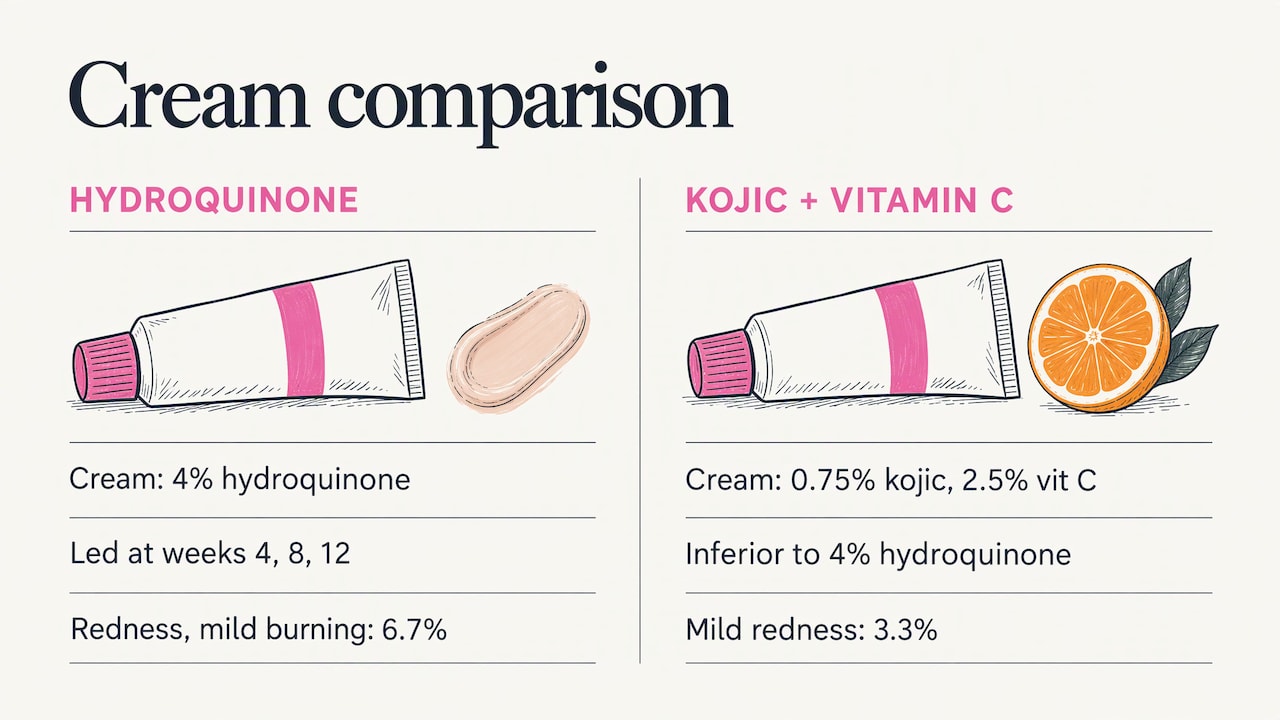
The study most people cite is a 12-week comparison of 60 patients published in the Indian Journal of Dermatology in 2013. A 4% hydroquinone cream beat a 0.75% kojic acid cream (which also contained 2.5% vitamin C) at weeks 4, 8 and 12, and it worked faster. Side effects were minimal in both groups: mild redness in 3.3% of the kojic acid group, and redness with mild burning in 6.7% of the hydroquinone group.
Note the strengths. The kojic acid in that trial was a low concentration, and results shift when the dose changes. A 2023 systematic review of melasma treatments noted that 2% kojic acid cream earned a grade A recommendation, while 0.75% kojic acid was inferior to 4% hydroquinone. It also noted that 1% kojic acid plus 2% hydroquinone worked better than either alone.
Same strength: closer than you would expect
The 2024 guide describes a split-face study that used 2% kojic acid gel on one side of the face and 2% hydroquinone gel on the other. Both sides improved equally in 58% of subjects. The kojic acid side did better in 28%, and the hydroquinone side did better in 21%. At matched strength, then, the two are roughly even.
| Hydroquinone | Kojic acid | |
|---|---|---|
| How it works | Inhibits tyrosinase | Captures the copper ion tyrosinase needs |
| Speed | Faster in the 12-week trial | Slower, steadier |
| Strengths studied | 2% to 4% | 0.75% to 2% in the trials above |
| Typical side effects | Irritation, contact dermatitis, rarely ochronosis | Redness, irritation, peeling |
| US availability | Prescription | Found in cosmetic products |
| Typical role | Short, supervised courses | Maintenance, or paired with other brighteners |
Side effects and safety
The 2024 guide lists the hydroquinone side effects as irritation, exogenous ochronosis (a rare blue-gray darkening of the skin), colloid milium, contact dermatitis and leukoderma (loss of pigment). For kojic acid it lists redness, irritation and desquamation, which means peeling.
A 2024 systematic review in the Journal of the American Academy of Dermatology adds useful context. It found that the common hydroquinone reactions, such as irritant contact dermatitis and temporary pigment changes, are tolerable and often transient. The chronic risks, ochronosis and eye complications, were tied to long-term use without medical supervision. Alternatives including kojic acid showed comparable efficacy with less concerning side effects.
The practical rules from the 2024 guide are straightforward:
- Do not use hydroquinone continuously for more than 6 months at a time, to lower the risk of ochronosis.
- Apply it only to the dark areas. It lightens normal skin too, which can leave a pale halo around small spots.
- Stop right away if irritation or discoloration develops, to avoid postinflammatory hyperpigmentation, the dark mark that follows irritated skin.
Kojic acid limits
In Europe, the Scientific Committee on Consumer Safety concluded in 2022 that kojic acid is safe as a skin lightener in cosmetics at concentrations up to 1%. It also noted that a weakened skin barrier, for example after peeling agents, could increase absorption. That is a good reason to be careful about stacking kojic acid with strong exfoliants or in-clinic resurfacing unless one person is planning the whole routine.
If your skin gets darker
A lightening product should not darken your skin. If a patch gets darker, burns, itches or looks irritated, stop the product and see a dermatologist. Irritation itself can cause new pigment, which is exactly what you were trying to remove.
What US rules say about hydroquinone
The rules changed in 2020. The CARES Act required over-the-counter hydroquinone products to go through FDA drug approval, and the 2024 guide reports that most were withdrawn. The American Society for Dermatologic Surgery notes that hydroquinone has been available only by prescription since September 2020, and that the FDA-approved single-ingredient cream is 4%. A 2026 review adds that no OTC hydroquinone skin lightener is legally marketed in the US.
What this means for you:
- If you want hydroquinone, you need a licensed prescriber to evaluate you and write the prescription.
- A product sold online as hydroquinone without a prescription falls outside that framework, so do not rely on it.
- Kojic acid is sold in cosmetic products. Concentrations vary by brand, so read the label.
The same ASDS statement points out that the 2006 cancer concerns came from oral studies in rats, and that no cancer has been reported from topical hydroquinone in humans. Its position is that prescription use under physician oversight is appropriate.
Can you use them together?
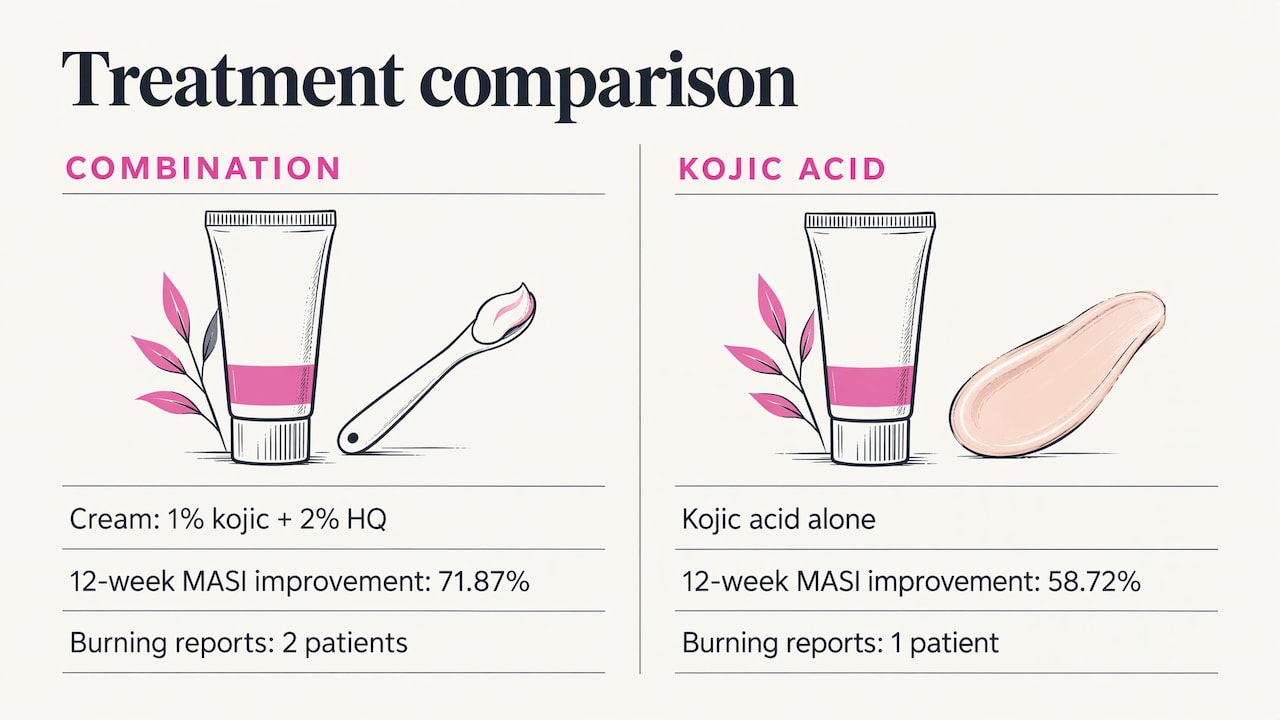
Yes, and the evidence for it is better than for either alone. In a randomized study of 80 melasma patients over 12 weeks, a cream with 1% kojic acid and 2% hydroquinone gave the best result: a mean MASI improvement of 71.87%, against 58.72% for kojic acid alone. MASI is a scoring system dermatologists use to rate melasma severity. One patient in the kojic-only group and two in the combination group reported burning. There was no dermatitis and no contact allergy to kojic acid.
The 2024 guide reports a similar pattern: adding 2% kojic acid to a hydroquinone and glycolic acid gel improved outcomes to 60%, compared with 47.5%.
Two cautions apply. A combined cream containing hydroquinone is still a prescription product. And layering several active ingredients on your own is where irritation tends to start, so have one professional design the routine.
Which one fits your situation
| Your situation | Where to start |
|---|---|
| Stubborn patches, melasma or a long-standing dark area | Get an assessment. Prescription hydroquinone, alone or in a combination, is something a licensed prescriber decides. |
| Sensitive or reactive skin | Kojic acid in a low-strength cosmetic is generally the milder place to begin. |
| Spots are already fading and you want to keep them that way | Kojic acid or another brightener for maintenance, plus daily sunscreen. |
| Dark marks after acne or irritation | The cause matters. Our guide to post-inflammatory erythema explains how redness differs from brown pigment. |
| Pigment from years of sun | See our guide to sun damage face treatment. |
Whichever you choose, sun is the thing that undoes the work. Ultraviolet light switches pigment cells back on, so a daily tinted sunscreen matters as much as the active ingredient. Affordable tinted daily sunscreen options make that habit easier to keep.
In-clinic options for dark spots
Creams are one path. A treatment plan built around your skin can also bring in professional options. At Sudbury Med Spa, our menu includes facial peels and laser treatments, microneedling with PRP and Morpheus 8, and Hydrafacial and personalized facials. We address specific skin concerns such as fine lines, wrinkles, skin restoration and hyperpigmentation with personalized treatment plans.
The reason to start in person is simple. Kojic acid and hydroquinone both act on the same enzyme, but dark patches come from different causes: sun, hormones, old acne marks, irritation. A plan that matches the cause is more likely to give you the result you want, and a plan built by one team avoids stacking products that irritate each other.
Book a free consultation
We offer free consultations, so you can talk through your pigment concerns, your skin type and your budget before committing to anything. Our team has completed over 15,000 treatments, and we also offer financing options.
If you plan to return for ongoing care, our annual memberships are listed at $399 (Silver), $499 (Gold) and $599 (Platinum) per year.
If a prescription ingredient such as hydroquinone is part of the picture, a licensed prescriber must evaluate you first. We will tell you plainly what fits your skin and what does not.
Our perspective
Most people who ask us about kojic acid versus hydroquinone are really asking a different question: “Why is this spot here, and how do I get rid of it?” The ingredient is the second decision. The first is understanding the pigment.
The studies agree on the broad picture. Hydroquinone is quicker at 4%, kojic acid is gentler, and the two together beat kojic acid alone. They also agree that results depend on strength, duration and supervision. That is why we prefer a plan to a single product: a person looks at your skin, picks the approach, and adjusts it as your skin responds.
Our team, led by founder Natalie NgocTrang, builds personalized treatment plans around your skin concerns, whether that is hyperpigmentation, fine lines or skin restoration. We keep the clinic clean and comfortable, and the consultation is free, so your first step costs you nothing but a conversation.
Chris
FAQ
Is kojic acid as strong as hydroquinone?
Not at the strengths usually compared. A 12-week trial found 4% hydroquinone beat 0.75% kojic acid. At equal 2% strengths in a split-face study, the two were equal for 58% of subjects, and kojic acid did slightly better than hydroquinone in 28% versus 21%.
Can I use kojic acid and hydroquinone together?
Studies have used them together, for example 1% kojic acid with 2% hydroquinone, and the combination outperformed kojic acid alone in melasma patients. Because hydroquinone requires a prescription in the US, have a licensed prescriber set up any combination.
Is hydroquinone legal in the US?
Yes, but only with a prescription. Since September 2020, hydroquinone products have not been legally sold over the counter, and the FDA-approved single-ingredient cream is 4%. A prescriber decides whether it is right for you and for how long.
How long can I use hydroquinone?
The 2024 clinical guide advises against using it for more than 6 months at a time, to lower the risk of ochronosis. Apply it only to the dark areas, and stop and call your provider if irritation or discoloration appears.
Why did my skin get darker after using a lightening product?
Irritation can trigger new pigment, so a product that stings, burns or itches can leave a darker mark. Stop using it and see a dermatologist before trying anything else.
Sources
- A practical guide to over-the-counter treatments for hyperpigmentation (JEADV Clinical Practice, 2024)
- A Comparative Study of the Efficacy of 4% Hydroquinone vs 0.75% Kojic Acid Cream (Indian Journal of Dermatology, 2013)
- Topical and Systemic Therapies in Melasma: A Systematic Review (2023)
- Kojic acid, Scientific Committee on Consumer Safety opinion (European Commission, 2022)
- Hydroquinone and Alternative Agents for Hyperpigmentation (Journal of the American Academy of Dermatology, 2024)
- ASDSA position statement on hydroquinone (2023)
- Advances in Skin Whitening Agents: Mechanisms, Clinical Evidence (2026)
- Kojic Acid vis-a-vis its Combinations with Hydroquinone and Betamethasone Valerate in Melasma (2013)
- Affordable tinted daily sunscreen options


