
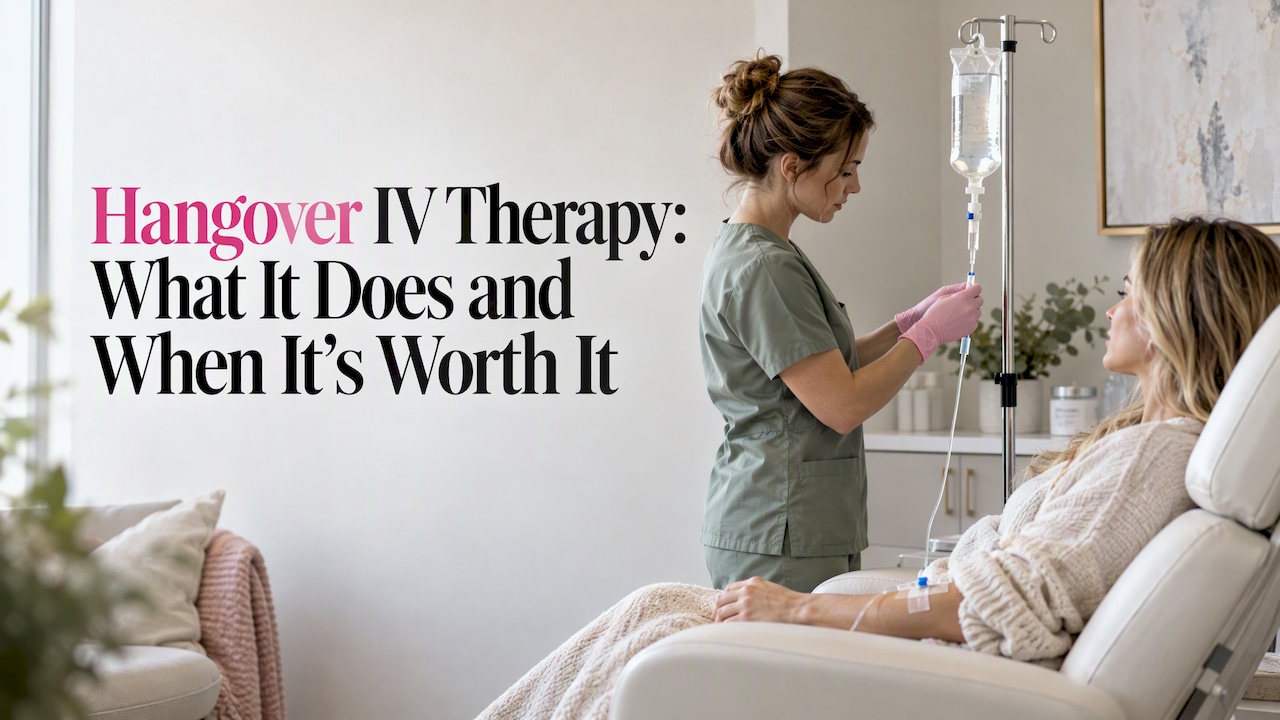

Hangover IV therapy is a drip of saline, electrolytes and usually vitamins, given through a vein, that can ease the dehydration part of a rough morning after. It does not cure a hangover. The National Institute on Alcohol Abuse and Alcoholism (NIAAA) says no remedy has been scientifically proven to work and that only time lets your body finish processing alcohol. A drip can still make sense for some people, as long as a licensed clinician screens you first and you know what you are paying for.
This guide explains what is in the bag, what the evidence supports, what to expect in Massachusetts, and how to decide between an infusion and a night of toast, water and sleep.
TL;DR
- An IV delivers fluid, electrolytes and sometimes vitamins straight into the bloodstream. It may speed up rehydration, but it is not a proven hangover cure.
- Doctors do not routinely recommend IV fluids for a hangover unless you cannot keep liquids down, according to University of Rochester Medical Center.
- Prices around Boston run from roughly $200 to $600 depending on the ingredients, per a Boston Globe report.
- Screening matters more than the menu. Heart or kidney conditions, medications and a clean, supervised setup all change whether a drip is safe for you.
- Water, an electrolyte drink, bland food and rest remain the first-line approach for most people.
Table of Contents
- What a hangover IV actually is
- Does it work? What the evidence says
- When an IV is reasonable, and when it isn’t
- The self-care baseline that costs almost nothing
- Risks to take seriously
- What to expect in Massachusetts
- Our perspective
- If you want to explore IV therapy with us
- Hangover IV or home care: a quick comparison
- Better ways to avoid the problem
- FAQ
- Sources
What a hangover IV actually is
A hangover IV is a bag of sterile fluid, typically a saline or similar base, run through a small catheter in your arm. Clinics add electrolytes and often a B-complex or vitamin C blend. Some add an anti-nausea medication or an anti-inflammatory, which require a clinician’s order.
The pitch is simple. Alcohol is a diuretic, you lose fluid and salts, and you feel it as headache, thirst, dizziness and nausea. Fluid delivered directly into the bloodstream skips the stomach, so it bypasses digestion. That can matter when you are too queasy to drink. According to the URMC overview, a session typically takes 30 to 60 minutes.
What the bag does not do is clear the toxic byproducts of alcohol metabolism, which are a root driver of how bad you feel. It also does not fix poor sleep, an irritated stomach lining or the mini-withdrawal the brain goes through as the buzz wears off, which the NIAAA hangover fact sheet describes.
Does it work? What the evidence says
Honest answer: it may help with some symptoms, and the research on hangovers specifically is thin.
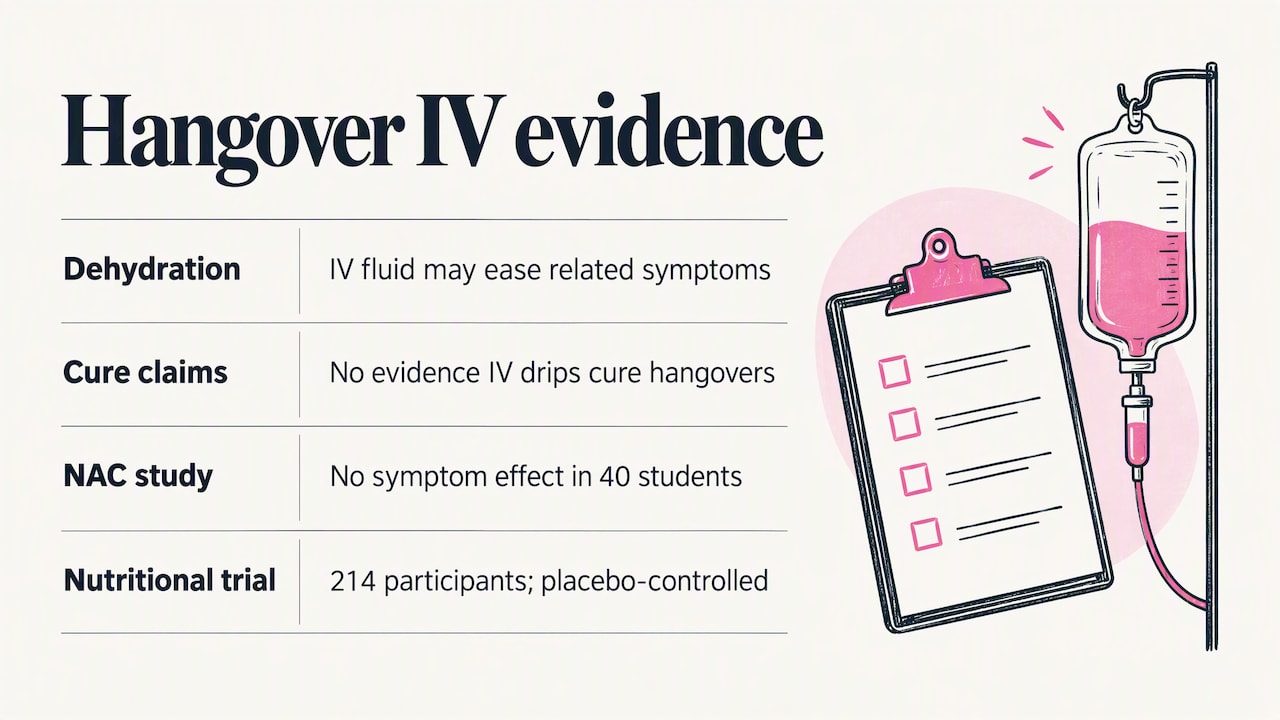
Where a drip plausibly helps. If dehydration is a big part of your symptoms, getting fluid and electrolytes in quickly can ease headache, dizziness and weakness. Healthline makes the same point: IV fluid may relieve symptoms linked to dehydration but does not address every factor behind a hangover.
Where the claims run ahead of the science. Many clinic menus promise a cure in under an hour. GoodRx notes there is no evidence IV drips cure hangovers, and that there isn’t evidence for any single cure.
The add-ins are a mixed bag. Glutathione, B vitamins and NAC (N-acetylcysteine) show up on many menus. In a 2024 clinical study of 40 students, NAC had no effect on hangover symptoms or on markers of oxidative stress and electrolyte levels after binge drinking. That does not prove every additive is useless, but it is a reason to ask what each ingredient is for and what evidence the clinic can point to.
What the large hangover trials show. A randomized, double-blind, placebo-controlled study of 214 participants tested a nutritional product against hangover symptoms. It is a useful reminder that proper hangover research uses a placebo group, which most drip marketing does not.
When an IV is reasonable, and when it isn’t
Here is a practical way to sort it.
| Your situation | Sensible next step |
|---|---|
| Mild to moderate headache, thirst, tired | Water or an electrolyte drink, bland food, rest |
| Queasy but keeping small sips down | Sip slowly, eat toast or crackers, wait it out |
| Cannot keep any fluid down, dizzy on standing | Consider medical care, where IV fluids are an accepted use |
| Repeated vomiting, confusion, chest pain, very fast heartbeat | Urgent care or the ER, not a drip bar |
| Heart or kidney condition, or on regular medications | Talk with your own doctor before any infusion |
| Planned recovery day and you want a supervised hydration session | A screened, nurse-administered infusion can be a reasonable choice |
Severe vomiting, confusion, seizures or slow breathing after heavy drinking can signal alcohol poisoning, which is an emergency. Call 911.
The self-care baseline that costs almost nothing
Before you book anything, know what the major health sources recommend, because it works for most people. The NIAAA’s guidance, echoed by the Cleveland Clinic, comes down to three things: hydrate with water or an electrolyte beverage, eat bland foods such as toast or crackers to steady blood sugar, and get rest. Skip drinking more alcohol the next morning. It only delays recovery.
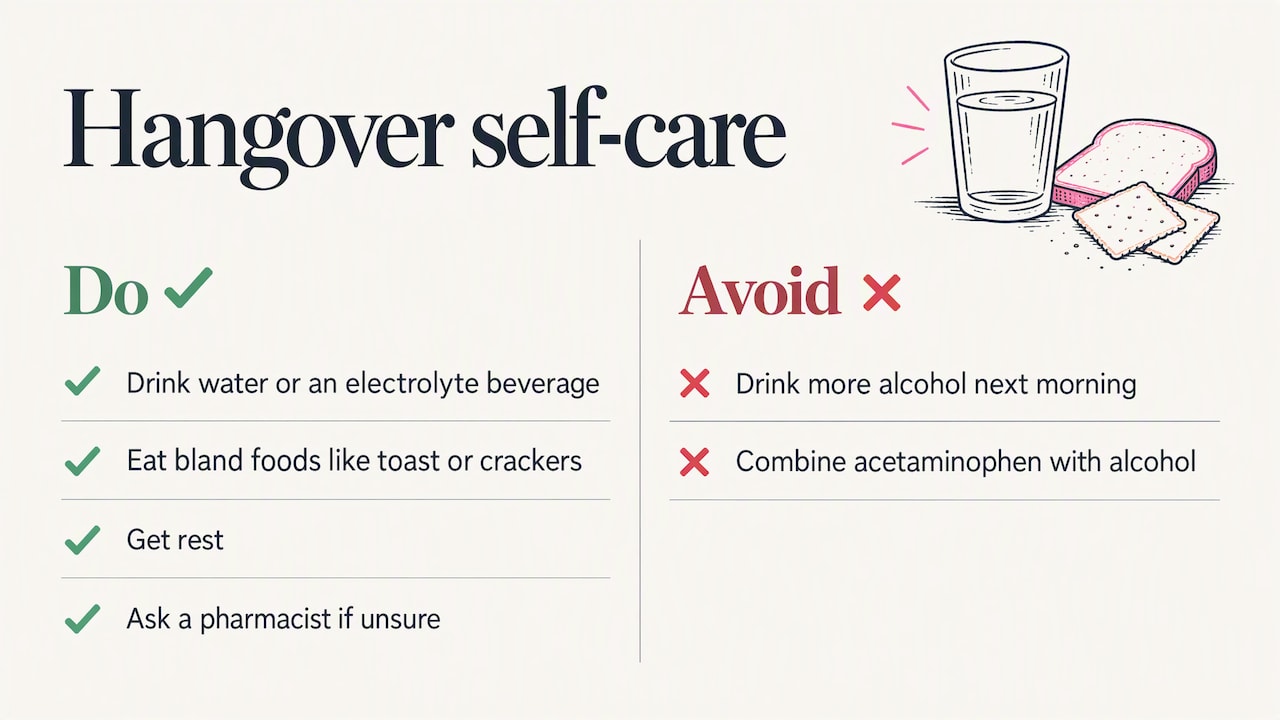
Be careful with painkillers. The Mayo Clinic warns that acetaminophen (Tylenol) combined with alcohol can cause serious liver damage, and that aspirin, ibuprofen or naproxen can irritate a stomach that is already sensitive. If you are unsure what is safe for you, ask a pharmacist.
Symptoms can last up to 24 hours, according to the NIAAA, and often peak when your blood alcohol concentration returns to near zero. So a drip at hour three may not change much about hour twelve.
Risks to take seriously
An IV is a medical procedure, even when it is sold like a wellness add-on. Putting a catheter in a vein carries risks of infection, irritation at the site and, if products or technique are poor, serious complications. URMC notes that an infusion should be done under medical supervision with properly sourced, sterile ingredients.
Those risks are not abstract. The FDA has issued a warning letter to a seller for introducing misbranded IV fluid drug products into interstate commerce, citing the inherent risks to consumers. Quality control in the supply chain matters.
Screening matters too. IV fluids can be dangerous for people with certain heart or kidney conditions. A good provider takes a medical history before the needle goes in, not after you have paid.
What to expect in Massachusetts
The Boston Globe’s March 2026 report says Massachusetts requires IV drips to be administered by nurses, and that some Boston-area drips cost about $200 while newer compounds such as NAD+ can run up to $600. The same piece quotes a public-health expert on how the category sits in a gap between state and federal oversight. For you, that means the burden of vetting falls partly on you.
Questions to ask before you book
- Who places the IV, and what is their license? You want a licensed nurse working under a clinician’s protocol.
- Who reviews my history? Expect questions about medications, allergies, heart, kidney and pregnancy status.
- What exactly is in the bag, and why? Ask for each ingredient and its purpose. Be wary of long menus of exotic additives.
- Where do the products come from? Pharmacy-sourced, sterile, properly labeled ingredients are the baseline.
- What is the total price? Ask whether the quoted price includes the nurse visit, add-ons and any fees.
- What happens if I react badly? A clinic should have a clear plan for adverse events.
Our perspective
We get this question often, and we answer it the same way: a drip is a hydration tool, not a magic bullet. At Sudbury Med Spa, IV therapy sits alongside the rest of our non-surgical menu, and we approach it the way we approach everything else, starting with a conversation about you rather than a one-size menu.
Our founder, Natalie NgocTrang, built the practice around personalized plans, a clean and comfortable environment, and free consultations, and we have completed more than 15,000 treatments. That consultation habit matters most with IV therapy. Before anyone thinks about an infusion, we want to know their health history, what they are hoping to feel better from, and whether simple self-care would serve them just as well.
If the honest answer is “drink water, eat something and sleep,” we would rather tell you that. If you are a good candidate and want supervised hydration, we can talk through your options. We would also steer away from anyone who feels so unwell after drinking that they need a hospital rather than a spa.
— Chris
If you want to explore IV therapy with us
We offer IV therapy at our Sudbury, MA clinic, and you can read about it on our IV therapy page or see it with our other wellness services on our services overview. We do not publish a price for IV therapy, so ask at your free consultation. If you plan to combine wellness visits with skin or injectable care, our membership plans are listed at $399 per year (Silver), $499 per year (Gold) and $599 per year (Platinum).
Hangover IV or home care: a quick comparison
| IV drip | Home care | |
|---|---|---|
| Speed of rehydration | Potentially faster, no stomach involved | Slower, depends on keeping fluids down |
| Evidence for hangover relief | Limited, mostly about dehydration | Backed by NIAAA and Cleveland Clinic guidance |
| Cost | About $200 to $600 in the Boston area | Close to nothing |
| Risks | Infection, vein irritation, product quality, unsuitable for some conditions | Minimal if you avoid risky painkillers |
| Best for | Planned, screened recovery or when oral fluids are hard | Most ordinary hangovers |
Better ways to avoid the problem
The best way to avoid a hangover is to drink less. The NIAAA is plain about that. Some practical habits:
- Eat before and while you drink, and alternate alcohol with water.
- Set a limit before the night starts.
- Plan your next day so you can rest, not so you can power through.
- Do not rely on supplements. Even popular ones such as NAC did not help in the 2024 study above.
FAQ
Is a hangover IV worth the money?
For most people, probably not. Water, an electrolyte drink, food and rest work for ordinary hangovers at almost no cost. A drip may be worth considering if you are dehydrated, struggle to keep fluids down, and have been cleared by a licensed clinician.
How long does hangover IV therapy take?
Sessions typically last 30 to 60 minutes, according to URMC. Plan for check-in and screening on top of that. You may still feel tired afterward, because symptoms can persist for up to 24 hours.
Is a hangover drip safe?
It can be when a licensed nurse administers sterile, properly sourced products after reviewing your history. Risks include infection, vein irritation and, in the worst cases, serious complications. People with heart or kidney problems should speak with their own doctor first.
What should I do if I’m hungover and have to go to work?
Sip water or an electrolyte drink, eat something bland like toast, and avoid more alcohol. Be cautious with painkillers: the Mayo Clinic warns against mixing acetaminophen with alcohol. If you have severe vomiting or confusion, seek medical care instead of pushing through.
Sources
- NIAAA: Hangovers
- NIAAA: Hangover fact sheet
- University of Rochester Medical Center: Do Hangover IVs Work?
- Healthline: IV Fluids for Hangover
- GoodRx: Do IV Drips Work for Hangovers?
- PMC: N-Acetylcysteine and binge-drinking hangover study
- PMC: Randomised placebo-controlled study on veisalgia symptoms
- Mayo Clinic: Hangovers, diagnosis and treatment
- FDA warning letter: ivsupplyclinic.com


