

Neither laser is better for everyone. The right one depends mostly on your skin tone and hair color. A diode laser (about 800 to 810 nm) is a strong all-rounder for light to medium-brown skin with dark hair. A long-pulsed Nd:YAG laser (1064 nm) is the safer pick for deeper or tanned skin, because its longer wavelength is absorbed less by the pigment in the skin’s surface. Alexandrite (755 nm) tends to perform best on fair skin with dark hair. Below we explain why, what the studies show and how to decide.
TL;DR
- Diode: a good balance of results, speed and comfort for most light to medium skin tones, and cleared for darker skin with cooling and longer pulse widths.
- Nd:YAG: the usual recommendation for very dark or tanned skin, with a lower risk of surface injury. In several head-to-head trials it removed less hair than diode or alexandrite in fair-skinned patients.
- Alexandrite: the strongest results in studies on fair skin and dark hair, but the least forgiving on deeper skin tones.
- Every laser needs a course of sessions, and no study shows one device winning for everyone.
- Your skin type and hair color decide the match, so start with a consultation rather than a device name.
Table of Contents
- How the three lasers differ
- What the studies say about effectiveness
- Skin tone and hair color decide the match
- Comfort and side effects
- How many sessions to expect
- What about IPL?
- Which one should you choose?
- Book a free consultation
- FAQ
- Sources
How the three lasers differ
All three lasers do the same job. They send light that dark pigment (melanin) in the hair absorbs, the hair follicle heats up, and its ability to regrow is reduced. What separates them is wavelength, measured in nanometers (nm).
A 2022 systematic review in the Journal of Lasers in Medical Science describes the range. The 755 nm alexandrite and the 800 to 810 nm diode sit in the mid-spectrum. The 1064 nm Nd:YAG absorbs so little melanin that it needs very high fluences or short pulse durations to heat the hair shaft effectively.
That single property explains most of the differences you will read about:
- Shorter wavelength, more melanin absorption. The hair is heated efficiently, but so is the pigment in the skin’s surface layer.
- Longer wavelength, less melanin absorption. More energy passes through the epidermis and reaches deeper, which protects darker skin but asks more of the device settings.
| Alexandrite | Diode | Nd:YAG | |
|---|---|---|---|
| Wavelength | 755 nm | About 800 to 810 nm | 1064 nm |
| Melanin absorption | Highest | High | Lowest |
| Typically suited to | Fitzpatrick I to III, dark hair | Fitzpatrick II to V | Fitzpatrick IV to VI, tanned skin |
| Main strength | Strong results on fair skin | Versatility and comfort | Safety on deeper skin |
The skin-type ranges in the table come from a 2026 clinical guide. They are general guidance, not a rule for any one person.
What the studies say about effectiveness
The honest summary: the three lasers are closer than the marketing suggests, with some real differences on fair skin.
Diode vs. Nd:YAG
In a 2010 trial of 29 Chinese women, underarm hair reduction at the second follow-up was 78.56% for diode and 64.50% for Nd:YAG. Pain scores right after treatment were also lower with the diode in sessions 2 and 3. The authors concluded the diode was more effective and more comfortable for underarm hair removal in that group.
A 2005 comparison in 20 women with Fitzpatrick type II skin found a bigger gap. At three months, alexandrite achieved 59.3% hair reduction and diode 58.7%, while Nd:YAG reached only 31.9%.
These results come from light skin, where Nd:YAG is working far from its sweet spot. That context matters, and it is why the next section is about skin tone.
Alexandrite vs. diode vs. Nd:YAG
A 2004 study in the Journal of the American Academy of Dermatology reviewed 805 treatments in 75 patients. Mean hair reduction was 65.6% for alexandrite, 46.9% for diode and 42.4% for Nd:YAG. Once the number of sessions was accounted for, alexandrite and diode did not differ significantly, and both beat Nd:YAG.
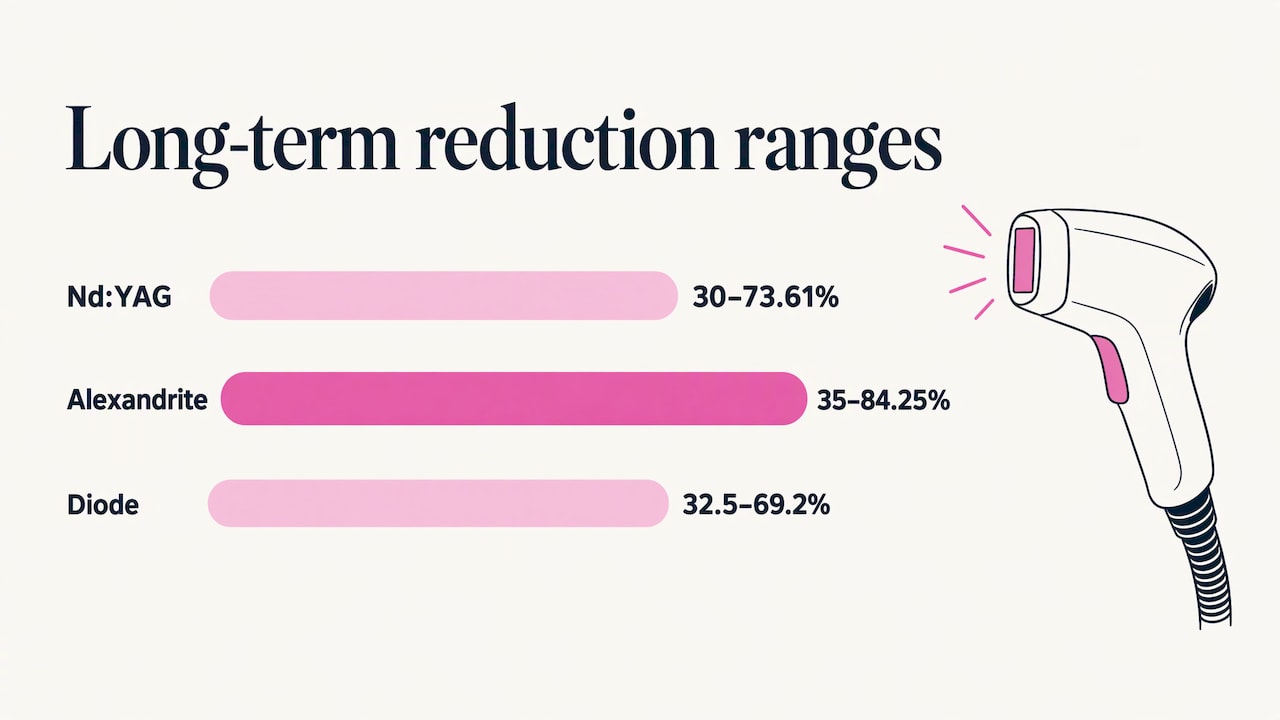
The pooled evidence is less clear-cut. The 2022 review above reported average long-term reduction of 30 to 73.61% for Nd:YAG, 35 to 84.25% for alexandrite and 32.5 to 69.2% for diode. Those ranges overlap heavily. The authors noted that the trials did not show one device to be superior and that none was of high methodological quality. They also found that results were highest on legs, which have a one-year hair growth cycle, and lowest on the face, which has a six-month cycle.
A 2023 network meta-analysis of 13 randomized trials (652 participants) found diode laser significantly lowered hair counts at about three and six months compared with no treatment. It found no significant difference among the laser types. Side effects were transient with no permanent scarring.
Put simply, when the device is matched to the patient and the settings are right, the gap between lasers shrinks.
Skin tone and hair color decide the match
The pigment that lets a laser find the hair is the same pigment that lives in your skin. That is the reason skin tone drives the choice.
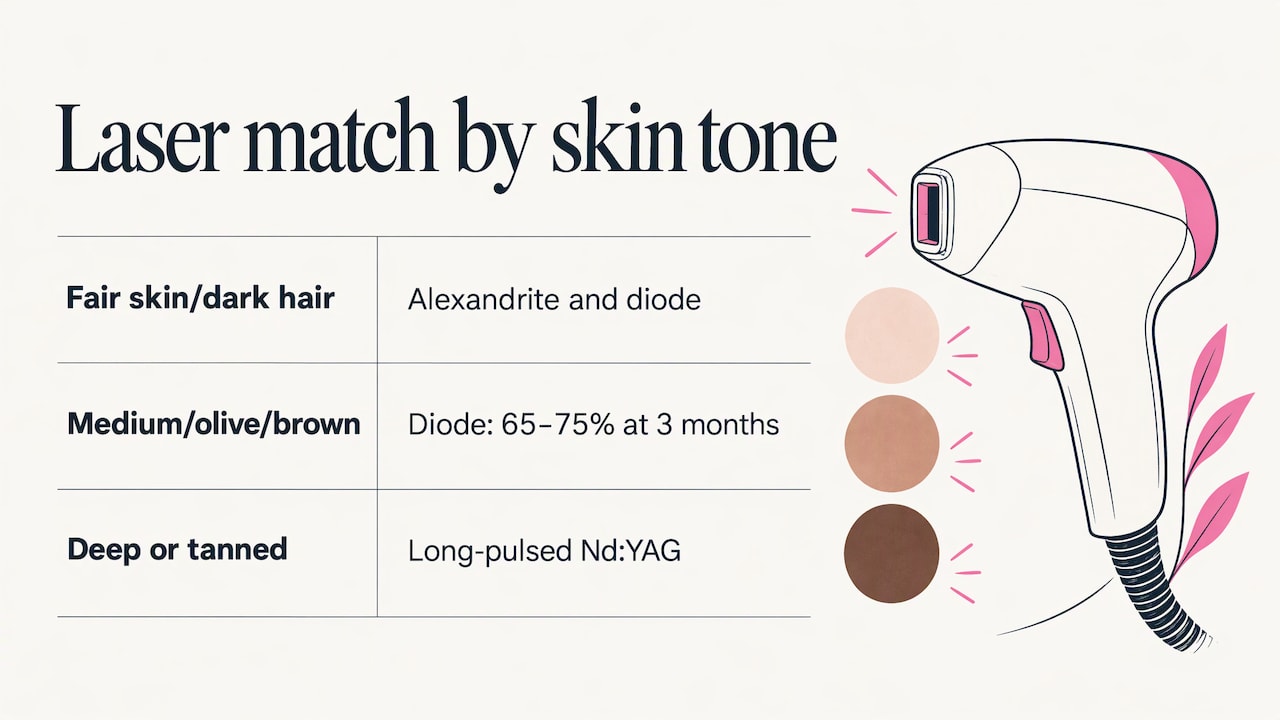
Fair to light-medium skin, dark hair. A professional chapter on laser hair reduction describes the ideal candidate as someone with fair skin and dark, coarse hair. Alexandrite and diode both fit here, and the studies above show them performing well.
Medium to olive or brown skin. A 2020 review in the US National Library of Medicine’s PMC notes that darker skin can be treated more safely with diode because of its longer wavelength, active cooling and longer pulse widths. It reports hair reduction of 65% to 75% at three months after one to two treatments.
Deep skin tones, or a recent tan. The same review says the long-pulsed Nd:YAG remains the recommended choice for very dark and tanned patients. A medical textbook chapter agrees: the longer wavelength and deeper penetration reduce the risk of surface injury when combined with proper cooling. A 2018 review of Fitzpatrick types IV to VI adds that Nd:YAG, diode, alexandrite and certain IPL sources can all reach safe hair reduction when wavelength and energy are chosen well.
If you have a tan or have had recent sun exposure, read our guides on laser hair removal with a tan and laser hair removal and sun exposure before booking. For deeper skin tones, our page on 1064 nm laser hair removal for dark skin explains test pulses and cooling.
Hair color matters as much as skin
No laser can treat what it cannot see. White, gray, blonde and fine vellus hair have little melanin, which is why the same Clinical Gate chapter calls those patients poor candidates for laser hair removal. This holds for diode, alexandrite and Nd:YAG alike.
Comfort and side effects
Every laser hair removal session feels like a snap or sting, and sensations vary by area. The 2010 comparison found less immediate pain with diode than Nd:YAG. A 2026 randomized trial in 48 women comparing IPL with an 810 nm diode found diode pain scores were consistently higher than IPL, with more perifollicular swelling, while IPL caused more redness. Both were well tolerated across skin types I to IV. Comfort therefore depends on the device, the cooling and the body area, not on one wavelength. Our guide to laser hair removal pain covers real sensations and how a clinician can make sessions easier. The medical textbook chapter above adds that many patients benefit from topical numbing cream, particularly in sensitive areas.
Expected, short-lived effects include redness, mild swelling around follicles and itching. Less common effects include blistering and temporary pigment change, and rare ones include scarring or lasting pigment change, according to the 2026 clinical guide. A trained clinician lowers these risks by choosing the right wavelength and settings for your skin. If you take medication that makes skin light-sensitive, get frequent cold sores or have a history of scarring, tell your provider at the consultation.
How many sessions to expect
A single session will not do it. The textbook chapter above says a full course typically takes six to eight treatments and that one treatment yields only minimal improvement. The reason is biology: according to the diode laser guide, only about 15% to 20% of hairs are in the active growth phase at any moment. So sessions are spaced four to eight weeks apart to catch each new wave of hairs, with maintenance later.
For hormone-related growth, such as with PCOS, expect more sessions and medical support. We cover it in laser hair removal for PCOS.
What about IPL?
IPL is a broad-spectrum light, not a laser, and people often lump it in with these devices. A 2019 meta-analysis of 12 trials in skin types III to VI found alexandrite beat IPL for reducing hair count, while Nd:YAG and diode were not statistically different from IPL. Nd:YAG was favored over IPL for avoiding post-inflammatory darkening. The textbook chapter notes IPL can work for lighter skin, types I to III, depending on the filter. If you are curious, see our IPL treatments page.
Which one should you choose?
Use this as a starting point, not a prescription:
- Fair or light skin, dark hair: alexandrite or diode are both well supported by the studies.
- Light brown to olive or medium-brown skin: diode is the common choice for its versatility, cooling and pulse-width control.
- Deep skin or recently tanned: long-pulsed Nd:YAG is the recommended safety-first option.
- Blonde, gray, white or very fine hair: laser hair removal is unlikely to work well whatever the device.
- Large areas such as legs or back: ask about treatment time, since coverage speed varies by device and handpiece.
Two patients can reasonably end up on different lasers, and the same patient can need different settings in summer and winter. The device matters less than whether the operator is trained to match it to you.
Our perspective
Clients often arrive asking for a specific laser by name. We understand why: the marketing is loud. But in our experience the more useful question is what your skin and hair actually need. The research agrees that no single device wins for everyone, and that skin type, wavelength and settings work together.
That is why we start with a free consultation. We look at your skin tone, hair color and the areas you want treated, talk through your history and sun exposure, and build a personalized treatment plan. Our laser hair removal work is built around choosing what is appropriate for you, not what is trendy, and it comes with the clean, comfortable setting we hold ourselves to.
Our team, led by founder Natalie NgocTrang, has completed over 15,000 treatments, and we bring that care to every plan we write.
Chris
Book a free consultation
If you are in Sudbury, MA or the Boston area, we can look at your skin and hair and walk you through your options, with no obligation. Our laser hair removal page explains how the process works, and we offer financing options. Our membership plans are published at $399 (Silver), $499 (Gold) and $599 (Platinum) per year.

If you also want to see our other treatments, browse our full service menu.
FAQ
Is a diode or YAG laser better for dark skin?
Nd:YAG is the traditional recommendation for very dark or tanned skin, since its 1064 nm wavelength is absorbed less by surface pigment. Diode can also treat darker skin, according to a 2020 review, thanks to longer wavelength, active cooling and longer pulse widths. A clinician should choose based on your exact skin type.
Does a YAG laser remove hair?
Yes, but it often needs more energy to heat hair, and in some trials on light skin it removed less hair than diode or alexandrite. Its main advantage is safety on deeper skin tones. As with any laser, expect a course of six to eight sessions.
Which is stronger for hair removal: diode, YAG or alexandrite?
In studies on fair skin, alexandrite has often shown the highest reduction, with diode close behind and Nd:YAG lower. Pooled reviews found overlapping results and no clear winner, so strength depends on matching the laser to your skin and hair.
Is diode less painful than YAG?
One 2010 trial found lower immediate pain with diode than Nd:YAG for underarm hair. Pain depends on the cooling system, body area and your sensitivity, and numbing cream can help.
Is laser hair removal permanent?
It gives long-term reduction, not a guarantee of zero regrowth. Studies report reduction ranges that vary widely by device, body area and patient, and maintenance sessions are common.
Sources
- Efficacy of Laser in Hair Removal: A Network Meta-analysis (2023)
- An efficacy comparison of hair removal utilizing a diode and Nd:YAG laser (2010)
- Efficacy of lasers and light sources in hair removal (2022)
- Prospective, Comparative Evaluation of Three Laser Systems (2005)
- Laser hair removal: comparison of long-pulsed Nd:YAG, alexandrite and diode lasers (2004)
- Laser Treatment in Hirsutism: An Update (2020)
- Laser and Light Treatments for Hair Reduction in Fitzpatrick skin types IV to VI (2018)
- Laser- and Light-Based Approaches to Hair Removal
- Hair Reduction with Lasers
- Laser hair removal guide (2026)
- Diode Laser Hair Removal: 808 nm Devices, Skin Types
- Lasers for reduction of unwanted hair in skin of colour (2019)
- Efficacy and safety of intense pulsed light compared to diode laser (2026)


