

Laser hair removal treats large areas quickly and, for most people with dark hair, gets you to long-lasting smoothness in a handful of sessions. Electrolysis treats one hair at a time with an electric current, takes many more visits, and is the only method the FDA calls permanent. Which one fits you comes down to your hair color, your skin tone, the size of the area and how much time you want to spend.
Below, we compare the two on the things that decide the choice, then look at how both compare with waxing and shaving.
TL;DR
- Laser works on pigment, so it suits dark hair best. Lasers cannot effectively target blonde, white, gray or red hair.
- Electrolysis works on any hair color and skin tone, but it is slow: 12 to 30 sessions over about a year is typical.
- Laser costs more per session and needs fewer sessions. Electrolysis costs less per session and needs many more, so the total depends on the area.
- Neither is covered by insurance, and both beat shaving and waxing for how long results last.
- Not sure where you fall? A free consultation tells you whether laser suits your hair and skin before you commit to anything.
Table of Contents
- How the two methods work
- Which is more permanent?
- Hair color and skin tone decide more than anything
- Cost: per session vs. total
- Pain, side effects and aftercare
- The face: a special case
- Perspective
- How laser and electrolysis compare with waxing and shaving
- How to choose: a quick decision guide
- What to expect from laser at Sudbury Med Spa
- FAQ
- Sources
How the two methods work
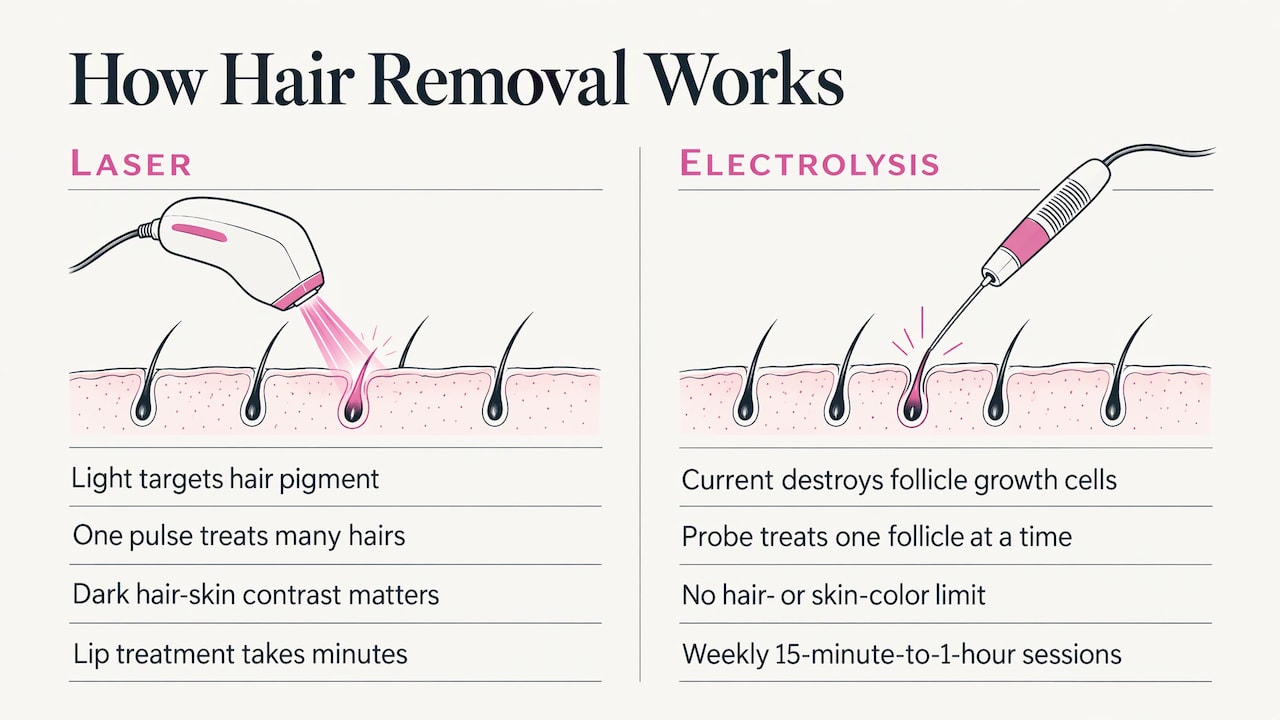
Laser hair removal sends a beam of light into the skin. The pigment in the hair absorbs it, the heat damages the follicle, and the hair stops growing as vigorously. Because the laser looks for dark pigment, the contrast between hair and skin matters a lot. It treats many hairs in a single pulse, so a lip takes minutes and legs or a back take a reasonable appointment.
Electrolysis is done by a licensed electrologist who slides a hair-thin probe into each follicle and delivers a small current to destroy the growth cells. In the US, electrologists are licensed in their state of practice and work independently, and sessions are typically weekly, lasting between 15 minutes and an hour according to the Canadian Dermatology Association. Because it does not rely on pigment, it does not care what color your hair or skin is.
Which is more permanent?
This is the question behind most searches, and the wording matters.
WebMD notes that electrolysis is the only hair removal method the FDA calls permanent. Laser is generally described as long-term reduction. That said, the American Academy of Dermatology says that after six or more treatments to an area, laser hair removal is permanent, except on a woman’s face. The American Academy of Family Physicians reports that laser has shown hair reduction of 40% to 80% depending on the laser type and the number of treatments.
In practice, that means:
- Laser: hair becomes much finer, sparser and slower to return. Some people need occasional maintenance. WebMD says maintenance can range from once or twice a year to every few years.
- Electrolysis: each treated follicle is meant to be finished for good, but you have to treat every follicle, which is why the process is long.
The Canadian Dermatology Association adds that after laser, results can last three to six months or longer before hair visibly grows back, and that a series of six to eight treatments is usually needed for lasting results.
Hair color and skin tone decide more than anything
If you take only one thing from this article, take this. The best method depends on who you are, not on which technology is newer.
Dark hair
Dark, coarse hair is what laser is built for. The AAFP says laser can be up to 60 times faster to perform than electrolysis and is the preferred approach for permanent reduction in most patients. If you have dark hair on the legs, underarms, bikini line, back or chest, laser is usually the efficient route.
Light, gray, red or blonde hair
The AAD is clear that laser will not work on blonde, white, gray or red hair. UCSF’s guidelines likewise say laser is generally ineffective on thin, light, red, blonde or gray hairs. This is a matter of physics, not technique. If most of your hair is light, electrolysis is the method that can reach it. If you have a mix of dark and light hairs, some people use laser for the dark ones and electrolysis for the rest.
Deeper skin tones
People of all skin tones can have laser hair removal safely when the operator is experienced with their skin tone, according to the AAD. The device matters too: UCSF notes that a 1064 nm Nd:YAG wavelength is the only one considered safe for Fitzpatrick skin types 5 or 6. We explain how test pulses and cooling are used in our guide to 1064 nm laser hair removal for dark skin.
Tanned skin
A tan changes how the laser interacts with your skin. The AAD says that if you have a tan, you must wait for it to fade completely before laser hair removal is safe. Read laser hair removal with a tan and laser hair removal and sun exposure before you book a summer series.
Cost: per session vs. total
Neither method is covered by insurance. Healthline describes laser as an optional cosmetic procedure not covered by insurance, and says the same of electrolysis. The sources below are published national figures, not our pricing.
| Laser hair removal | Electrolysis | |
|---|---|---|
| Typical sessions | About 4 to 6, up to 10 for full results | 12 to 30 on average |
| Time to finish | Spaced weeks apart, often several months | Often around a year |
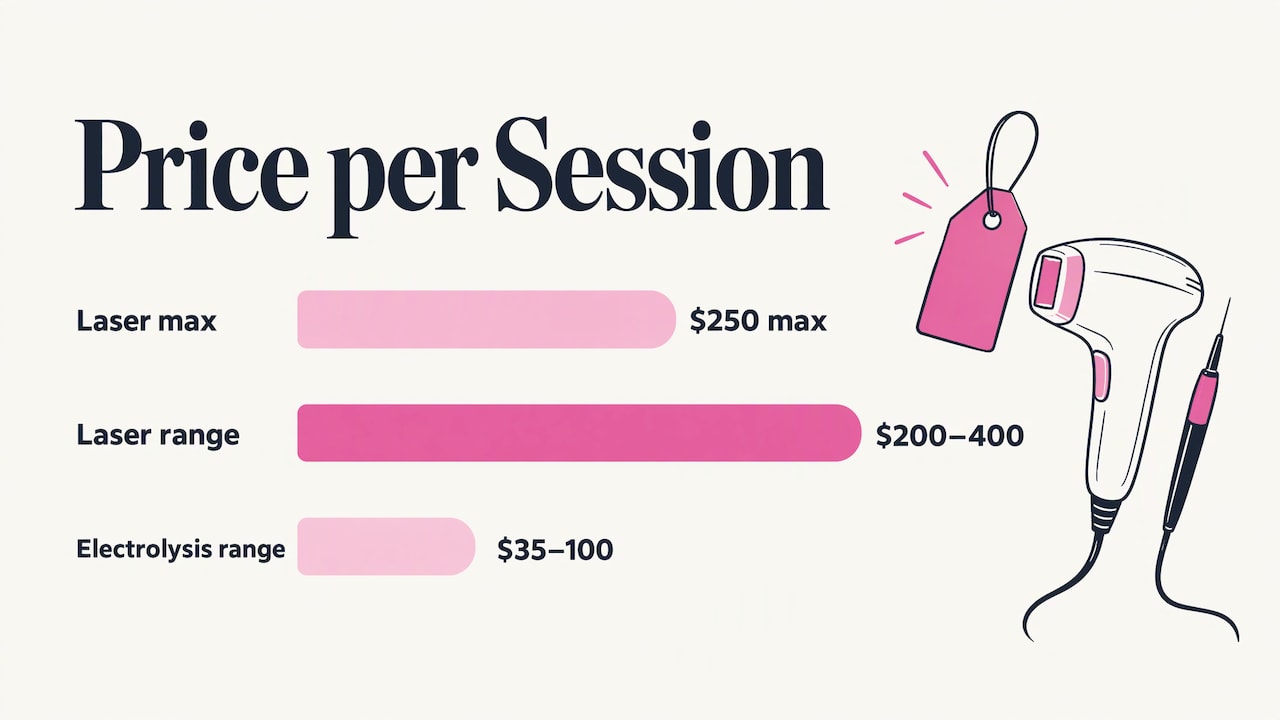
| Price per session | Up to $250; $200 to $400 in another estimate | About $35 to $100 |
| Small area total (face) | Varies with sessions | $100 to $500 |
| Large area total (legs) | Varies with sessions | $2,000 to $10,000 |
The pattern is consistent: individual electrolysis treatments are cheaper but need more of them, while laser costs more per session but needs fewer. On a small area such as the upper lip or chin, the totals can be close. On large areas, laser’s speed is what keeps the total manageable, because electrolysis has to treat follicles individually.
If you want a figure for our own services, our price booklet and a free consultation are the places to look, because the right number of sessions depends on your hair and the area.
Pain, side effects and aftercare
Both methods are uncomfortable, and how much varies a lot from person to person.
Laser. Most people describe a quick snap or sting with each pulse. The most common reactions are swelling and redness that generally resolve within 24 hours. Healthline says skin irritation and redness usually go away after a few hours, and that burns are uncommon. Changes in pigment, lighter or darker patches, can happen and relate to skin color, which is why operator experience and a patch test matter. Our piece on what laser hair removal really feels like has clinician tips for comfort.
Electrolysis. WebMD says it can be painful and takes hours even on small areas overall. Healthline lists skin irritation as the most common effect, with rare but serious outcomes including scarring, infection and keloids, which are more common in darker skin tones. The AFP adds that electrolysis is the least standardized method, regulation varies from state to state, and success depends on the skill of the operator.
Safety notes worth knowing:
- People with pacemakers should not have electrolysis.
- Avoid sun and tanning before and after laser, and let a tan fade fully first.
- Tell your provider about medications, skin conditions and any hormone-related hair growth. For PCOS, see laser hair removal for PCOS.
The face: a special case
Facial hair is where people ask most about this choice. Hair on the face, especially on women, is often finer and can be hormonally driven, so it can return more readily. The AAD’s note that permanence after laser does not extend to a woman’s face reflects that. Expect more sessions and occasional touch-ups on the chin and jawline, and talk to a medical provider if sudden or heavy facial hair growth appears, since it can have a hormonal cause.
For dark facial hair on lighter skin, laser is commonly used because it clears an area like the upper lip quickly. For fine, light or gray facial hair, electrolysis is the approach that can reach it. Many people with mixed hair use a combination, starting with laser to thin the dark hairs and finishing the stragglers another way.
Perspective
Most people who come to us asking about laser versus electrolysis are really asking one question: how do I get smooth skin without spending a year of my life on it?
For dark hair, we believe laser is the practical answer. It covers legs, underarms, bikini lines and backs in appointments that fit into a lunch hour, and it treats many follicles with each pulse. We build a plan around your hair color, skin tone and goals, and we explain what a realistic number of sessions looks like before you begin. Our consultations are free, so you can ask every question first.
What matters most is the operator. Skin tone, recent sun and hair color all change how a laser should be set, so we take the time to assess them before treating. If you have a tan, we will tell you honestly to wait. If you have a concern about ingrown hairs, we will explain what laser can do about them.
Our team has completed over 15,000 treatments across our services, and we bring that same care to every hair removal appointment.
Chris
How laser and electrolysis compare with waxing and shaving
Many people searching for laser also wonder if it is worth the step up from what they already do. Here is the honest comparison.
| Method | How long it lasts | Typical cost | Main drawbacks |
|---|---|---|---|
| Shaving | Days | Very low | Stubble returns quickly, nicks, ingrown hairs |
| Waxing | 2 to 8 weeks | $50 to $70 per appointment, $20 to $30 for at-home kits | Pain, ingrowns, repeat visits forever |
| Laser | Long-term reduction | Higher up front | Series of sessions, needs contrast between hair and skin |
| Electrolysis | Permanent per treated follicle | Lower per session, many sessions | Slow, operator dependent |
Laser vs. waxing
Waxing is the cheaper option in the short term, less expensive than laser or electrolysis, but the results fade within weeks and you repeat it indefinitely. The AFP notes that plucking or waxing is effective but painful and can cause scarring, folliculitis and hyperpigmentation. Healthline lists irritation, ingrown hairs, redness, bumps and sun sensitivity among waxing’s side effects. If you have been waxing for years, laser is the step that can end the cycle. If ingrowns are your main complaint, read laser hair removal for ingrown hairs.
Waxing also has limits on where it is safe: Healthline says not to wax over varicose veins, moles, warts, or chapped or sunburned skin, and avoid the nipples, ears and eyelashes.
Laser vs. shaving
Shaving is free of appointments and cheap, but the hair returns in days, and the blunt regrowth feels like stubble. Laser takes shaving out of the routine for the treated areas. During a laser series, you will typically shave between sessions, since the laser needs short hair at the surface, so you do not need to stop shaving to start.
How to choose: a quick decision guide
Work through these in order.
- What color is your hair? Dark brown or black: laser is likely a good fit. Blonde, red, white or gray: laser will not be effective, and electrolysis is the method that reaches those hairs.
- How big is the area? Large areas such as legs, back, chest and bikini favor laser for speed. Very small areas of fine hair can suit electrolysis.
- What is your skin tone and tan status? Deeper skin tones need the right wavelength and an experienced operator. A tan needs to fade first.
- What is your timeline? Laser sessions are shorter and fewer. Electrolysis commonly runs around a year.
- What is your budget model? Spread cost across fewer, pricier laser visits, or many cheaper electrolysis visits.
- Is there a medical factor? PCOS and other hormonal conditions can mean more sessions and a medical follow-up. A pacemaker rules out electrolysis.
For intimate areas, our comparison of Brazilian and bikini laser hair removal helps you decide what to treat.
What to expect from laser at Sudbury Med Spa
If laser looks like your match, here is how we approach it. You start with a free consultation, where we look at your hair, skin tone and any recent sun exposure, talk through your goals and map out a treatment plan. We offer laser hair removal alongside our other non-invasive services, and we have financing options if you prefer to spread the cost. You can read more on our laser hair removal page, see how treatments are described in unwanted hairs can be zapped in a snap, or explore our membership plans, listed at $399 (Silver), $499 (Gold) and $599 (Platinum) per year.

Ready to find out whether laser suits you? Book a free consultation with Sudbury Med Spa and we will build a plan around your hair and skin.
FAQ
Is laser or electrolysis better?
Neither wins for everyone. Laser is faster and suits dark hair on any area, while electrolysis can treat any hair color and is the only method the FDA calls permanent. If your hair is dark, laser is usually the practical choice. If it is light or gray, electrolysis is the method that reaches it.
Which is cheaper, electrolysis or laser?
Electrolysis costs less per session, around $35 to $100, but needs 12 to 30 sessions. Laser costs more per session but needs fewer. For small areas the totals can be close, and for large areas laser’s speed usually matters more.
Why is electrolysis not as popular as laser?
Mostly because of time. Electrolysis treats one follicle at a time, so even small areas take hours overall, while laser treats many hairs per pulse. Laser also suits the large areas that most people want treated.
Does laser hair removal work on blonde or gray hair?
No. Lasers target pigment, and the AAD says they cannot effectively target light-colored hair. During a free consultation we can look at your hair and tell you whether laser is a fit.
Can I have laser hair removal with dark skin?
Yes, with the right approach. The AAD says people of all skin tones can safely have it when the operator has experience with their skin tone, and UCSF notes that a 1064 nm wavelength is the one considered safe for the deepest skin types.
Sources
- Hair Removal Options: Which Ones Are Permanent? (Healthline)
- Laser Hair Removal vs. Electrolysis: What’s the Difference? (Healthline)
- Waxing vs. Shaving: 16 Things to Know (Healthline)
- Electrolysis vs. Laser Hair Removal: The Pros and Cons (Byrdie)
- Electrolysis vs. Laser Hair Removal: Which Treatment Works Best (Allure)
- What’s the Best Way to Remove Unwanted Hair? (WebMD)
- 6 ways to remove unwanted hair (American Academy of Dermatology)
- Hirsutism in Women (American Family Physician, 2019)
- Removal of Unwanted Facial Hair (American Family Physician, 2002)
- Hair removal (UCSF Gender Affirming Health Program)
- Hair Removal & Reduction (Canadian Dermatology Association)


