
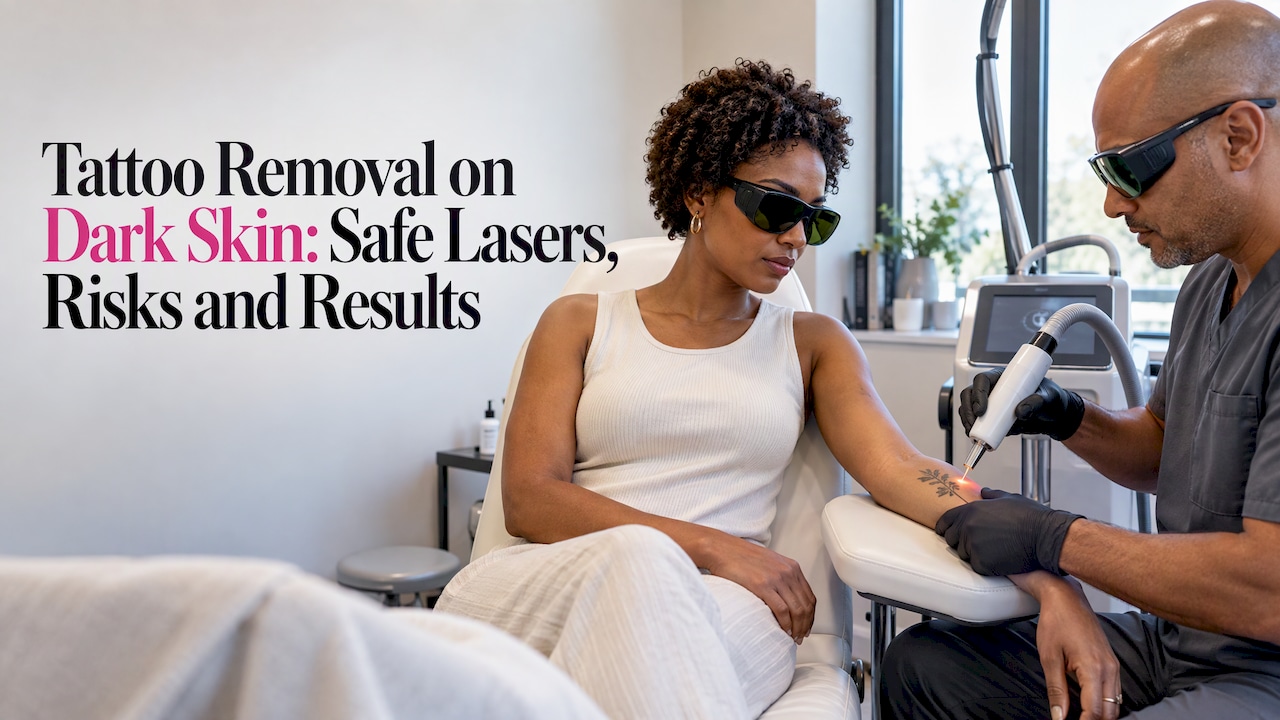

Yes, tattoos can be removed from dark skin. The safest approach pairs a longer-wavelength laser (the 1064 nm Nd:YAG family) with conservative energy, a test spot, generous spacing between sessions and strict sun protection. The risk is not that removal fails. The risk is pigment change in the surrounding skin when the wrong device or settings are used, which is why who treats you matters as much as which laser is used.
This guide explains why dark skin needs a different plan, which lasers suit it, how ink color changes the outlook, how many sessions to expect and how to heal. We are Sudbury Med Spa, and we offer laser tattoo removal with free consultations, so you can talk through your own skin and tattoo before committing to anything.
TL;DR
- Longer wavelengths, especially 1064 nm Nd:YAG, pass through epidermal melanin and target ink deeper in the skin, which is why they are the standard choice for darker skin types.
- Light or dark patches can follow treatment. The AAD says these tend to fade within 6 to 12 months, and careful settings plus sun protection lower the odds.
- Expect more sessions, spaced further apart, than the fast timelines you see online: roughly 8 to 12 weeks between visits for darker skin.
- Intense pulsed light (IPL) is not a tattoo removal tool, and no single laser clears every ink color.
- Choose a provider with real laser training and experience with your skin tone, and follow aftercare to the letter.
Table of Contents
- Why dark skin changes the plan
- Which lasers are safest for darker skin
- Ink color matters as much as skin tone
- The risks, stated plainly
- What a dark-skin-safe treatment plan looks like
- How many sessions to expect
- Choosing who treats you
- Healing well after each session
- Our perspective
- Ready to plan your removal?
- FAQ
- Sources
Why dark skin changes the plan
A tattoo sits in the dermis, below the surface layer of skin. A laser fires a very short pulse that shatters the ink into particles, and your body then clears those particles away. The AAD explains that the body, not the laser, eliminates the ink by flushing out those tiny fragments, and that redness, swelling and a little blistering after a session can be normal.
The complication on darker skin is melanin. The epidermis of a darker skin type holds more of it, and melanin absorbs laser light too. If the wavelength is absorbed by that pigment, the energy that should reach the ink is partly spent on the skin above it. That can cause burns, scarring, or changes in skin color.
The literature is direct about this. A clinical update on laser tattoo removal notes that people with darker skin have a higher risk of complications, including scarring and hyper- or hypopigmentation. Clinical teaching texts add that Fitzpatrick skin types IV to VI are at increased risk of postinflammatory dyspigmentation, and that lower fluences and longer wavelengths are preferred to reduce the risk of both lightening and darkening.
None of that means you should give up on removal. It means the treatment has to be planned around your skin rather than copied from a standard protocol.
Which lasers are safest for darker skin
The core principle is wavelength. The same clinical update explains that the longer 1064 nm wavelength of the Q-switched Nd:YAG laser is minimally absorbed by epidermal melanin and penetrates more than 2 mm into the skin, which makes it well suited to tattoo pigment in darker skin types with heavy epidermal melanin.
Other research points the same way:
- A case series on Nd:YAG tattoo removal in darker skin types found the 1064 nm Q-switched laser safe for these skin types, because the longer wavelength reaches the dermis and acts on dark pigment while sparing the melanocytes and keratinocytes in the epidermis.
- A review of laser optimization calls the 1064 nm Q-switched Nd:YAG the workhorse laser for blue-black pigment in darker skin types, since its wavelength is less competitively absorbed by melanin and causes fewer pigment changes.
- In a case series of 25 patients with Fitzpatrick type VI skin and 45 facial tattoos, Q-switched 1064 nm treatment produced an average clearance of 95% with minimal pigmentary and textural change.
The same clinical update notes that the Q-switched ruby laser tends to be associated with hypopigmentation in dark-skinned people. That is a good reason to ask about wavelength before you book, not after.
Nanosecond versus picosecond
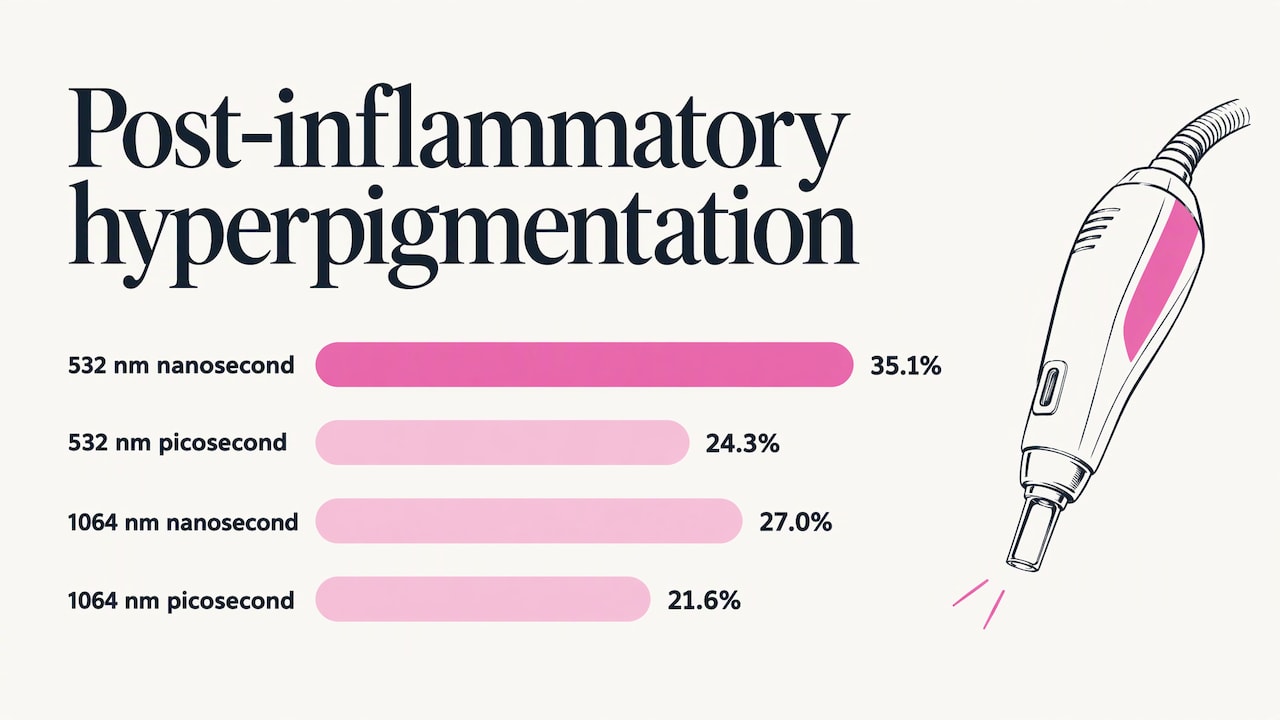
Picosecond lasers deliver even shorter pulses. In a prospective comparison of 532 and 1064 nm lasers, mild to moderate post-inflammatory hyperpigmentation appeared in 35.1% of tattoos treated with the 532 nm nanosecond laser, 24.3% with the 532 nm picosecond, 27.0% with the 1064 nm nanosecond and 21.6% with the 1064 nm picosecond. Paradoxical darkening (5.4%) occurred equally across all four. Two takeaways: the 1064 nm wavelength had lower rates than 532 nm, and the 1064 nm picosecond had the lowest rate of the group.
If you are weighing device types, our guide to PicoWay versus PicoSure walks through how picosecond platforms differ. Your consultation is where the choice gets matched to your skin and your ink.
Ink color matters as much as skin tone
Black and dark blue ink absorb the 1064 nm wavelength well, which is exactly why the safest laser for dark skin is also an effective one for the most common tattoo colors.
Color is where expectations need adjusting. The AAD states that a single laser cannot remove all ink colors, and that because artists layer ink, a laser cannot safely break down all the layers in one session. Red, green and other bright inks often respond to shorter wavelengths such as 532 nm, and those wavelengths are absorbed more readily by melanin. On darker skin, that makes a color tattoo a more careful, slower job and sometimes one where complete clearance is not realistic. A provider who tells you this honestly at the start is doing you a favor.
What about IPL?
Do not use IPL for tattoos. A 2024 review of laser therapies for dermal pigmentation notes that the German Dermatological Society consensus recommends picosecond or nanosecond Q-switched pigment and vascular lasers (Nd:YAG, ruby, alexandrite, KTP) and advises against IPL for all types of tattoos. IPL uses broad-spectrum light, which is also more readily absorbed by epidermal melanin.
The risks, stated plainly
The goal here is to treat safely, so it helps to know what a careful plan is guarding against.
Hyperpigmentation (dark patches). In a literature review covering a case series of 11 patients with Fitzpatrick types IV to VI treated with a Q-switched 1064 nm Nd:YAG, post-inflammatory hyperpigmentation developed in 73% of patients. It was manageable with topical hydroquinone and diligent photoprotection, and resolved completely in every case within 6 to 12 months (Lee et al., JCRM).
Hypopigmentation (light patches). The same review reports it in 27% of those patients, persisting beyond 12 months in two cases. That is why conservative settings and a test spot are standard recommendations, not extras.
Scarring and keloids. The review summarizes expert consensus recommendations stating that types IV to VI face substantially elevated risks of pigmentary change and keloid formation. If you have ever formed a keloid, tell your provider at the first consultation.
Normal reactions. Almost everyone reacts. In an online questionnaire cited in the clinical update, local reactions occurred in 97% of 157 participants, and only 38% reported complete removal. Redness, swelling and some blistering are expected. The AAD adds that some people develop light or dark spots, and these tend to disappear within 6 to 12 months.
The best way to lower these numbers is a plan built for your skin type, which the next section covers.
What a dark-skin-safe treatment plan looks like
The consensus recommendations summarized in the JCRM review are a useful template for what careful treatment involves for Fitzpatrick IV to VI skin:
- A test spot first. A small area is treated and observed before the full tattoo.
- Conservative starting energy. The review cites initial fluences of 50 to 70% of standard settings.
- Longer gaps between sessions. The review cites a 10 to 12 week minimum in the expert recommendations, and another passage in the same review recommends 8 to 10 weeks minimum. Either way, think in terms of roughly two to three months, not monthly visits.
- Consideration of pre-treatment with a depigmenting agent. Teaching texts describe hydroquinone 4% cream for one month before treatment, stopped one week before the laser, and short courses of topical corticosteroid for three to four days afterward to help prevent pigment change. These are medical decisions to make with your clinician, not products to start on your own.
- Sun avoidance throughout. A tan or fresh sun exposure raises the amount of melanin in the skin, which is the very thing you are trying to work around. We cover the same principle in our guides to laser hair removal on dark skin and sun exposure and lasers.
Because of the longer gaps, dark-skin tattoo removal is a marathon. That patience is what protects your skin tone.
How many sessions to expect
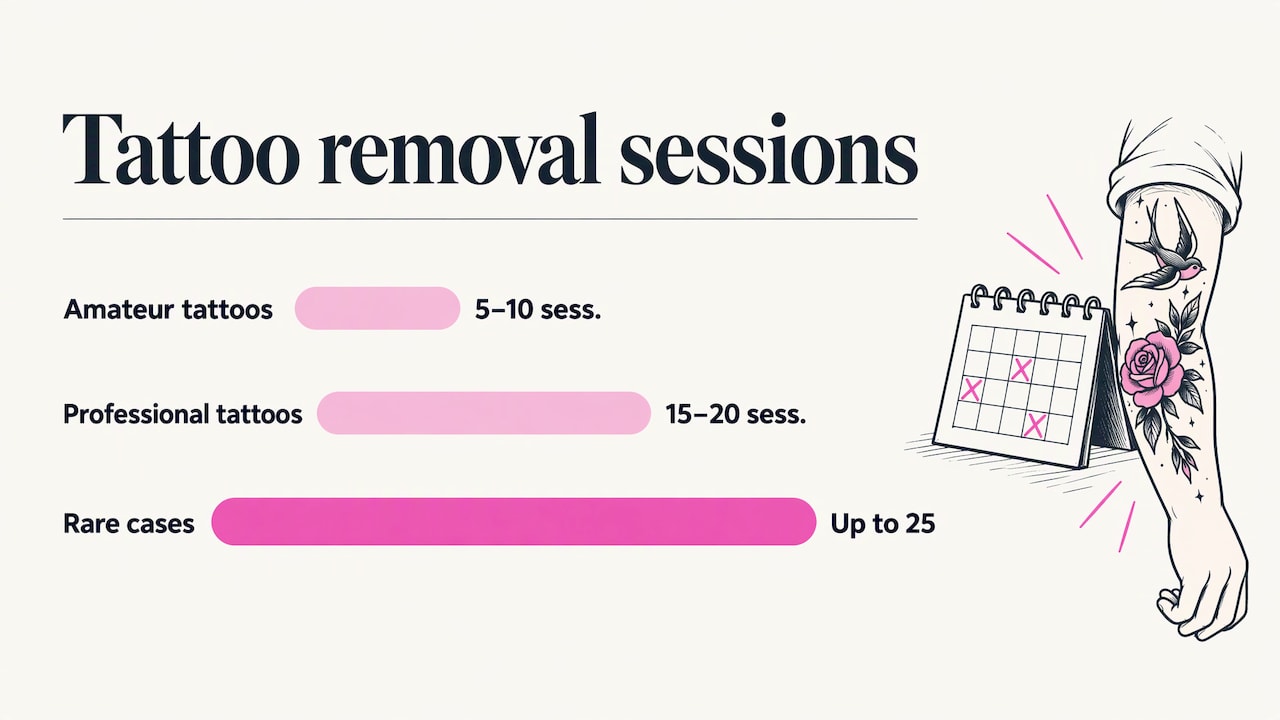
The honest answer is more than most people hope. A review by Sardana and colleagues states that 5 to 10 sessions are standard for amateur tattoos and 15 to 20 for professional tattoos, and up to 25 in rare cases. Add the 8 to 12 week spacing recommended for darker skin and a professional tattoo can be a multi-year project.
What moves the number up or down:
| Factor | Fewer sessions | More sessions |
|---|---|---|
| Ink | Black or dark blue | Bright colors, layered inks |
| Tattoo type | Amateur or hand-poked | Professional, dense, saturated |
| Spacing | Fully healed between visits | Rushed visits, irritated skin |
| Skin care | Strict sun protection | Tanning or sun exposure |
| Your health and history | Typical healing | Past keloids or slow healing |
For a bigger-picture look at what laser removal can and cannot do, see does laser tattoo removal work and our overview of why laser is the preferred method.
Choosing who treats you
This decision carries more weight than any device specification. The AAD says that when someone without medical training performs laser tattoo removal, scarring, texture changes and burns are more common. Its guidance, shared through Dr. Marie Leger, is to make sure the person treating you is extremely skilled with lasers and has in-depth knowledge of the skin.
At a consultation, good questions to bring are:
- Which wavelength will be used on my skin, and why?
- Will you treat a test spot before the full tattoo?
- How much experience does the team have with my skin tone?
- What cooling and pre- and post-treatment steps will you use to protect against pigment change?
- How many sessions and what spacing do you expect for this ink?
A confident, specific answer to each is what a careful provider gives. Our consultations are free, and they are built for exactly this kind of conversation.
Healing well after each session
Aftercare is where you directly influence the result, especially on skin prone to pigment change. The AAD’s aftercare guidance recommends:
- Wash the treated area twice a day with water and a gentle cleanser.
- Apply petroleum jelly.
- Cover it with a dressing until it heals.
- Keep it out of direct sun, then use broad-spectrum sunscreen of SPF 30 or higher once healed.
- Do not pick at blisters or scabs.
That comes from the AAD’s post-removal care advice, which also says to contact a dermatologist if you notice increasing redness and pain, swelling or pus. Picking and infection are two of the quickest routes to scarring and uneven color, so treat those warning signs as a reason to call right away.
We lay out the full healing timeline in our tattoo removal aftercare guide.
Our perspective
Most of the people who ask us about tattoo removal on dark skin have already been told, somewhere, that it is risky or that it will not work. What we tell them is simpler: it is a matter of planning. The wavelength, the energy, the spacing and the sun habits all have to be set around your skin, not around a template.
That is why we start with a free consultation and a personalized treatment plan rather than a quote over the phone. We look at the ink, the color, the age of the tattoo, your skin history and your goals, then map out a realistic number of sessions. Our team has completed more than 15,000 treatments, and our approach is built on patience and individualized care.
If you have a tattoo you want gone, or one you want lighter before a cover-up, bring it in. We would rather spend an hour on a thoughtful plan than rush a session.
Chris
Ready to plan your removal?
If you are in Sudbury or the surrounding Massachusetts area, book a free consultation for laser tattoo removal. We will review your tattoo and skin, explain the approach we recommend and talk through the session schedule. Financing options are available if you want to spread the cost of a longer series.

If the tattoo you want to change is permanent brow pigment rather than body ink, read our note on microblading removal first, because the approach is different. You can also see everything we offer on our services page.
FAQ
How many sessions does it take to remove a dark tattoo on dark skin?
Black and dark blue ink usually respond best, and amateur tattoos often need 5 to 10 sessions while professional ones can need 15 to 20, according to published review data. On darker skin the visits are spaced further apart, so the calendar time is longer. A consultation can give you an estimate based on your actual tattoo.
Will laser tattoo removal leave light or dark patches?
Some people develop them. The AAD notes that these spots tend to disappear within 6 to 12 months. Conservative settings, longer intervals and consistent sunscreen use all help lower the chance, and a clinician can advise on topical options if pigment changes appear.
Does IPL remove tattoos on dark skin?
No. Dermatology consensus advises against IPL for all tattoo types and recommends pigment-targeting Q-switched lasers instead. On darker skin, IPL light is also more likely to be absorbed by surface melanin.
Can red or colored tattoos be removed from dark skin?
Often partly, sometimes fully, but it is slower. The AAD says no single laser removes every ink color, and the wavelengths that target reds and greens are more easily absorbed by melanin. A realistic plan for a color tattoo should be set at a consultation.
Does tattoo removal on dark skin hurt more?
The sources we reviewed do not compare pain by skin tone. Most people describe each pulse as a sharp snap, and cooling and numbing options can help. Ask your provider what comfort measures they use.
Sources
- AAD: Tattoo removal, lasers outshine other methods
- Laser Tattoo Removal: A Clinical Update (PMC)
- Nd:YAG Laser Tattoo Removal in Individuals With Darker Skin Types (PMC)
- Laser Treatment of Pigmented Lesions and Tattoos (Clinical Tree)
- Q-Switched Nd:YAG Laser Removal of Facial Amateur Tattoos (Medscape)
- Optimising Laser Tattoo Removal (PMC)
- Prospective Comparison Study of 532/1064 nm Picosecond and Nanosecond Lasers (PMC)
- Laser Tattoo Removal: An Update and Literature Review (JCRM)
- Advancements in Laser Therapies for Dermal Pigmentation (PMC)
- AAD: How to care for your skin after tattoo removal


