
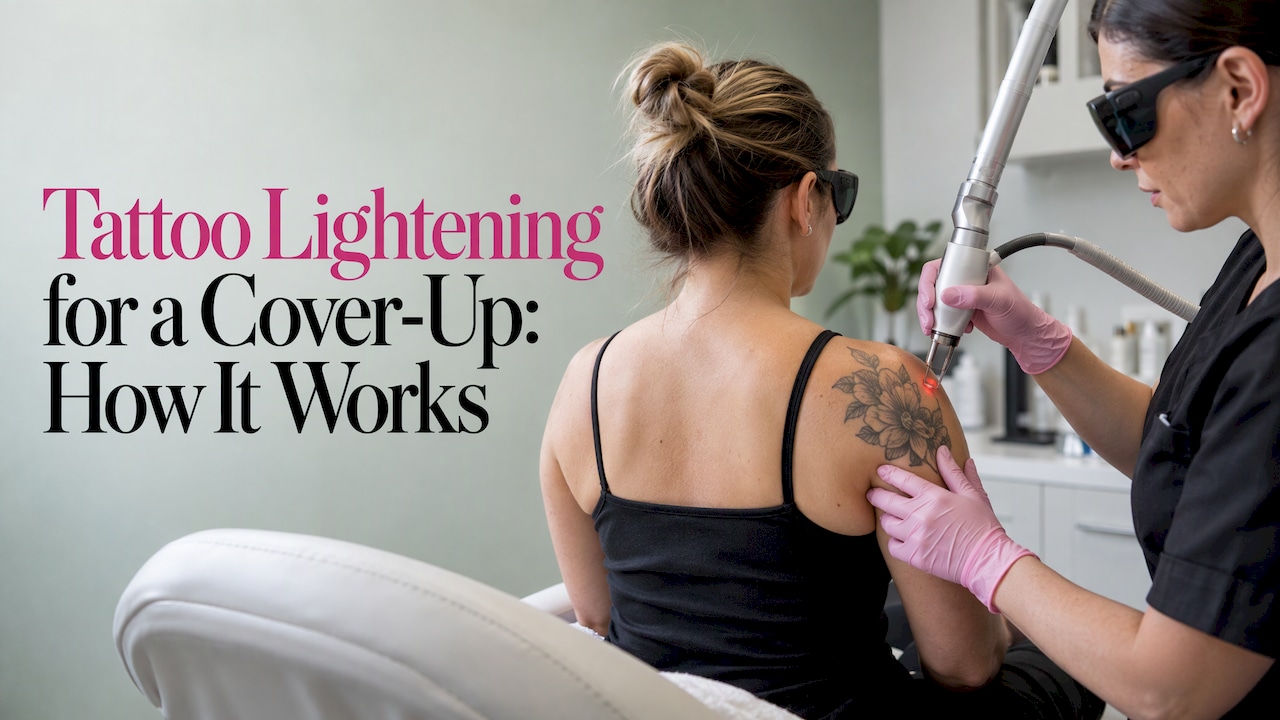

Tattoo lightening for a cover-up means using a few laser sessions to fade old ink, not erase it, so your artist has a lighter canvas and more design freedom. How many sessions you need depends on your ink, your skin and your cover-up plan. Your artist and your laser provider should decide it together, before you book either one.
Below you will find how lightening works, when you need it and when you don’t, what slows it down, what to expect while you heal and how to line up the timing with your tattoo artist.
TL;DR
- Lightening is partial fading with a laser. The goal is less contrast and ink density, not a blank patch of skin.
- Many dark tattoos can be covered with no laser at all, but the new design must be planned around the old one, and that usually means darker, heavier work.
- Session counts vary widely. Published ranges run from a handful to 10 or more, spaced about six to eight weeks apart.
- Protect the skin from the sun and follow aftercare closely. Skin that heals well gives your artist a better surface.
- Talk to your cover-up artist first, then have a laser consultation with their goals in hand.
Table of Contents
- What tattoo lightening actually does
- Do you need lightening at all?
- How many laser sessions to expect
- What changes how much a tattoo lightens
- What the process looks like
- Healing between sessions
- Lightening versus covering: how to choose
- Questions to ask before you start
- Our perspective
- Plan your lightening with Sudbury Med Spa
- FAQ
- Sources
What tattoo lightening actually does
A tattoo laser sends energy into the skin that shatters tattoo ink into small particles, which your immune system then clears over time. Each treatment removes some pigment, and the tattoo gets lighter after each one.
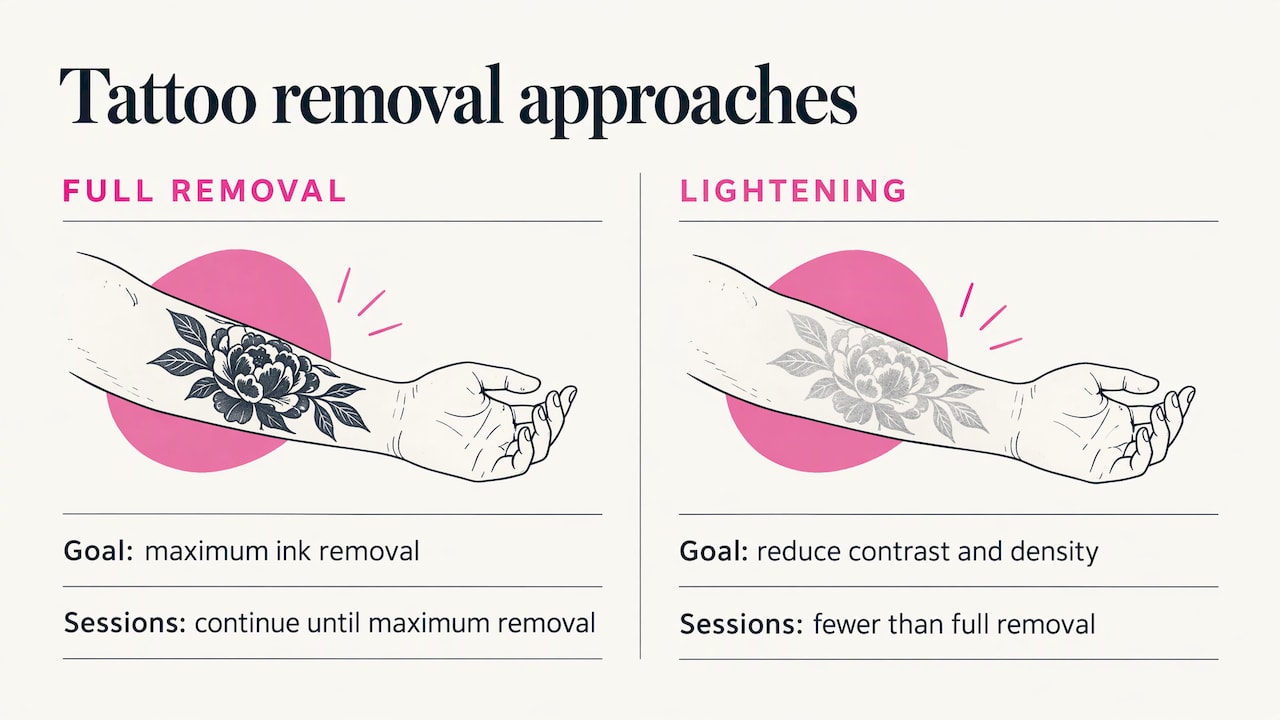
Full removal keeps going until as much ink as possible is gone. Lightening stops early. Lightening is a partial-fading approach with fewer sessions than full removal, aimed at reducing contrast and ink density so a new tattoo over the old one looks cleaner. An artist may suggest it when the existing piece is too dark, too large or too dense for a clean cover-up.
Think of it as giving your artist options. A heavily saturated black piece forces a cover-up to be dark and bold. A faded one lets the artist use more detail, brighter colors or finer line work.
Do you need lightening at all?
Not always. Many dark tattoos can be covered without lasers, but the design, size, composition and placement of dark areas have to be planned around the old tattoo. A direct cover-up is a real option when you are happy with a dark, dense replacement.
Color choice matters too. Tattoodo’s guide says black, dark blue, purple, deep green and brown cover well, while pastels won’t hide dark ink. It also notes that artists who work in traditional, Japanese and blackwork styles usually take on the most cover-ups.
Lightening tends to earn its cost in these situations:
- You want a lighter or more detailed design than a dark cover-up allows.
- The old tattoo is large, very dark or has thick, solid blocks of black.
- The old piece has crisp outlines that would show through a delicate new design.
- The tattoo sits in a place where raised or scarred ink would be hard to hide.
The cleanest way to decide is to bring the old tattoo to a cover-up specialist and ask what they could do with it today, and what they could do if it were 50 percent lighter. Then you know what the laser is buying you.
How many laser sessions to expect
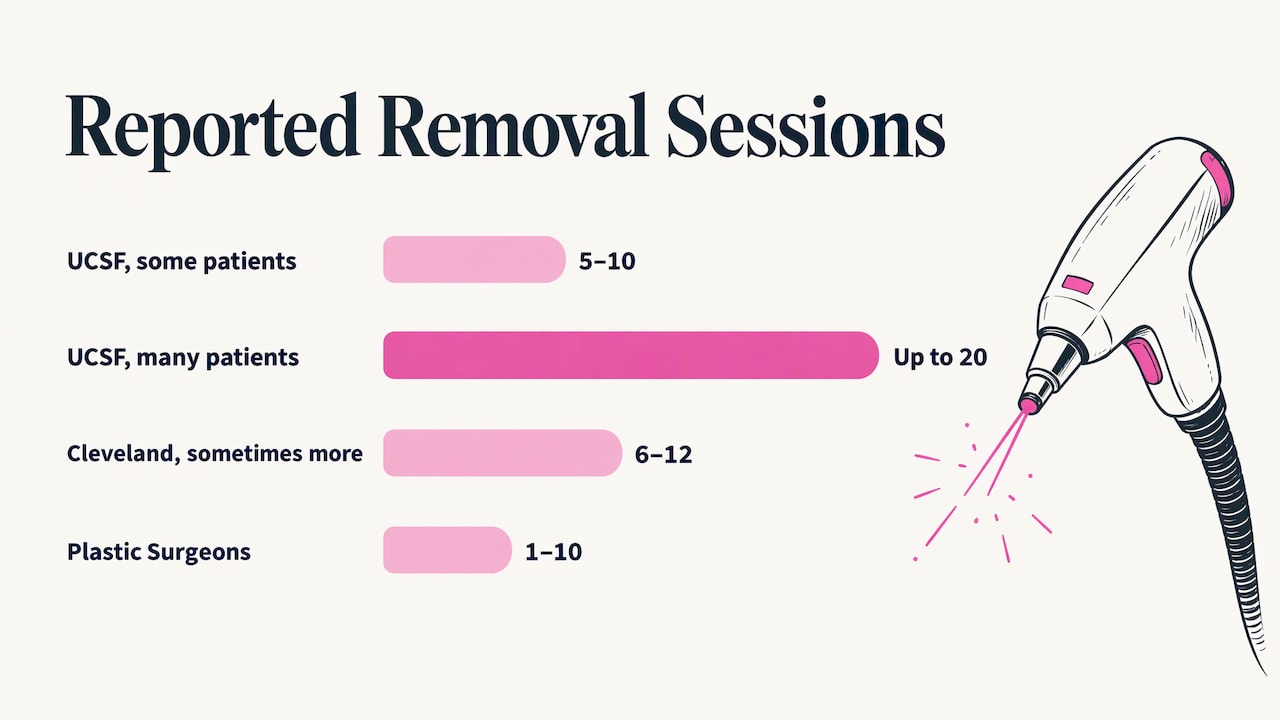
There is no single number, and honest sources say so. Here is what established medical sources report for tattoo removal in general. Lightening for a cover-up is usually a portion of these figures, but no one can promise a count before they see your tattoo.
| Source | Reported sessions | Spacing |
|---|---|---|
| UCSF Health | Five to 10 for some patients, up to 20 for many | Typically six to eight weeks |
| Cleveland Clinic | Six to 12 visits, sometimes more | Time between sessions to flush ink |
| American Society of Plastic Surgeons | 1 to 10 depending on design, size and color | About six weeks |
Why so many visits? A laser cannot safely break down all the layers of ink in one session, and the skin needs time to heal and the body needs time to flush the shattered particles.
For lightening, clinics often quote shorter courses than for removal. Those quotes are a planning guide, not a guarantee, and there is no validated clinical threshold for exactly how light is light enough. That is why the right target is set with your artist, who knows what the new design needs, rather than by a session count alone.
What changes how much a tattoo lightens
Two people with the same tattoo can see different results. These are the main variables.
Ink color
The FDA says green, red and yellow are the hardest colors to remove, while dark blue and black are the easiest. Because different colors absorb different wavelengths, a multicolored piece may need more than one laser. Mayo Clinic makes the same point: multicolored tattoos might need various lasers and different wavelengths.
A special note for white ink, flesh-toned ink and permanent makeup. The FDA warns these are tricky because the pigment can oxidize and turn black when treated by laser. If any part of your tattoo is one of these, mention it at your consultation so the provider can plan for it.
Size, location, age and ink load
UCSF Health says session numbers depend on tattoo size, color, location, age and the amount of ink in the skin, and that bright, multicolored tattoos are the most difficult and frequently need the most sessions.
Laser type and skin tone
Mayo Clinic says Q-switched lasers are often the treatment of choice and that a Q-switched Nd:YAG laser might be used on darker skin to avoid permanently changing skin pigment. A 2020 systematic review in the Journal of the American Academy of Dermatology found Q-switched Nd:YAG lasers safe and effective, with picosecond lasers showing an edge on blue, green and yellow pigments. Both worked well on black ink.
In plain terms, the right device depends on your ink colors and your skin. It is a question to bring to a laser consultation, not something to decide from an article.
What the process looks like
- Sketch the plan with your artist. Show them the current tattoo and ask how light it needs to be for the design you want.
- Book a laser consultation. Bring photos of the cover-up idea. Tell the provider the tattoo is being faded for a cover-up, not removed, so they can pace treatment.
- Treat, then rest. Sessions are generally spaced weeks apart so the skin can heal. Mayo Clinic notes the skin is numbed with a local anesthetic injection before treatment, and your provider will go over comfort options.
- Check progress with the artist. After a few sessions, send the artist a photo or visit them. They can tell you whether the canvas is ready.
- Wait for the skin to settle. Many artists want several weeks after the last laser session before they tattoo. Some prefer longer. Their word is the one that counts, since they are the one working on your skin.
- Get the cover-up. Keep following sun protection and moisturizing habits afterward.
If you want a closer look at how we approach laser work, our page on laser tattoo removal in Boston, MA explains the treatment, and our article on whether laser tattoo removal works covers realistic expectations.
Healing between sessions
How your skin heals between sessions affects how smoothly the cover-up goes. Treated skin can show redness, swelling and a little blistering, and the AAD advises following your dermatologist’s at-home care instructions, which may include washing the area and applying antibiotic ointment.
Cleveland Clinic adds that you can use an ice pack to soothe the area, apply a topical antibiotic if advised, cover the site with a bandage and wear sunscreen outdoors. Follow the instructions your own provider gives you. If you notice signs of infection, such as increasing pain, pus or spreading redness, contact your provider or doctor promptly.
Sun protection deserves its own mention. The AAD says to protect treated skin from the sun for three months. Choosing a reliable sun care product for treated skin and covering up with clothing both help. For our full routine, see our tattoo removal aftercare guide.
Risks to know about
The FDA lists the possible risks: skin that ends up lighter than the surrounding skin, scarring, infection, pinpoint bleeding, redness or soreness. The short-term ones should not last long. Complete removal can also be impossible in some cases, which is one reason lightening for a cover-up is a sensible goal: you are asking for less, not for perfection. Cleveland Clinic notes that some colors resist treatment and some pigment sits too deep for lasers to reach.
Skip creams and kits. The FDA says it has not approved tattoo removal ointments, creams or do-it-yourself kits, that their ingredients may cause rashes, burns or scars, and that they cannot reach the pigment deeper in the skin.
Lightening versus covering: how to choose
Use these questions to decide.
| Question | Points toward a direct cover-up | Points toward lightening first |
|---|---|---|
| What look do you want? | Dark, bold, dense | Lighter, detailed or colorful |
| How dark is the old tattoo? | Faded or medium | Solid black, thick lines |
| How large is it? | Small to medium | Large, with lots of ink |
| How patient are you? | Want to start soon | Fine with months of sessions |
| What does your artist say? | Confident it will work | Recommends a lighter canvas |
There is no shame in either route. A skilled artist might tell you a direct cover-up will deliver exactly what you want. Another may ask for a few laser sessions first. Hearing both opinions is worth the time.
Questions to ask before you start
Bring these to your artist:
- What would the cover-up look like today, and what would change if the old tattoo were lighter?
- How light does it need to be, and can you show me a reference photo?
- How long after my final laser session do you want me to wait?
- Do you want to see the skin partway through?
And to your laser provider:
- Which laser or lasers would you use for my ink colors and skin tone?
- Does my tattoo have white, flesh-toned or other ink that could darken?
- How many sessions do you expect before we check in, and how far apart?
- What aftercare do you want me to follow?
Our perspective
Most of the people who come to us for lightening aren’t trying to erase a chapter of their lives. They want a better version of it. They already have an artist in mind and a design they love, and the old tattoo is the obstacle.
That’s why we start from the end goal. We want to know what your artist plans to do, how light the canvas needs to be and how soon you’d like to start. Then we build a treatment plan around that, rather than around a one-size-fits-all session count.
Our team has completed more than 15,000 treatments, and we lean on that experience to keep each plan personal. We offer free consultations, so you can walk in with your tattoo, your artist’s notes and your questions, and leave knowing what to expect. We also keep a clean, comfortable treatment environment because we want you to feel at ease from the first visit.
Lightening works best as teamwork between you, your laser provider and your artist. When all three are on the same page, the cover-up tends to look the way you imagined.
Chris
Plan your lightening with Sudbury Med Spa
If you are in Sudbury or the surrounding Massachusetts area, we can look at your tattoo, talk through your cover-up plan and explain what laser lightening would involve. Consultations are free, and financing options are available. We do not publish a price for laser tattoo removal, so the consultation is where you will get a plan and a number that fit your tattoo.

Start with our laser tattoo removal page or see everything we offer on our services page. If you want ongoing care for your skin, our membership plans are listed at $399 (Silver), $499 (Gold) and $599 (Platinum) per year.
FAQ
Can I lighten a tattoo with white ink instead of a laser?
Some artists use white ink or heavy coverage as part of a cover-up, and the result depends on the old tattoo and the design. Ask your artist to show you healed examples of similar work. Be careful with white ink if you ever plan laser treatment later, since the FDA notes white pigment can turn black under a laser.
How many sessions does it take to lighten a tattoo for a cover-up?
It varies. Medical sources report removal courses from a handful of sessions to 10 or more, spaced roughly six to eight weeks apart, and lightening usually needs fewer than full removal. Your provider can give a better estimate after seeing your tattoo’s colors, size and depth.
How can I lighten my tattoo at home?
There is no safe way. The FDA has not approved removal creams or home kits, and warns that they may cause rashes, burns or scars without reaching deeper pigment. Professional laser treatment is the route to ask about.
Is it better to cover up a tattoo or remove it?
It depends on what you want. If you like the idea of a new design over the old one, a cover-up, with or without lightening, fits. If you want the skin as clear as possible, removal is the goal, though it can take many treatments and may not be complete.
What should I do if my skin is red or blistered after a session?
Mild redness, swelling and a little blistering can happen, and your provider’s aftercare instructions come first. Keep the area clean, protected and out of the sun. Call your provider or doctor if you see signs of infection such as worsening pain, pus or spreading redness.
Sources
- Tattoo Removal: Options and Results (FDA)
- Laser Tattoo Removal (UCSF Health)
- Tattoo Removal: How It Works, Process, Healing and Scarring (Cleveland Clinic)
- Tattoo removal: Lasers outshine other methods (American Academy of Dermatology)
- Tattoo Removal (American Society of Plastic Surgeons)
- Tattoo removal (Mayo Clinic)
- Comparing the efficacy and safety of laser treatments (Journal of the American Academy of Dermatology)
- Tattoo Cover-Ups: How to Cover Up a Tattoo (Tattoodo)
- Can a Dark Tattoo Be Covered Without Laser Removal?
- Tattoo Removal vs Tattoo Lightening: What’s the Difference


