

PRP (platelet-rich plasma) may be a useful part of a plan for traction alopecia, but only after the pulling stops and only while the follicles are still alive. Early traction hair loss often grows back once tension is removed. Once the scalp has scarred, no treatment is expected to bring those follicles back. PRP is not FDA approved for hair growth, so the most useful step is an exam that tells you which stage you are in.
TL;DR
- Removing the tension (tight braids, weaves, ponytails, extensions) is the first treatment. Nothing replaces it.
- Most early traction alopecia can reverse, while long-standing cases can turn into permanent scarring, according to a 2018 review.
- PRP has the most research behind it in pattern hair loss. For traction alopecia the published evidence is thinner, so it is best used as support for follicles that are still viable.
- A typical starting protocol is three sessions spaced one to two months apart, with maintenance after that. Two sessions are usually a starting point, not a full course.
- Side effects are usually short-lived: tenderness, swelling and redness that settle within about a day.
Table of Contents
- What traction alopecia is, and why the stage matters
- Can traction alopecia grow back?
- What the research says about PRP and hair
- Who is a reasonable candidate
- How many PRP sessions, and is two enough?
- When results show up
- Side effects and safety
- Protect the hairline while you treat it
- Plan your PRP consultation
- Questions to bring to your appointment
- FAQ
- Sources
What traction alopecia is, and why the stage matters
Traction alopecia is hair loss caused by repeated pulling or tension on the follicle. Tight braids, locs, weaves, extensions, slicked-back styles and heavy ponytails are the usual triggers. The thinning shows up along the hairline, temples and edges, where the tension is greatest.
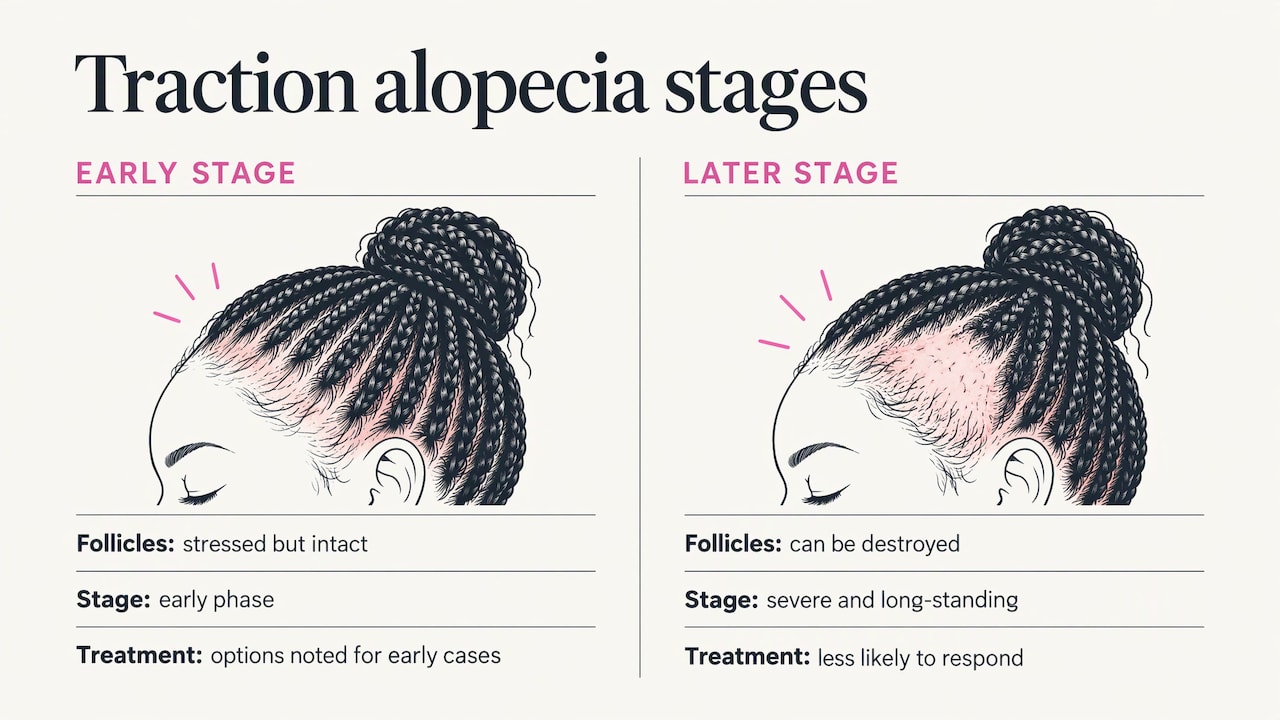
The stage decides the outcome. In the early phase the follicles are stressed but intact. Later, repeated inflammation can destroy them and replace them with scar tissue. JAMA Dermatology’s patient information notes that no treatments are FDA approved for traction alopecia, that early cases are treated with options such as topical corticosteroids, steroid injections, anti-inflammatory antibiotic pills and minoxidil, and that severe, long-standing cases with permanent scarring are less likely to respond to medical treatment.
That is why a conversation about PRP should start with a question: are there still hairs, even fine ones, in the thinning area, or is the skin smooth and shiny with no visible follicle openings?
Can traction alopecia grow back?
Often, yes, if it is caught early. Billero and Miteva’s review says most cases can be reversed when the right steps are taken at an early stage. It also says that chronic traction alopecia in its later stages can progress to irreversible scarring alopecia that does not respond to therapy (source).
Signs that point toward a reversible, earlier stage include:
- Fine, short vellus hairs still present along the hairline
- Small bumps or tenderness after tight styles
- Broken hairs around the edges
- Thinning that is recent, rather than years old
A 2025 dermoscopy review found that remaining vellus hair was the most common finding under magnification in traction alopecia, seen in 93.6% of patients across cross-sectional studies. It also explains that hair casts around the shaft are consistent with ongoing traction, while empty follicle openings and lower density can occur at any stage (source). In practice this means a trained clinician looking at your scalp closely tells you far more than a mirror does.
What the research says about PRP and hair
PRP is made from a small sample of your own blood, spun to concentrate the platelets, then injected into the scalp. Platelets release growth factors. The AAD’s clinical summary says the exact mechanism is still unclear, but those growth factors are thought to push follicles into the growth (anagen) phase and may improve blood supply around the follicle (AAD Clinical Pearls). The same document is clear about status: PRP is not FDA approved for hair growth, and PRP devices are not FDA cleared for alopecia.
Here is what the larger studies report across hair loss in general:
| Study | What it found |
|---|---|
| 2023 systematic review, 27 controlled trials, 1,117 people | PRP raised hair density compared with saline over medium-term follow-up (about 25.6 more hairs per cm²), though the evidence was rated low quality |
| 2024 meta-analysis, 21 studies, 628 people | PRP significantly improved hair density and thickness and reduced the number of hairs pulled out, in studies of female pattern hair loss |
| 2025 systematic review and meta-analysis | Activated PRP increased hair density and reduced recurrence compared with placebo |
Most of this research is in androgenetic alopecia (pattern hair loss), where follicles shrink but stay alive. For traction alopecia specifically, the published evidence is mostly case-level. One 2022 case report followed a patient with central centrifugal cicatricial alopecia (CCCA) and traction alopecia who received four PRP sessions. Follicular density rose during monthly treatments and fell after six-month gaps.
The sensible reading: PRP is a promising support for follicles that are still viable, and the better studied the condition, the firmer the numbers. A clinician who treats it should describe it that way, as one tool in a plan.
Who is a reasonable candidate
PRP makes the most sense for someone who has:
- Stopped the tension. Without that, any treatment is working against the cause.
- Visible miniaturized or vellus hairs in the thinned area, which show there is something to stimulate.
- Recent or moderate thinning, rather than a long-standing smooth, scarred patch.
- Realistic expectations about gradual change over months.
PRP is a poor fit for areas where follicles are gone. Be careful with any provider who promises regrowth on bare, scarred skin. Scarring forms for a reason, and it is why a proper assessment comes first.
Certain situations need a medical opinion before any injections. If your scalp is painful, pustular, itchy or inflamed, or if you take blood thinners, have a blood disorder or are pregnant, see a dermatologist or your primary care clinician first. Hair loss can also have other causes, such as thyroid disease or iron deficiency, that a blood test can find.
How many PRP sessions, and is two enough?
The AAD summary suggests starting with a series of three treatments spaced one to two months apart. Maintenance sessions every four weeks for up to six months have been proposed (AAD Clinical Pearls). A 2023 review also notes that a meta-analysis recommended monthly sessions for three months, followed by maintenance.
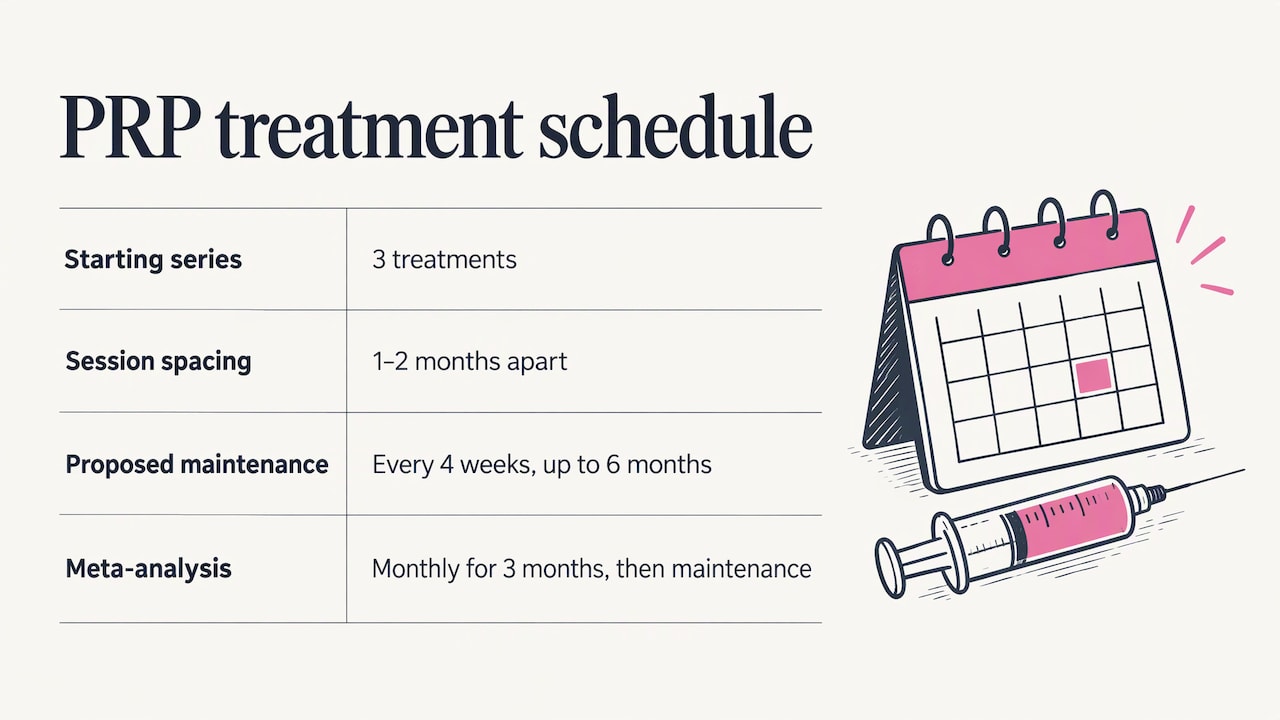
So two sessions fall short of the usual starting series. They can begin the process, but you would not judge the result from them.
Maintenance matters too. In the CCCA case report above, density dropped after six-month intervals, and the authors suggest a shorter interval than six months for stabilized patients (source). Your provider should set a schedule based on your response, not a one-size package.
When results show up
Hair cycles are slow, so patience is part of the plan. In one study of 20 people with pattern hair loss, hair growth from PRP peaked at three months and held through the one-year follow-up (Kaiser et al., 2023). Individual results differ, and traction alopecia may behave differently from pattern hair loss, so treat that as a reference point, not a promise.
A practical way to track progress:
- Take photos before your first session, in the same light and from the same angles
- Photograph again before each session
- Compare at three and six months, not week to week
What about shedding after PRP?
Some people notice more shedding in the weeks after treatment. Providers commonly describe this as part of the hair cycle resetting, but this is not well documented in the studies cited here, so do not self-diagnose. Tell your provider if shedding is heavy, if it lasts for weeks, or if your scalp becomes sore, patchy or inflamed. Those signs deserve a look and may point to another cause.
Side effects and safety
The most common scalp PRP side effects are pain, swelling, bleeding, lightheadedness and redness. The AAD says these are immediate and resolve on their own within 24 hours (AAD Clinical Pearls). A 2020 systematic review reported no major side effects such as scarring, progressive worsening or infection. It found only mild headache, temporary injection pain, mild itching and flaking, and transient swelling.
Because PRP uses your own blood, the risk of allergic reaction is low. Even so, preparation matters. The 2025 meta-analysis found that non-activated PRP was associated with more adverse effects (Anitua et al.). Ask your provider how their PRP is prepared and which system they use.
To get the most from a session:
- Eat beforehand and stay hydrated, since lightheadedness is one of the listed effects
- Tell the clinician about blood thinners, supplements and any bleeding disorder
- Ask for written aftercare, including when you can wash your hair, color it or return to exercise
- Keep follow-up visits, so your clinician can check the hairline and adjust the plan
Protect the hairline while you treat it
Treatment only works if the cause stops. The habits that make the biggest difference:
- Loosen or retire styles that pull at the edges. If your scalp feels tight or sore, the style is too tight.
- Give your hairline breaks between braids, weaves and extensions.
- Keep braids lighter and avoid adding heavy extension hair at the temples.
- Alternate where your ponytail or bun sits.
- Use satin or silk bonnets and pillowcases to cut friction at night.
- Be gentle with edges, including brushing and edge control products.
If you also use medical treatments such as minoxidil or prescribed topicals, keep using them as directed by your dermatologist. PRP is meant to be added to a plan, not to replace the one you already have.
Our perspective on PRP and hair
At Sudbury Med Spa, the question we hear most is whether PRP will “fix” thinning edges. Our answer starts with the follicle. If there are living hairs in the area, even fine ones, a plan that combines less tension with PRP is worth discussing, and we are designed around exactly that kind of personalized planning.
We offer free consultations so you can have someone look closely at your hairline, talk through your history and styling habits, and set a realistic schedule before you commit to anything. PRP works gradually, and we would rather map out a series with you and track photos along the way than hand you a one-size package.
With more than 15,000 treatments behind our team, led by founder Natalie NgocTrang, we focus on comfort, a clean treatment room and clear explanations. Hair restoration is one part of a broader, non-surgical menu, so your plan can grow with your goals.
Chris
Plan your PRP consultation
If you are in Sudbury, MA or nearby and want to know whether PRP fits your hairline, start with a free consultation. We will look at your scalp, ask about your styling habits and history, and explain what a series would involve. You can read how the process works in our guide to PRP hair restoration and see our PRP injection page for details.

When you are ready, book through our services page. If you want ongoing care, our membership plans are listed there, too. Our team also offers microneedling with PRP for skin concerns.
Questions to bring to your appointment
- Do you see living follicles or scarring in my thinning areas?
- How is your PRP prepared, and is it activated?
- How many sessions do you suggest for me, and how far apart?
- What maintenance schedule would you expect after the first series?
- How will we measure progress, and when?
- Should I also see a dermatologist for medical treatment or testing?
Good answers are specific and tied to your scalp. Vague answers or guarantees are a reason to keep asking.
FAQ
Does traction alopecia heal?
Often, when it is caught early and the tension stops. Most early cases can reverse, but long-standing traction can lead to scarring and permanent loss (Billero and Miteva). A clinician can check which stage you are in.
What are the side effects of PRP injections?
The common ones are pain, swelling, minor bleeding, lightheadedness and redness. The AAD says they appear right away and resolve within 24 hours (AAD Clinical Pearls). Call your provider if pain, swelling or redness gets worse instead of settling.
Is two sessions of PRP enough?
Usually not on its own. The AAD suggests starting with three treatments one to two months apart, with maintenance proposed after that. Your provider can adjust the plan based on how your hair responds.
Can PRP reverse scarring from traction alopecia?
No treatment is expected to regrow hair from follicles that scarring has destroyed (JAMA Dermatology). PRP is aimed at follicles that are still alive, which is why an early exam matters.
Sources
- Traction Alopecia, JAMA Dermatology
- Platelet-rich plasma for alopecia, AAD Clinical Pearls
- Traction alopecia: the root of the problem
- Dermoscopy of Traction Alopecia in Black Scalp Patients
- Platelet-rich plasma for the treatment of alopecia: a systematic review
- Effectiveness of platelet-rich plasma in treating female pattern hair loss
- Platelet-Rich Plasma in the Management of Alopecia
- Transitory hair growth using platelet-rich plasma therapy
- Treatment of Androgenetic Alopecia: Current Guidance
- Systematic Review of Platelet-Rich Plasma Use in Alopecia


