

Most lip filler swelling is at its most noticeable in the first day or two, fades noticeably over the first week, and is mostly gone by week two. The final shape can take two to four weeks to show. Your own timeline depends on how much filler you had, your skin, and how well you look after it. At Sudbury Med Spa, we offer free consultations before any filler treatment, so you can ask about your own recovery before you book.
TL;DR
- Expect swelling, tenderness and some bruising right after treatment. Cleveland Clinic says swelling usually fades after 24 to 48 hours but can last up to a week.
- Uneven, lumpy or oversized lips in the first days are common. The shape usually settles over two to four weeks.
- Ice for short periods, skip hard workouts for a few days, and avoid blood-thinning pain relievers unless your doctor says otherwise.
- Extreme pain, pale lips or skin, or purple discoloration around the lips need an immediate call to your injector.
- Book filler at least two weeks before a big event.
Table of Contents
- Why lips swell after filler
- Lip filler swelling stages, day by day
- Do lip fillers look uneven at first?
- Lip filler bruising: what is normal
- How to reduce swelling after lip filler
- What affects how long swelling lasts
- Warning signs: when to call right away
- Perspective
- Planning your lip filler with Sudbury Med Spa
- FAQ
- Sources
Why lips swell after filler
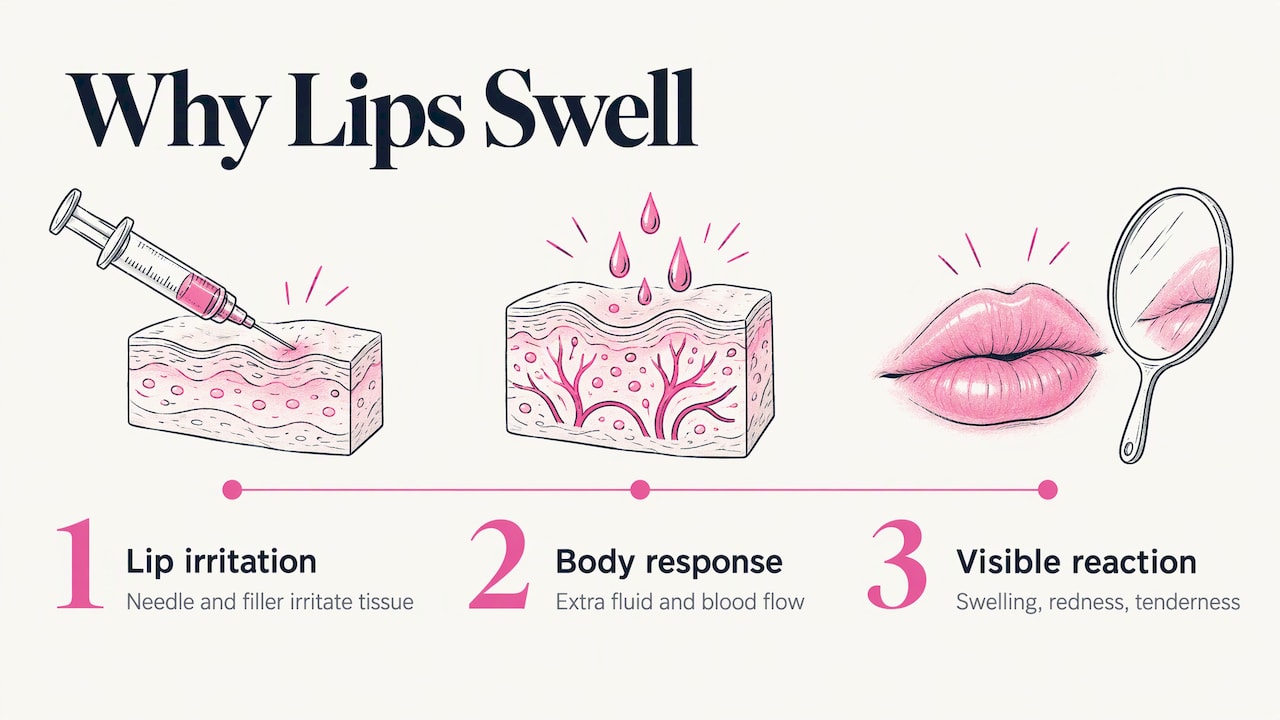
A needle passing through the lip, plus the filler itself, irritates the tissue. The body responds with extra fluid and blood flow, which you see as swelling, redness and tenderness. The lips are a soft, richly supplied area, so they react more visibly than most places on the face.
This is expected, not a sign that something went wrong. A peer-reviewed review of dermal filler adverse events describes short-lived swelling as normal with all dermal fillers. It is related to how much filler is injected and the technique used, and most trauma-related swelling clears within a week.
The FDA’s consumer guidance on dermal fillers lists bruising, redness, swelling, pain, tenderness, itching and rash as common risks. It says most of these happen shortly after injection and resolve in a few days to weeks.
Lip filler swelling stages, day by day
Every pair of lips heals a little differently. The stages below are a typical pattern, built around the ranges published by medical sources. Use them to judge the shape of your recovery, not to hold it to a stopwatch.
| Stage | What you usually see | What it means |
|---|---|---|
| Day 1 | Fullness, tenderness, redness, possible small bruises | Normal reaction to the injections |
| Days 2 to 3 | Lips look puffy and may be uneven; bruises can darken | Swelling is often at its most noticeable early on |
| Days 4 to 7 | Puffiness drops, tenderness fades, bruises change color | Most swelling is gone for most people |
| Week 2 | Lips look close to normal, a little firmness may remain | Filler is settling into the tissue |
| Weeks 3 to 4 | Soft, even, natural feel | Final result is visible |
Day 1: the immediate reaction
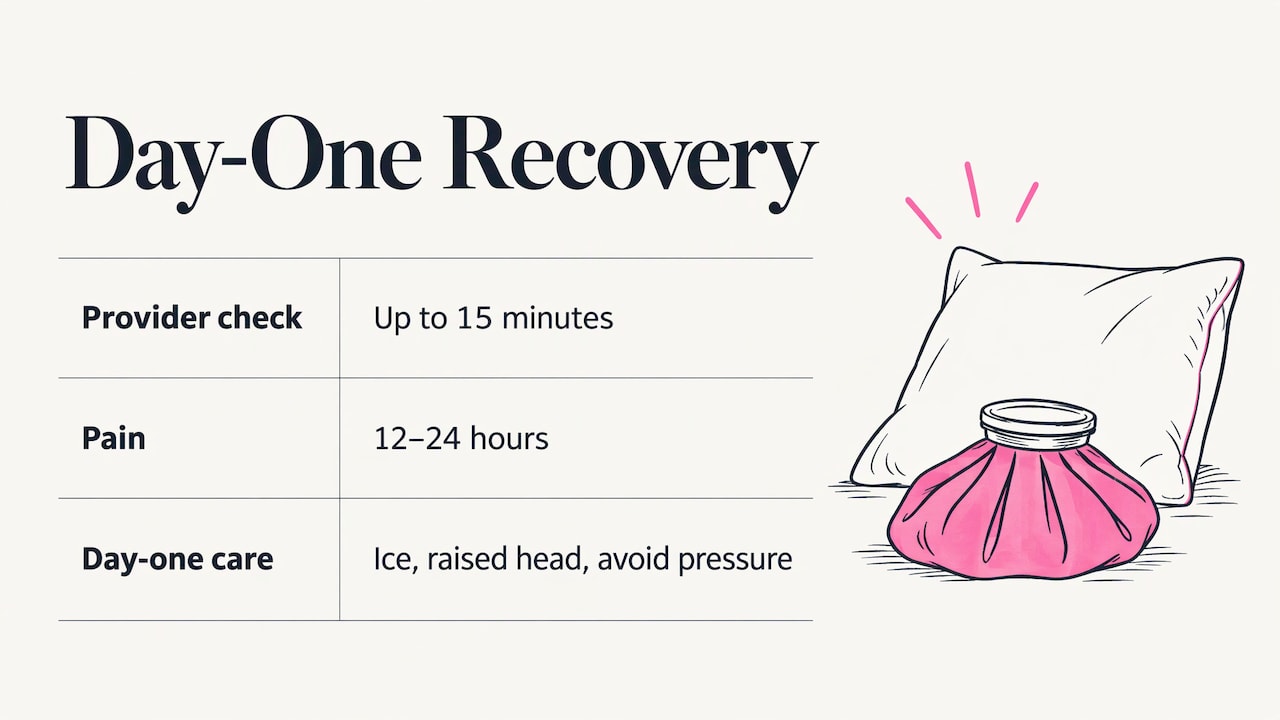
Your lips will look fuller than you planned, and that is normal. You may notice tenderness, a tight feeling, and small spots of redness or bruising at injection points. Cleveland Clinic notes that pain should go away after 12 to 24 hours, and that your provider watches you for up to 15 minutes after the procedure for dizziness, nausea or heavy bleeding before you leave.
The first day is the time to be gentle. Use a short ice session, keep your head slightly raised when you rest, and avoid pressing on or pinching your lips.
Days 2 and 3: puffy and sometimes lopsided
This is the stage that worries people most. The lips can look bigger than on day one, one side may seem fuller than the other, and a bruise can appear or darken. Swelling is rarely perfectly symmetrical, so one side can lag behind the other for a few days.
If the unevenness is mild and the pain is easing, you are most likely seeing swelling, not a problem with the filler. Judging the result now is like judging a haircut while the stylist is still cutting. Wait.
Days 4 to 7: visible improvement
By the end of the first week, most people have lost the bulk of the puffiness. Bruises turn from purple toward yellow or green as they fade. Lips feel softer and less tight.
The Cleveland Clinic guidance says swelling may take up to a week. The American Academy of Dermatology says common side effects such as redness, swelling, tenderness and occasional bruising tend to clear within 7 to 14 days or earlier.
Week 2: settling in
Most people can go out and about without feeling self-conscious. Tiny irregularities may still be felt more than seen. The FDA’s prescribing information for the Juvéderm Volbella XC lip filler states that mild to moderate injection-site responses in the lips typically resolve within 14 days.
This is also when many providers schedule a check-in. Cleveland Clinic describes a follow-up about two weeks after the procedure, which is a good moment to judge symmetry and shape.
Weeks 3 to 4: the final result
Cleveland Clinic’s aftercare page says it usually takes two to four weeks for swelling to fully resolve and for the filler to integrate with the lip tissue. Only now is the result a fair picture of what you paid for. If you still want a small change, this is the point to discuss it, not day three.
Do lip fillers look uneven at first?
Yes, often. Swelling does not spread evenly, one side may be injected slightly more, and bruising on one side adds to the difference. A lip can look bulky at the center, feel hard in one spot, or sit slightly off in the first days.
Three things help you tell normal unevenness from a problem:
- It changes. Normal swelling shifts and shrinks from day to day. A lump that stays exactly the same, or grows, deserves a call.
- It comes with mild discomfort only. Tenderness that eases each day is expected.
- The color is normal or pink-red. Pale, white or purple-blue skin is not expected (see the warning signs below).
Cleveland Clinic lists lip asymmetry among the possible risks of filler, so if the lips still look uneven once the two to four weeks are up, go back to your injector. Do not attempt to massage or fix it yourself unless you have been told how.
Lip filler bruising: what is normal
Bruising is the most visible part of recovery for many people. A few small marks are typical. Larger patches can appear if a tiny blood vessel is nicked, which happens even with skilled hands.
A few facts worth knowing:
- Bruises usually fade over several days to a couple of weeks, shifting color as they heal.
- The review in PMC reports that bruising is treated with cold compresses and vitamin K cream. The same review notes that technique matters, with more bruising seen with fanning and threading than with depot placement at the preperiosteal level.
- The FDA’s prescribing information notes that patients taking aspirin, NSAIDs or warfarin may experience increased bruising or bleeding at injection sites. If you take a blood thinner prescribed for a medical reason, never stop it on your own. Talk to the prescribing doctor first.
Other injectables bring their own short-lived reactions. If you are also considering Botox, here is a breakdown of Botox side effects and red flags.
How to reduce swelling after lip filler
The goal is to calm the tissue and avoid anything that increases blood flow to the lips in the first days.
- Ice briefly. Cleveland Clinic recommends an ice pack for up to 10 minutes to reduce inflammation, pain and swelling. The FDA’s prescribing information says ice may be applied with gentle pressure for a brief period after treatment. Wrap the ice in a cloth and press lightly.
- Skip hard workouts. Cleveland Clinic advises avoiding vigorous exercise for several days because it can worsen swelling and bruising. Light activity such as a brisk walk or gentle yoga is fine.
- Choose acetaminophen over NSAIDs for discomfort. According to Cleveland Clinic’s Dr. Murray, acetaminophen is preferred because it does not thin the blood the way NSAIDs do, so it should not add to bruising. Check dosing with your own doctor if you have liver disease or take other medicines.
- Be gentle with your lips. Avoid pressing, picking, or touching them. Cleveland Clinic’s earlier guidance suggests avoiding lipstick or balm for at least 24 hours, and its aftercare page notes eating, drinking and using a straw will not affect the outcome even if you want to change them for comfort. Follow whatever your injector tells you.
- Sleep with your head raised. An extra pillow for the first nights helps fluid drain away from the face.
- Plan around events. Cleveland Clinic advises booking filler at least two weeks before a wedding or other big event so recovery is complete.
What not to bother with
There is no shortcut that makes swelling vanish overnight. Heat, hard massage and exercise to “work it out” are more likely to make it worse. Patience, ice and rest do most of the work.
What affects how long swelling lasts
- Amount of filler. The PMC review ties swelling to injection volume and technique. A subtle first treatment tends to swell less than a larger one.
- Technique and the injector’s training. Gentle placement can mean less trauma. The AAD notes that serious side effects are more likely when the injector lacks adequate medical training.
- Medications and supplements. Blood thinners, aspirin and NSAIDs can increase bruising.
- Your own tissue. Some people simply swell more. Thin, sensitive lips can react more visibly.
- Activity. Exercise, heat and alcohol in the first day or two raise blood flow to the area.
- Illness and other procedures. The FDA lists delayed inflammation after illnesses, vaccinations or dental procedures as a less common risk of dermal fillers, so tell your injector if you plan dental work or vaccines soon after treatment.
Warning signs: when to call right away
Swelling that gets steadily better is reassuring. Symptoms that get worse are not. Cleveland Clinic’s aftercare guidance says extreme pain, paleness in the lips or surrounding skin, and purple discoloration around the lips could signal a vascular occlusion, which means filler blocking a blood vessel. Contact your provider immediately if any of these occur. If you cannot reach them, go to urgent care or the emergency room.
The FDA also lists less common risks that need medical attention: nodules, infection, allergic reaction and tissue death (necrosis). Call your injector or your doctor if you notice:
- Pain that rises after the first day instead of easing
- Pale, white or dusky skin on or around the lips
- Fever, pus, spreading redness or heat
- Hard lumps that grow or appear weeks later
- A cold sore outbreak, which Cleveland Clinic lists as a possible reaction
- Trouble breathing, widespread hives or facial swelling beyond the lips: call 911
One more safety point from the FDA: use only FDA-approved fillers, supplied by prescription and injected by a licensed health care professional. The agency warns against fillers sold directly to the public, which are not approved and may be contaminated. The AAD adds that you should never get filler in a non-medical setting such as a salon or someone’s home, where reports of lumps, infections and severe swelling rise sharply.
Perspective
Lip swelling is the part of filler nobody photographs, and it is the part patients remember. In our experience of the topic, the best preparation is a clear plan before the needle comes out: what you want to look like in a month, not in an hour.
That is why we start with a free consultation and a personalized treatment plan. We want you to know what product we recommend, what recovery looks like for that product, and when you should plan the appointment around your calendar. Our team has completed over 15,000 treatments, and our founder, Natalie NgocTrang, built the practice on individualized care in a clean, comfortable setting.
Our advice is simple. Book your filler with room to heal, follow your aftercare, and judge the result at the two to four week mark. The swelling stages are temporary. The relationship with a medical team who knows your face stays useful for years.
Chris
Planning your lip filler with Sudbury Med Spa
If you are thinking about lips, cheeks or smile lines, our dermal filler page explains the options, and our services menu shows the full range, including Juvéderm, Restylane and Radiesse. We offer free consultations and financing options, so you can talk through the treatment and its recovery before you commit.

If you come back for regular treatments, our membership plans are listed at $399 (Silver), $499 (Gold) and $599 (Platinum) per year. You can also browse our price booklet or book a consultation to plan your first appointment.
FAQ
How long does lip swelling last after filler?
For most people, swelling is gone within about a week, and Cleveland Clinic says it usually fades after 24 to 48 hours but may last up to a week. The AAD says common side effects clear within 7 to 14 days. Full settling can take two to four weeks.
How many days should I ice my lips?
Ice in short sessions of up to 10 minutes, mainly in the first day or two when swelling is most noticeable. Wrap the ice pack in a cloth and press gently. Stop if the skin feels numb or uncomfortable.
When will my lips look normal after filler?
Many people feel presentable by day four to seven, with lips close to normal by week two. The final shape and feel typically appear by week four. Book at least two weeks before an important event.
Is it normal for one lip to swell more than the other?
Yes, uneven swelling is common in the first days. If the difference shrinks over time, it is probably swelling. If it persists beyond a few weeks, or comes with severe pain or color changes, contact your injector.
Sources
- Dermal Filler Do’s and Don’ts for Wrinkles, Lips and More (FDA)
- Lip Fillers: What to Expect, Types, Benefits & Side Effects (Cleveland Clinic)
- Lip Filler Aftercare: What Not To Do (Cleveland Clinic)
- Dermal fillers in aesthetics: an overview of adverse events (PMC)
- Fillers: FAQs (American Academy of Dermatology)
- Juvéderm Volbella XC prescribing information (FDA)


