
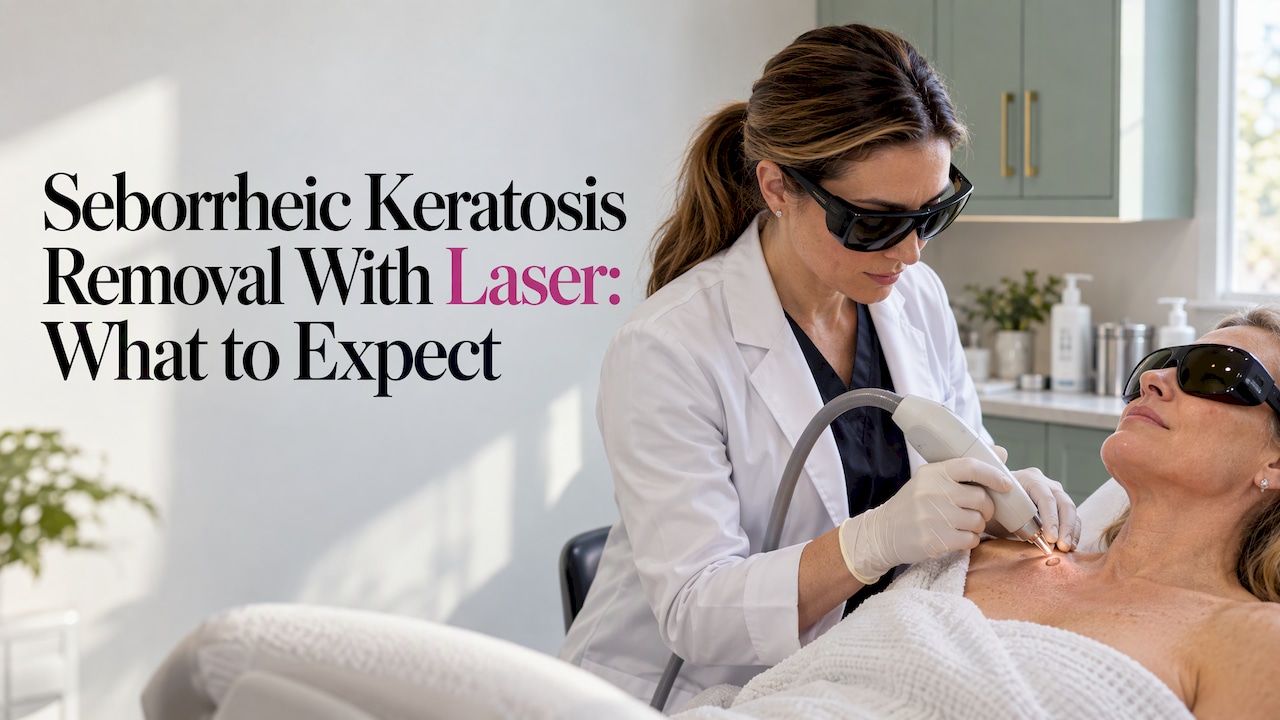

Laser removal can clear many seborrheic keratoses (SKs), the waxy or stuck-on brown growths that appear with age. A 2025 review found that ablative CO2 and Er:YAG lasers cleared up to 90% of lesions in a single session. The first step is not the laser, though. It is making sure the growth really is an SK. At Sudbury Med Spa, a free consultation is where you can start that conversation, and our CO2 laser mole removal page explains the technology we use on raised skin growths.
TL;DR
- SKs are harmless and usually need no treatment, but many people remove them because they snag on clothing, get irritated or look unsightly.
- Ablative lasers (CO2, Er:YAG) can clear many lesions in one session. Pigment-targeting lasers usually take 1 to 3 sessions. Recurrence in studies was 0 to 6% at up to 12 months.
- Any growth that looks unusual, changes or bleeds needs a clinician’s examination, and sometimes a biopsy, before any laser touches it.
- In a 2025 US survey, ablative laser procedures averaged $1,157 at medical spas. That is a figure for ablative laser work in general, not an SK quote.
Table of Contents
- What a seborrheic keratosis is, and when removal makes sense
- Step one: confirm the diagnosis
- Which lasers remove seborrheic keratosis
- What the CO2 laser appointment looks like
- Risks, healing and recurrence
- How much laser removal costs in the US
- Choosing who performs your laser treatment
- Our perspective
- Start with a free consultation
- FAQ
- Sources
What a seborrheic keratosis is, and when removal makes sense
A seborrheic keratosis is a common, non-cancerous skin growth. It can be tan, brown or black, flat or raised, smooth or rough, and it often looks like it was stuck onto the skin. You can have one or dozens, on the chest, back, face, scalp or elsewhere.
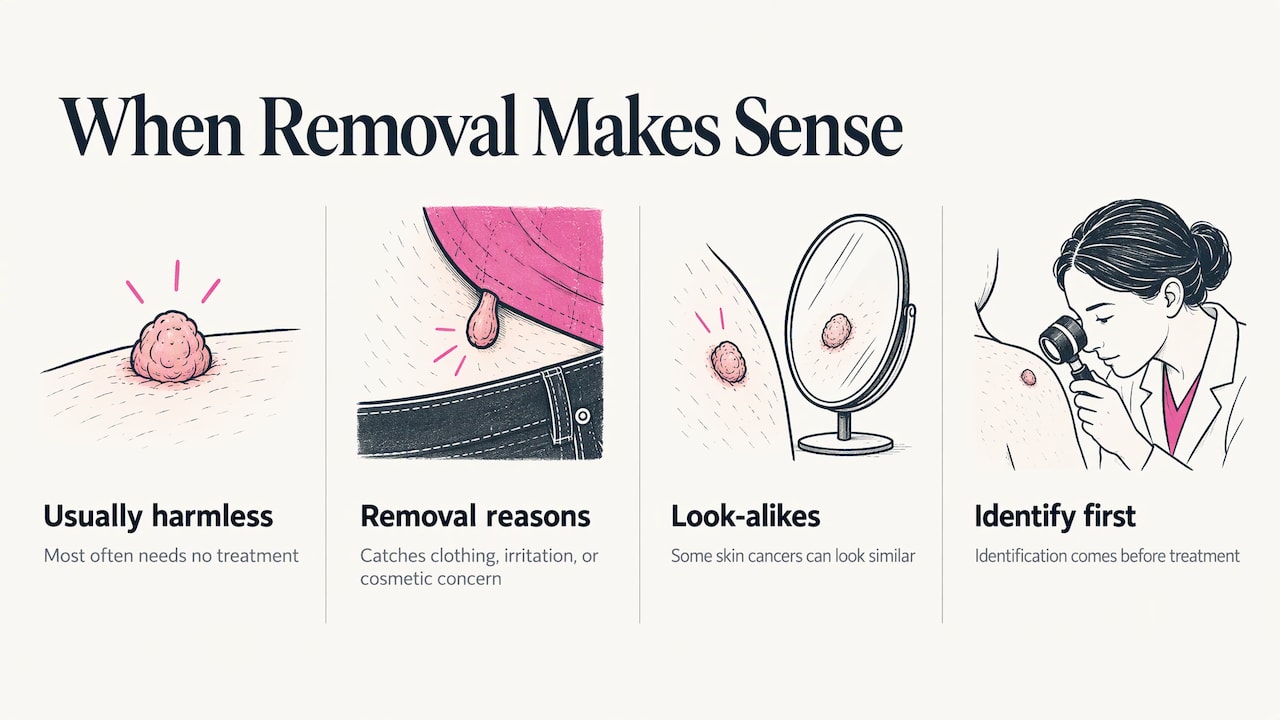
The American Academy of Dermatology (AAD) says SKs are harmless and most often need no treatment. Removal is reasonable when a growth looks like skin cancer, catches on clothing or jewelry, becomes irritated easily, or simply bothers you cosmetically. If you are in the last group, you are exactly who laser removal is designed for: someone who wants a smooth result without surgery.
SKs do not turn into cancer on their own. The concern is that a few skin cancers, including melanoma, can look similar. That is why identification comes before treatment.
Step one: confirm the diagnosis
The AAD notes that in most cases a dermatologist can identify an SK just by looking at it. If a growth looks like skin cancer, it is removed and examined under a microscope, which is the only way to know for sure.
Clinicians often use a dermatoscope, a lighted magnifier, to look at the structure of the growth. A 2026 review describes a two-step dermatoscopy approach. First the clinician looks for features that point toward a pigmented mole or melanoma, such as a pigment network or blue-gray pigment. Then they look for features typical of SK, such as ridged or brain-like surface patterns, comedo-like openings and tiny cyst-like dots.
It matters most on sun-exposed skin. A Korean study of SKs found frequent mismatches between the clinical and the microscope diagnosis on sun-exposed areas, and its authors recommended sampling suspected SKs there so premalignant or malignant disease is not missed.
What this means for you:
- Do not self-diagnose from photos. A growth that is new, changing in color or shape, bleeding, crusting or not healing should be seen by a dermatologist first.
- Laser vaporizes tissue, so there may be nothing left to send to a lab afterward. That is why a suspicious lesion should be sampled or examined before it is lasered, not after.
- If your growth is clearly a typical SK, laser becomes a cosmetic choice rather than a medical necessity.
Bring every growth you are curious about to a consultation. Ours is free, and it is the right place to talk through which spots are candidates for treatment and which ones should go to a dermatologist first.
Which lasers remove seborrheic keratosis
There are two broad families, and the difference explains why session counts vary.
Ablative lasers: CO2 and Er:YAG
Ablative lasers vaporize the thin layer of tissue containing the growth. The CO2 laser emits mid-infrared light at 10,600 nm. According to a Kentucky medical board opinion on laser surgery, it can be used in a defocused mode to vaporize superficial skin disorders. EyeWiki, from the American Academy of Ophthalmology, lists CO2 and Er:YAG as the ablative options for SK.
The 2025 scoping review from George Washington University found ablative CO2 and Er:YAG lasers achieved single-session clearance in up to 90% of lesions. In a comparison of 42 patients, Er:YAG produced less post-inflammatory darkening than liquid nitrogen freezing, and the same review reported that a group of irritated SKs treated with a CO2 laser showed no recurrence at 6 to 12 months.
Pigment-targeting lasers
These lasers aim at the pigment in the growth rather than vaporizing the surface. The review lists 755-nm alexandrite, 1,064-nm Nd:YAG, 532-nm KTP, 585-nm pulsed-dye and picosecond lasers. They needed a mean of 1 to 3 sessions, with recurrence of 0 to 6% at follow-up of 12 months or less.
A 2025 study in Germany using a 532-nm laser found that 67% of patients preferred laser for future treatments, citing minimal bleeding and no dressings. Medscape’s 2026 treatment update says that across laser types, adverse events were generally mild and temporary, and satisfaction ran from 64 to 95%.
Quick comparison
| Ablative (CO2, Er:YAG) | Pigment-targeting (alexandrite, Nd:YAG, KTP and others) | |
|---|---|---|
| How it works | Vaporizes the thin tissue layer holding the growth | Targets the pigment in the lesion |
| Sessions reported | Single-session clearance in up to 90% of lesions | Mean of 1 to 3 sessions |
| Recurrence reported | Low in studies, with none seen at 6 to 12 months in one irritated-SK group | 0 to 6% at 12 months or less |
| Best for | Raised, thicker growths | Flatter, pigmented growths |
The “best for” row is a general guide. Your provider chooses the laser after looking at the thickness, color and location of each lesion, and your skin tone.
What the CO2 laser appointment looks like
The details vary by clinic and by lesion, but a typical CO2 laser removal follows this pattern:
- Assessment. The provider examines each growth and your skin, and confirms which ones are suitable. Anything suspicious is set aside for a dermatologist’s evaluation.
- Preparation. The area is cleaned and your provider will explain the comfort measures they use for the treatment area. Protective eyewear is standard for laser work.
- Treatment. The laser is passed over the growth, vaporizing it layer by layer. Small lesions take moments each. Treating many on the back or chest takes longer.
- Aftercare instructions. You leave with a plan for cleaning, protecting and moisturizing the area.
You can generally expect the treated spot to look pink or red as it heals, and a small crust or scab may form. Your provider’s aftercare instructions are the guide for how long that takes in your case, because healing depends on the size and depth of the lesion and where it is on the body.
Risks, healing and recurrence
The Kentucky board opinion lists the occasional complications of CO2 laser surgery as irregular pigmentation, pain, lingering redness and recurrence, with bleeding, infection and scarring or texture changes as rare. Knowing this helps you protect your results:
- Sun protection. Treated skin can change color more easily, so keep it covered or use sunscreen as your provider directs.
- Don’t pick. Let any crust fall off by itself to lower the chance of marks.
- Tell your provider about your skin tone and tanning. Darker or recently tanned skin changes how lasers are set, so share this at the consultation.
- Watch the area. Redness that worsens, pus, fever or spreading pain after treatment means you should contact your provider or doctor promptly.
- New growths. Removing a lesion does not stop you from developing others. Recurrence rates in studies are low (0 to 6%), but new SKs can appear elsewhere over time.
How much laser removal costs in the US
There is no single price for SK laser removal, and published SK-specific figures are scarce. A 2025 US study of 124 practices, by Coyle and Kesty, gives useful context for laser work overall. It found the average ablative laser procedure cost $1,157 in medical spas, $3,154 in plastic surgery offices and $4,055 in dermatology offices. Nonablative procedures averaged $485 in medical spas. Initial consultation fees averaged $30 in medical spas, against $153 in dermatology offices.
Those averages cover a wide range of laser procedures, not only SK removal, so treat them as a ballpark. What moves your own price:
- Number and size of lesions. Ten small spots cost more to treat than one.
- Laser type and sessions. Ablative treatments often finish in one visit. Pigment-targeting lasers may need a few.
- Location. Face and neck areas are more delicate than the back.
- Cosmetic, not medical. Because most SK removal is cosmetic, insurance usually does not pay for it. Check with your insurer if a clinician has removed a lesion for medical reasons.
Sudbury Med Spa does not publish prices for individual laser treatments. The free consultation gives you a quote based on your own lesions, and we offer financing options if you want to spread the cost out. You can also see our price booklet.
Choosing who performs your laser treatment
Laser outcomes depend on the person holding the device. Ask who will perform your treatment, how many similar procedures they have done, what happens if a lesion looks suspicious, and what the aftercare plan is. A clinic’s approach to selecting and introducing devices matters too: guidance on launching aesthetic devices safely shows the kind of training and safety steps a well-run practice follows.
Sudbury Med Spa has completed more than 15,000 treatments, and our team is led by founder Natalie NgocTrang. We keep a clean, comfortable treatment environment and build personalized plans for each client.
Our perspective
Most people who ask us about growths like these are not worried about health. They are tired of a spot that catches on a bra strap, a necklace or a razor, or one they cover with makeup. They want it gone without a surgical procedure.
We start every conversation with a free consultation, because a personalized plan starts with looking at your skin, not with a price list. We use CO2 laser technology for mole and skin growth removal, and we explain what we see, what is suitable for treatment and what you should have checked by a dermatologist first.
Laser is attractive because it is precise and typically needs little bleeding or bandaging. The data supports it: single-session clearance for many lesions with ablative lasers, and low recurrence. Our approach is simple. Understand your concern, set realistic expectations, treat carefully and give you clear aftercare. With over 15,000 treatments behind us, that is what we aim to deliver every time.
Chris
Start with a free consultation
If you have growths you want gone, we would like to look at them with you. At Sudbury Med Spa you can book a free consultation to talk through your skin concerns, learn which of our laser options may suit you and get a personalized plan. Financing options are available if you want to spread the cost.

See how our laser treatments and mole removal services work, browse all our services, or go to Sudbury Med Spa to book.
FAQ
Can laser remove a seborrheic keratosis permanently?
The growth that is treated typically does not return in most cases. Studies of laser treatment report recurrence between 0 and 6% at up to 12 months of follow-up. New SKs can still appear in other places over time, since they are linked to skin aging.
Do I need a biopsy before laser removal?
Not for every lesion. The AAD says a dermatologist can usually identify an SK by looking at it, but a growth that looks like skin cancer should be removed and examined under a microscope. If a growth is changing, bleeding or looks unusual, see a dermatologist before any laser treatment.
Is CO2 laser mole removal the same as SK removal?
They use related technology, since a CO2 laser vaporizes superficial skin growths. The two growths differ medically, and the diagnosis decides the treatment. Our free consultation is where we look at your skin and talk through your options.
Will insurance pay for it?
Usually not, because removing an SK for cosmetic reasons is considered elective. If a clinician removes a growth because it is irritated or needs evaluation, ask your insurer what applies to your plan.
How long does healing take?
Expect pinkness and sometimes a small scab at the treated spot. The timeline depends on the lesion’s size, depth and location, so follow the aftercare plan your provider gives you and keep the area out of the sun.
Sources
- Advances in Laser Treatments for Seborrheic Keratosis (George Washington University, 2025)
- Practical Approaches for Seborrheic Keratosis Treatment (PubMed, 2025)
- Seborrheic keratoses: Diagnosis and treatment (American Academy of Dermatology)
- Seborrheic Keratosis (EyeWiki)
- An update on the diagnosis and treatment of seborrheic keratosis (PMC, 2026)
- Clinical and Histopathological Investigation of Seborrheic Keratosis (PMC, 2016)
- Board Opinion on Laser Surgery (Kentucky Board of Medical Licensure)
- Seborrheic Keratosis Treatment and Management (Medscape, 2026)
- Cosmetic Lasers in the US (PMC, 2025)
- Device Launch: 9 Steps to Go Live Safely in Aesthetic Practices


