


Platysmal band Botox relaxes the thin neck muscle that pulls into two vertical cords under your chin and down your neck. It works when those cords are caused by muscle activity. It does nothing for loose skin or fat. Results show within about two weeks and usually last three to four months, and the neck is a spot where the skill of your injector matters a great deal.
Below is how the treatment works, what the FDA has actually approved, what it costs across the U.S., how it differs from the “Nefertiti lift,” and how to tell whether you are a good candidate before you book.
TL;DR
- Botox Cosmetic has been FDA-approved since October 18, 2024 for moderate to severe vertical platysma bands in adults.
- It only helps bands caused by muscle. Skin laxity and submental fat need other approaches.
- Expect results at about two weeks and a repeat visit every three to four months. U.S. pricing often lands between $300 and $600 per session, depending on units and location.
- The Nefertiti lift is an off-label jawline add-on, so ask whether your quote covers bands only or the full lower face.
- Choose an experienced injector. Deep or misplaced injections can cause swallowing trouble and neck weakness, though this is rare.
Table of Contents
- What platysmal bands are
- What the FDA has approved
- Does it work?
- Are you a good candidate?
- Platysmal bands versus the Nefertiti lift
- What the appointment looks like
- Risks and how to lower them
- What platysmal band Botox costs
- Our perspective
- When Botox is not enough
- Book a consultation in Sudbury
- FAQ
- Sources
What platysmal bands are
The platysma is a flat, wide muscle that sits just under the skin of the neck and reaches up to the lower face. As we age, the front edges of the muscle can thicken and tighten, and they show up as two vertical cords. They stand out most when you talk, grimace or clench your jaw.
A 2022 anatomical review describes the platysma as the primary target muscle for neurotoxin injection aimed at bands and jawline lifting. The idea is simple. Botox blocks the signal that tells the muscle to contract, so the cords soften and the muscle’s downward pull on the lower face eases.
Not every neck line is a platysmal band. Horizontal “necklace” lines are creases in the skin and respond to different treatments. Sagging under the chin can come from skin, fat or both.
What the FDA has approved
Before October 2024, neck Botox was widely done but off-label. That changed when Allergan Aesthetics announced that Botox Cosmetic was approved for temporary improvement in the appearance of moderate to severe platysma bands in adults. The company called it the first and only aesthetic neurotoxin approved for this use.
The approved dosing depends on how many bands you have:
| Band pattern | Total units | Injection sites |
|---|---|---|
| One band per side | 26 | 18 |
| One band on one side, two on the other | 31 | 23 |
| Two bands per side | 36 | 28 |
Those figures come from the same approval announcement. The full label, including the safety warnings, is in the prescribing information. Read it before you consent, or ask your injector to walk you through it.
Does it work?
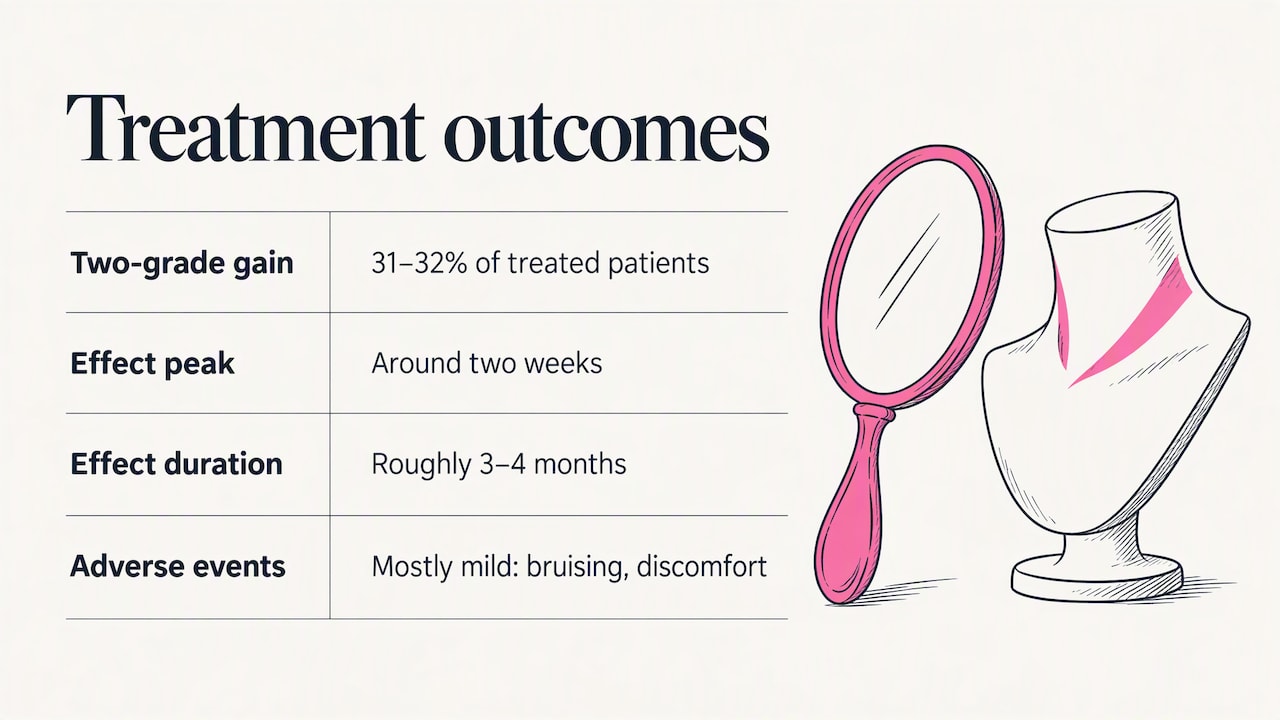
For the right candidate, yes, though the size of the effect varies. A 2026 meta-analysis of randomized trials found onabotulinumtoxinA effective for platysma prominence, with mostly mild adverse events such as bruising or temporary discomfort. Effects tend to peak around two weeks and fade over roughly three to four months.
Strict grading scales are harder to satisfy than a patient’s own impression. According to one clinical summary, about 31 to 32 percent of treated patients in the two pivotal studies reached a two-grade improvement in band severity. Many more will see some softening. That gap is worth knowing about, because “better” is not the same as “gone.”
A systematic review of mild to moderate platysma bands also examined efficacy, technique and complications and supports treating bands with botulinum toxin when technique is careful.
Are you a good candidate?
The most useful check takes ten seconds in a mirror. Clench your teeth and pull the corners of your mouth down. If vertical cords pop out, they are likely muscular and likely to respond. If the neck looks the same but the skin hangs, the problem is probably skin. Aesthetic specialists describe this contraction test as a core diagnostic step.
Good candidates tend to have:
- Visible vertical cords at rest or with movement
- Reasonably firm skin on the neck
- A realistic goal of softening, not erasing, the bands
Poorer candidates tend to have:
- Significant skin laxity, often called “turkey neck”
- Mostly fat under the chin
- Swallowing or neck-muscle problems already
Dr. Melanie Palm, quoted in the same guide, notes that Botox acts on muscle activity but cannot tighten skin or remove submental fat. If you have a neuromuscular condition, are pregnant or nursing, or take medications that affect muscles, talk to your physician before booking any neurotoxin treatment.
Platysmal bands versus the Nefertiti lift
These two get mixed up, and the difference changes your bill.
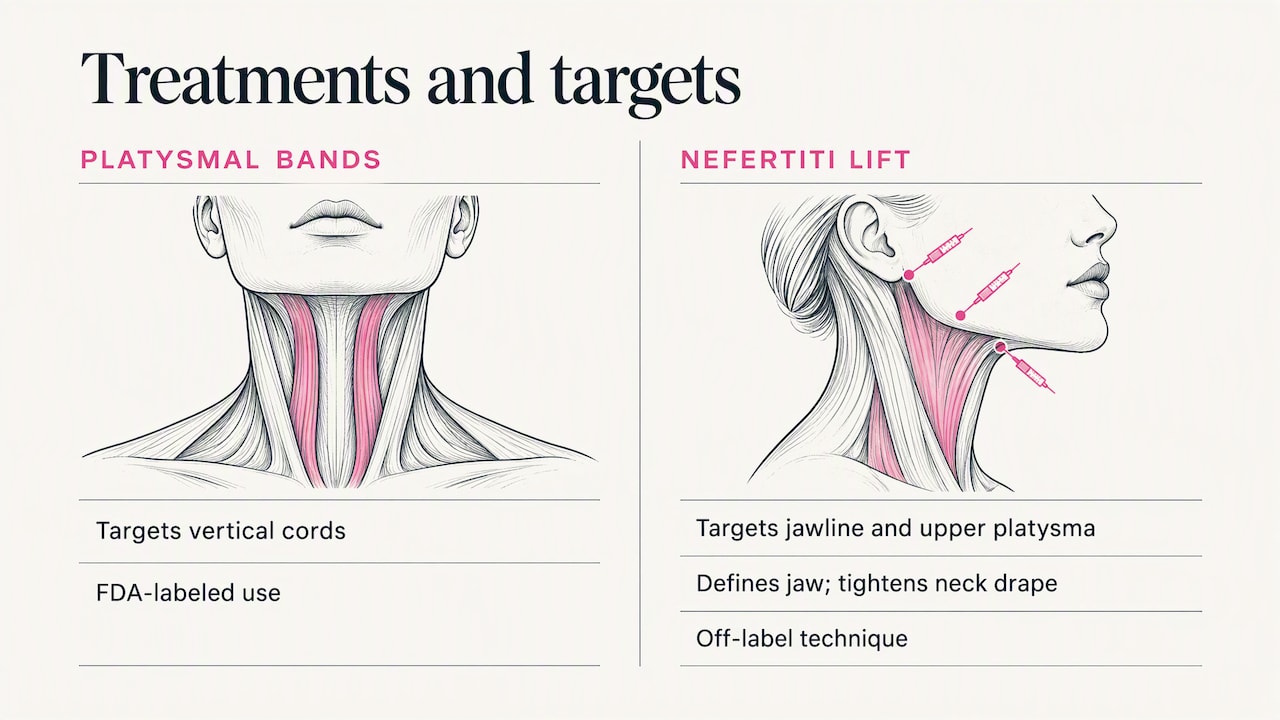
Platysmal band treatment targets the vertical cords. It is the FDA-labeled use.
The Nefertiti lift places small amounts of toxin along the jawline and the upper edge of the platysma. The goal is to weaken the muscle’s downward pull so the jaw looks more defined and the neck drape looks tighter. This is an off-label technique. The Allure explainer covers the approach and its risks for a general audience, and the 2022 review linked above maps the injection points for both.
Many providers combine them for a “mini-lift” effect. Be aware that the approved band protocol is a baseline, and a hybrid treatment can push totals from 36 units to 60 or more. So when you compare quotes, ask exactly what each one covers.
What the appointment looks like
- Assessment. Your injector watches the neck at rest and while you contract the muscle, and checks skin quality.
- Mapping. The bands and any jawline points are marked.
- Injections. Many small injections are placed along each band. Good technique involves grasping and lifting the band away from the deeper neck structures, which helps keep toxin out of muscles you need for swallowing, according to a clinical review of platysma neurotoxin technique.
- Aftercare. You can usually return to normal activity right away. Small bumps and pinpoint bruises are common and fade.
- Follow-up. Results build over about two weeks. A review at that point lets your injector decide whether a touch-up is worth it.
Risks and how to lower them
Most side effects are minor: bruising, tenderness, a bit of swelling. The serious ones are rare but real. Injecting too deeply or in the wrong place can affect muscles involved in swallowing and speech, leading to dysphagia or neck weakness. Practitioners quoted by Allure stress that injector expertise is the main safety factor.
The technical literature adds specifics. Complications are linked to deep injection or diffusion of toxin into underlying muscles, and careful injectors keep a margin of at least 1 cm below the jaw’s lower border to protect the chewing muscles.
Seek medical help right away if you have trouble swallowing, breathing or speaking after any neurotoxin injection. For less urgent worries, such as a heavy feeling in the neck or uneven results, call the clinic that treated you.
Questions to ask any provider before you commit:
- How many neck treatments do you do in a typical month?
- Will you grasp and lift the band during injection?
- How many units are in this quote, and is the jawline included?
- What is the plan if I have an issue swallowing or if the result is uneven?
What platysmal band Botox costs
Prices vary widely. One national price roundup puts neck band treatment at roughly $300 to $600 per session, with per-unit pricing averaging $12 to $16 and premium metro practices charging $800 or more. Treat these as ballpark numbers, since they come from a general price list and not from a clinic quote.
Three things move the number:
- Units. Between 26 and 36 for the approved protocol, more if the jawline is included.
- Pricing model. Some clinics charge per unit, others a flat fee per area.
- Location. Boston-area and other major-metro rates tend to sit higher.
Plan on repeating the treatment every three to four months to keep the effect, so the yearly cost is several sessions, not one. We do not publish a Botox price for the neck, because the unit count depends on your anatomy. You will get an exact figure at your consultation. Our price booklet is available if you want to look at published pricing first.
Our perspective
At Sudbury Med Spa, we would rather talk someone out of a treatment than sell them one that will not work. The neck is the clearest example. People come in asking for Botox for “neck bands” when what bothers them is loose skin or fullness under the chin. Botox will not fix that, and we say so during the consultation.
When the bands are muscular, we think neurotoxin is a sensible, non-surgical option, and an exact plan matters more than a standard formula. Your neck, your jawline and your goals are not the same as the next person’s. We map first, explain the unit count and what each part of the treatment is for, and let you decide.
The founder, Natalie NgocTrang, has built the practice around personalized plans, free consultations and a clean, comfortable setting, and our team has completed more than 15,000 treatments. That experience is why we are comfortable telling you when a different option, or no treatment at all, is the better choice. If you would like to see how we think about injectables more broadly, our comparison of Botox and Dysport explains why the injector matters more than the brand.
— Chris
When Botox is not enough
If your consultation shows that skin or fat is the main issue, there are other routes. Energy-based skin tightening and resurfacing can help with mild laxity, and surgical options suit significant laxity, as the specialists cited earlier point out. We offer Morpheus 8 and microneedling with PRP for skin texture and firmness, and CoolSculpting and EMSculpt on the body side. Whether one of them suits your neck is a conversation for an in-person exam, not an article.
If you are mainly concerned about lines on the upper face, see our page on targeting fine lines with Botox. If a small chin is part of the picture, our post on chin dimpling and Botox is a useful next step.
Book a consultation in Sudbury
If your neck bands are muscular and you want an honest read on whether Botox will help, start with a free consultation at Sudbury Med Spa. We will look at the bands with the muscle relaxed and contracted, talk through units and jawline options, and give you a clear quote before anything is injected. Financing options are available, and our yearly memberships come in Silver ($399 per year), Gold ($499 per year) and Platinum ($599 per year) tiers. See our Botox page and before and after photos to get a sense of our work, or go straight to our full service menu.
FAQ
Does Botox for platysmal bands work?
It works when the bands are caused by muscle contraction. Randomized-trial data show meaningful improvement with mostly mild side effects, though stricter grading shows a smaller share of patients reaching a two-grade change. It will not tighten loose skin.
How much does platysmal band Botox cost?
National estimates run about $300 to $600 per session, higher in premium metro practices. The final figure depends on units, pricing model and whether the jawline is included. Ask for the unit count in writing.
Does platysma Botox help jowls?
It can slightly soften the downward pull on the lower face, which is the logic behind the Nefertiti lift. It does not lift heavy jowls or replace volume or skin tightening. Jowls caused mainly by skin laxity need a different plan.
How long do results last?
Most people see peak results at about two weeks and keep them for roughly three to four months. After that, the muscle gradually regains movement and the bands return.
What is the riskiest part of neck Botox?
Deep or misplaced injections. They can spread toxin to muscles used for swallowing and speaking, causing dysphagia or neck weakness. The risk is rare and falls sharply with an experienced injector, so ask about experience before you book.
Sources
- AbbVie: FDA approval of Botox Cosmetic for platysma bands, Oct 18, 2024
- Botox Cosmetic prescribing information
- Meta-analysis of onabotulinumtoxinA for platysma prominence (PMC)
- Effective treatment of platysma bands with neurotoxin (PMC)
- Anatomical proposal for neurotoxin injection targeting the platysma (Toxins, 2022)
- Systematic review of botulinum toxin for mild to moderate platysma bands (PubMed)
- AestheticMedGuide: Botox for platysma bands
- Allure: What is the Nefertiti lift
- Med spa price list, USA


