
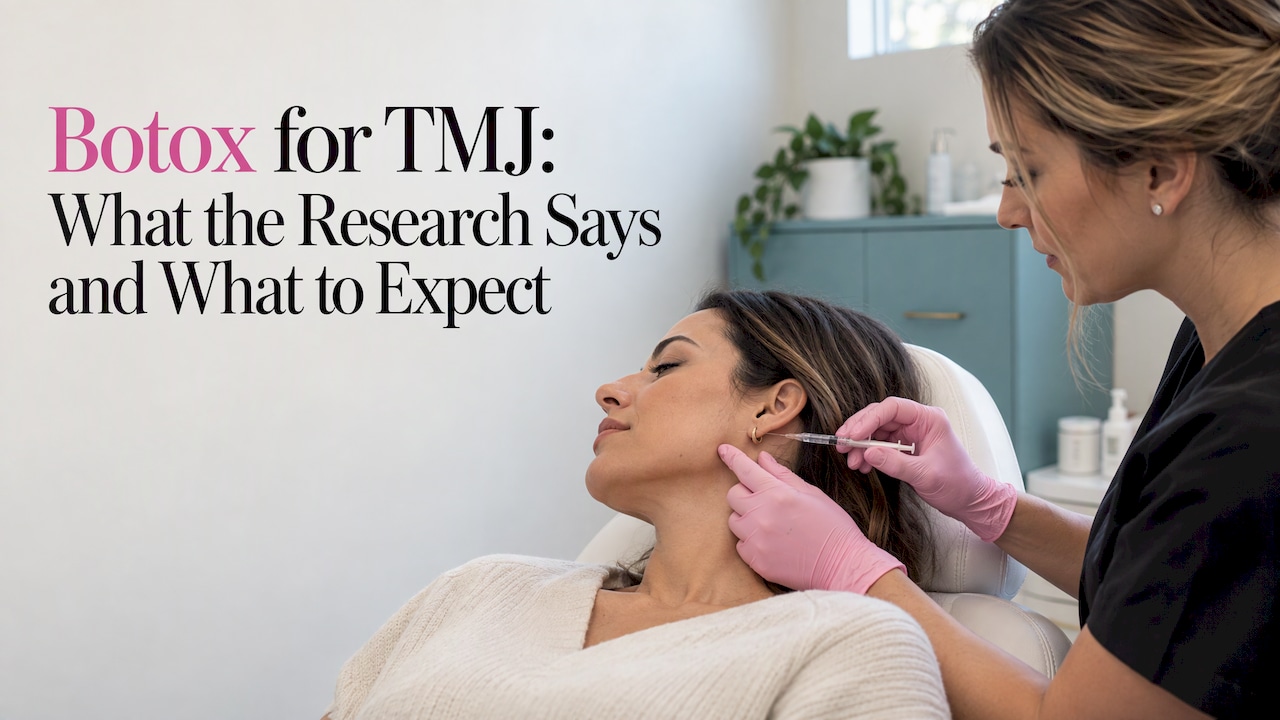

Botox can temporarily relax the jaw muscles that clench and ache in some people with TMJ-related pain, and some clinicians use it when other treatments haven’t helped. It is not FDA-approved for this use, and the research is mixed. Most experts treat it as a second-line option, not a first step. Below you’ll find how it works, who it may suit, what a session is like, the risks, how long it lasts, and what to ask before you book.
TL;DR
- Botox for TMJ is an off-label use: the FDA has not approved it for temporomandibular disorders, though some doctors still offer it.
- It relaxes overactive jaw muscles such as the masseter and temporalis. Effects usually last about three to four months.
- Studies disagree. A 2026 review says it may be an adjunctive or second-line option for selected patients after conservative care.
- Splints, physical therapy and medication usually come first, and often continue alongside injections.
- Choose a licensed, trained medical or dental provider, and tell them about your health history and medications.
Table of Contents
- What Botox for TMJ actually does
- Does it work? An honest read of the evidence
- Why isn’t Botox approved for TMJ?
- Who may be a candidate
- What usually comes before Botox
- What happens during a session
- How long until it works, and how long it lasts
- Side effects and safety
- Does insurance cover it?
- Our perspective
- Questions to ask before you book
- Botox at Sudbury Med Spa
- FAQ
- Sources
What Botox for TMJ actually does
“TMJ” is the shorthand most people use for pain in and around the temporomandibular joint, the hinge that connects your lower jaw to your skull. Clinicians call the broader group of problems temporomandibular disorders (TMD). Some are about the joint itself. Many are about the muscles that move it.
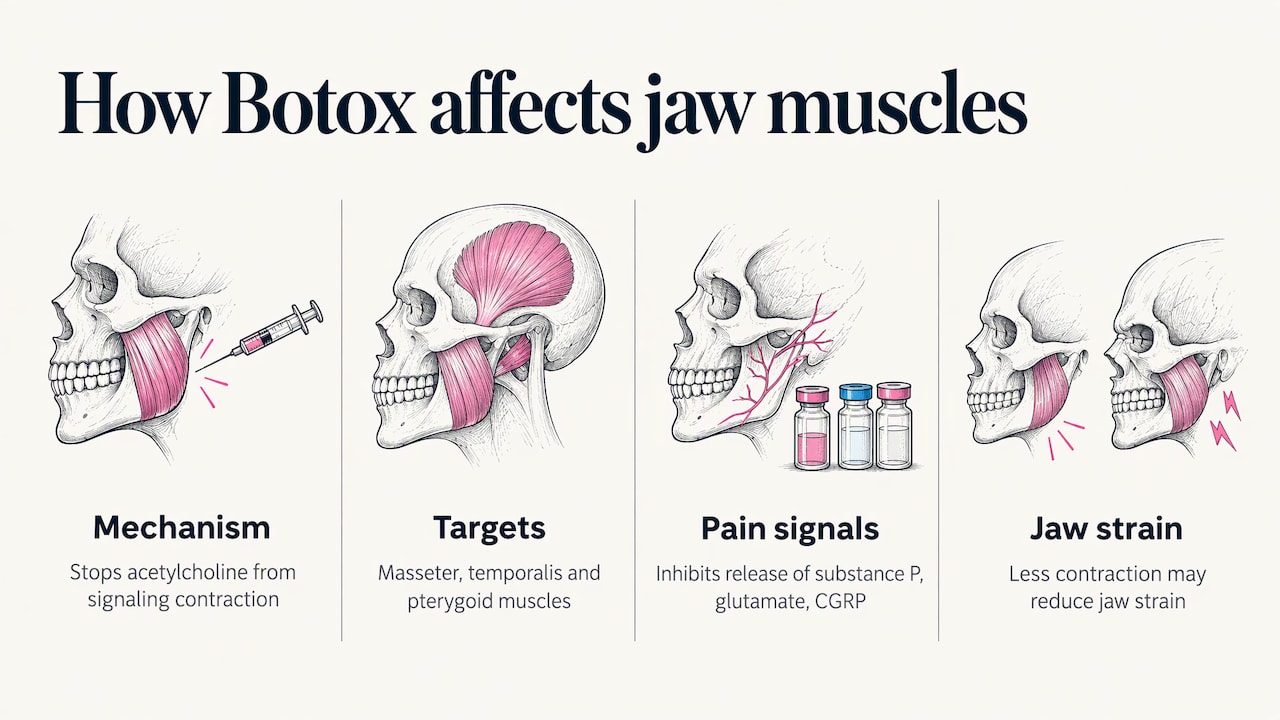
Botox targets the muscle side. According to Health, it temporarily weakens overactive jaw muscles by stopping acetylcholine from telling them to tighten. The masseter (the thick cheek-side muscle you can feel when you clench), the temporalis (at the temple) and the pterygoid muscles are the usual targets.
Cleveland Clinic explains the logic: when a muscle contracts less, it becomes less hyperactive, which can help break the cycle of chronic pain and reduce strain on the jaw.
Muscle relaxation may not be the whole story. The American Association of Endodontists notes that botulinum toxin also inhibits the release of pain-signaling chemicals, including substance P, glutamate and CGRP.
Does it work? An honest read of the evidence
The short answer is that it helps some people, and the studies don’t agree on how many. You deserve to know both sides before you decide.
Studies with encouraging results
- A 2024 randomized, double-blind trial in Scientific Reports found that 80 units of botulinum toxin in the masseter and anterior temporalis reduced pain more than saline at one and six months in patients with refractory myofascial pain.
- A 2024 systematic review of nine clinical trials, summarized by Healthline, found reduced bruxism events and pain scores in sleep bruxism.
- A 2022 review of 24 randomized trials found good evidence for masseter hypertrophy, equivocal evidence for muscle-based TMD, and very little for joint-based (articular) disorders.
Studies that urge caution
- A 2024 PLOS One meta-analysis of 14 trials found Botox was not significantly better than placebo for pain at 1, 3 or 6 months, and called for better-designed trials.
- A 2026 systematic review of 15 trials concluded the evidence does not support routine first-line use, while leaving room for selected patients who haven’t responded to conventional care.
- International recommendations from INfORM/IADR say that using Botox for degenerative or disc-related joint disorders lacks adequate evidence and should be regarded as experimental.
Why such different results? A 2026 narrative review points to wide variation in patient selection, muscles injected, dosing and technique, which makes standard protocols hard to define.
The practical takeaway: Botox appears most relevant when the problem is muscular, meaning clenching, grinding or myofascial pain, and less relevant when the joint itself is the issue. A proper diagnosis comes first.
Why isn’t Botox approved for TMJ?
Botox carries FDA approval for specific conditions. Cigna’s coverage policy lists FDA-approved uses such as chronic migraine prevention and cervical dystonia, and TMJ or bruxism is not among them.
That makes jaw use “off-label.” Off-label doesn’t mean illegal. It means a licensed provider uses a medication for a purpose outside its labeled indications, based on their clinical judgment. Healthline notes that some doctors choose it for some patients despite the lack of approval.
Who may be a candidate
Providers usually consider Botox when conservative treatments aren’t working or quality of life is suffering. Signs your situation may fit that description:
- Jaw pain or tightness that returns despite a night guard or splint
- Frequent clenching or grinding that wears on your muscles
- Tension headaches or temple pain linked to jaw use
- Visible jaw muscle enlargement from heavy clenching
The medical literature lists conditions that rule Botox out. Per Mor and colleagues, contraindications include:
- Known allergy to botulinum toxin
- Active infection or inflammation at the injection site
- Pregnancy and breastfeeding
- Neuromuscular disorders such as ALS, myasthenia gravis, Lambert-Eaton syndrome, muscular dystrophy or multiple sclerosis
- Use of aminoglycoside antibiotics
If any of these apply, say so before any appointment. If you take other medications or supplements, bring the list.
What usually comes before Botox
Conservative care is the standard starting point. A 2025 review recommends physiotherapy, muscle relaxation and strengthening exercises, and occlusal splints as the first-line approach, with botulinum toxin applied for persistent muscular hyperactivity when those fall short.
The Ferrillo review frames Botox as a carefully selected adjunct within a multimodal plan, not a replacement. Cleveland Clinic adds that patients receiving Botox will likely continue physical therapy, splints and medication.
A sensible order looks like this:
- Get a diagnosis from your dentist, an orofacial pain specialist or your physician.
- Try the basics: softer foods, jaw rest, a custom splint, physical therapy, and medication as advised.
- If muscle pain or clenching persists, discuss injections with a licensed provider who treats the jaw.
- Keep your other therapies going alongside.
What happens during a session
A typical appointment is short. Healthline reports that a session may take 10 to 30 minutes, and the injection may feel like a bug bite or prick. Your provider injects small amounts into the chosen muscles, often the masseter and temporalis.
For a walkthrough of how one TMJ-focused appointment is structured, including consultation and injection areas, see how TMJ Botox appointments work.
Aftercare
According to Healthline, you can return to regular activities afterward. The same source advises staying upright for at least four hours and avoiding rubbing or massaging the injection sites. Follow whatever specific instructions your provider gives you.
Dose and technique
There’s no universal dose. The INfORM/IADR recommendations say that, without established protocols, lower-dose regimens should generally be preferred, and that injection technique, training and interdisciplinary collaboration matter. Ask your provider how they decide on dose and injection sites.
How long until it works, and how long it lasts
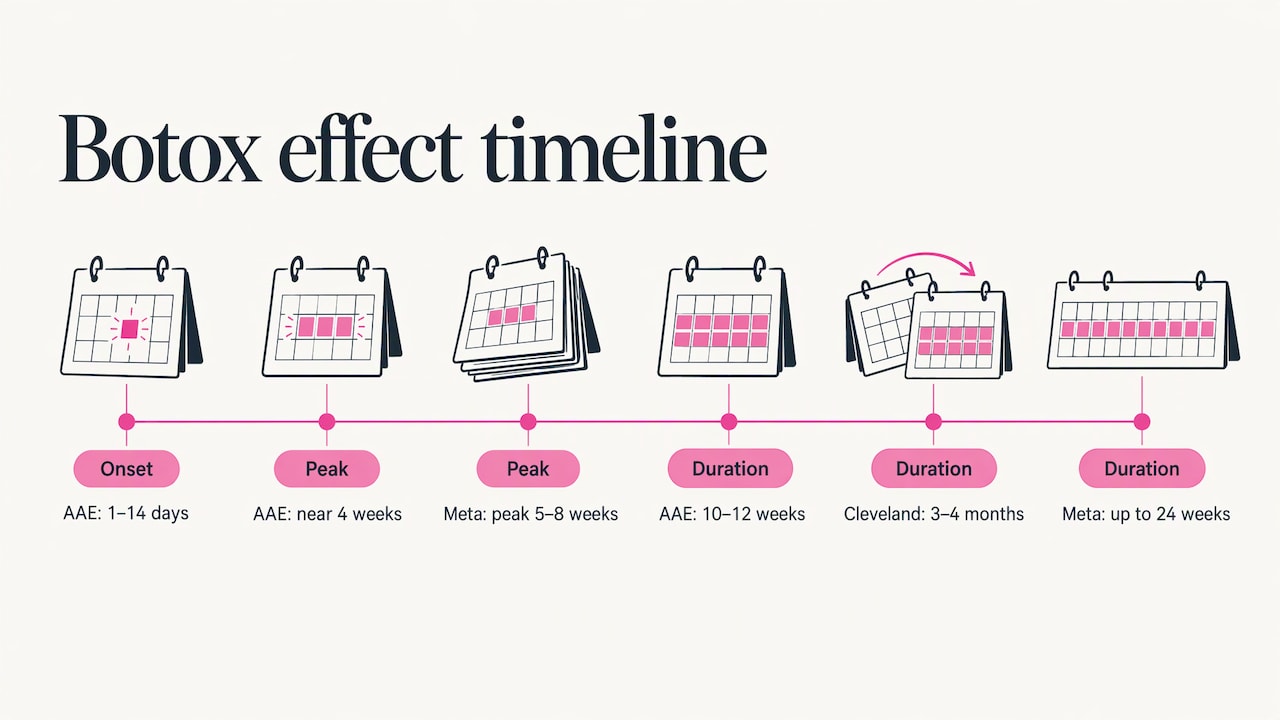
Onset is gradual. Cleveland Clinic says it can take anywhere from a day to a couple of weeks to feel the effects, and most people find results last about three or four months.
The AAE gives a similar picture: onset in roughly 1 to 14 days, a peak near four weeks, and wearing off after about 10 to 12 weeks. It calls the therapy temporary and palliative. A 2023 meta-analysis on bruxism found effects lasting up to 24 weeks, peaking at 5 to 8 weeks.
Because results fade, plan for repeat treatment. Healthline says you could expect at least three sessions over several months, depending on your response and whether symptoms return.
Spacing matters. One 2022 trial found muscle function fully recovered by week 33 after a 50-unit dose, which supported a reinjection interval of 33 weeks. The INfORM/IADR recommendations also note that repeated injections have been linked to effects on muscle and bone and should be planned accordingly. The AAE specifically mentions osteopenic changes and fracture risk with injections into masticatory muscles. Keep your schedule with your provider and don’t treat more often than advised.
Side effects and safety
Most side effects are mild and local. Cleveland Clinic lists:
- Pain, bruising, swelling or redness at the injection site
- Unwanted facial paralysis or cosmetic changes
- Infection or allergic reaction
- Headache and neck pain
- Flu-like symptoms, nausea or indigestion
- Muscle weakness
The FDA label includes a boxed warning about toxin spread beyond the injection site. Swallowing and breathing difficulties can be life-threatening, and you should get immediate medical care if you have trouble breathing, speaking or swallowing.
To reduce risk, get treated by a licensed healthcare provider in a medical setting. The INfORM/IADR recommendations call for trained, licensed medical or dental providers.
Does insurance cover it?
Often not. Because TMJ and bruxism aren’t on the FDA-approved list, major payers typically don’t recognize them as covered indications. Cigna’s 2026 policy, for example, doesn’t list TMJ or bruxism. Coverage varies by plan and by whether a physician bills it as a medical treatment, so call your insurer and ask before you book. Ask for the answer in writing if you can.
Our perspective
We see Botox every day, and we respect what a well-placed, carefully dosed injection can do for how a face looks and feels. Natalie NgocTrang founded Sudbury Med Spa on personalized plans, a clean and comfortable setting, and a team that explains each step before it happens. More than 15,000 treatments have shaped how we work.
When someone asks us about jaw tension, our view is simple: start with a diagnosis, keep your dentist or physician in the loop, and treat injections as one piece of a plan. The research says the same. Good outcomes come from clear goals, honest conversation and a provider who knows facial anatomy well.
That is why we offer free consultations. You can sit down with our team, talk through your goals and your health history, and learn how our Botox services work before you commit to anything. Our consultation is not a substitute for a diagnosis from your dentist or doctor, and we’re glad to work alongside them.
Chris
Questions to ask before you book
Whether you see a dentist, physician or aesthetic provider, these questions keep the conversation focused:
- Who diagnosed my jaw problem, and is it muscular, joint-related or both?
- Which conservative treatments have I tried, and should any continue?
- Which muscles will you inject, and why?
- What dose do you plan to use, and how do you adjust it?
- What is your training and licensure for this type of treatment?
- What can I expect over the next few weeks, and when should I call you?
- How many sessions might I need, and how far apart?
- Does my insurance cover any part of this?
Botox at Sudbury Med Spa
If you’re curious about Botox and want to meet our team, start with our Botox page. If it’s your first time, our first-time Botox guide walks through an appointment step by step. We offer free consultations and financing options, and our annual memberships are listed on our membership page: Silver is $399 per year, Gold is $499 per year, and Platinum is $599 per year.

To see everything we offer, browse our full treatment menu or contact us from our homepage to book a consultation.
FAQ
Does Botox for TMJ really work?
For some people, yes, but the research is mixed. Some randomized trials show less pain than placebo, while a 2024 meta-analysis found no significant difference. Experts generally see it as a second-line option for selected patients with muscle-based problems.
Is Botox good for jaw pain from clenching?
It may help when the pain comes from overactive jaw muscles. Botox relaxes those muscles for a few months, and some studies show fewer bruxism events and lower pain scores. Splints, physical therapy and a proper diagnosis usually come first and often continue alongside it.
Why isn’t Botox approved for TMJ?
The FDA has approved Botox for specific conditions, and temporomandibular disorders aren’t among them. Study protocols vary widely in muscles injected, dose and technique, which makes standardization hard. Using it for the jaw is therefore off-label, at a licensed provider’s discretion.
Will insurance cover Botox for jaw clenching?
Usually not. Major coverage policies list approved indications such as chronic migraine and cervical dystonia, and TMJ or bruxism typically isn’t listed. Plans differ, so ask your insurer before treatment.
How long does Botox for TMJ last?
Most people feel results within days to two weeks, with a peak around four weeks. Effects usually last about three to four months, so repeat sessions are common.
Sources
- Botox for TMJ: Benefits, Risks, and Costs (Health)
- Botulinum Toxin for Orofacial Pain Management (American Association of Endodontists)
- Botox for TMJ: What To Expect (Cleveland Clinic)
- Botox for TMJ: Cost, Side Effects, Efficacy, and More (Healthline)
- Botulinum toxin-A effects on pain, somatosensory and psychological variables (Scientific Reports)
- Botulinum Toxin for Treating Temporomandibular Disorders (PMC)
- The effectiveness of botulinum toxin for temporomandibular disorders (PLOS One)
- Clinical and Functional Effectiveness of Botulinum Toxin in TMD (PMC)
- Botulinum toxin in orofacial pain management (INfORM/IADR)
- Botulinum Toxin for Temporomandibular Disorder: Current Evidence (PMC)
- Multimodal Approaches in the Management of TMD (PMC)
- Botulinum Toxins: Botox coverage policy (Cigna)
- Temporomandibular Myofacial Pain Treated with Botulinum Toxin (PMC)
- BOTOX prescribing information (FDA)
- Effect of Botulinum Toxin Injection on EMG Activity and Bite Force (PMC)
- Effectiveness of Botulinum Toxin Injection on Bruxism (PubMed)


