


A vitamin C IV delivers ascorbic acid straight into a vein, which raises blood levels far higher than any pill or drink can. Doses range from a modest wellness infusion to the very large amounts used in research settings. The right dose for you depends on your health history, so a screening conversation comes before the needle. If you are in the Sudbury, MA area, our IV therapy menu starts with a free consultation.
TL;DR
- IV vitamin C bypasses the gut, so blood levels climb much higher than with oral vitamin C, which has a built-in ceiling.
- “High-dose” is usually defined as 10 grams (10,000 mg) or more per infusion. Research protocols go well beyond that.
- Anyone with G6PD deficiency, kidney disease or a history of kidney stones needs medical screening first, and G6PD deficiency rules out high doses.
- Vitamin C also works on skin from the outside in, so a drip and a skin treatment plan answer different goals.
- Start with a consultation, a health history and a clear plan for your goal.
Table of Contents
- What a vitamin C IV actually is
- IV versus oral vitamin C
- Typical doses and schedules
- What the research says about benefits
- Who needs screening first, and who should avoid high doses
- What the FDA says about injectable vitamin C
- What a good first visit looks like
- Pairing a drip with a skin plan
- Our approach to IV vitamin C
- Start with a free consultation
- FAQ
- Sources
What a vitamin C IV actually is
A vitamin C drip is a sterile solution of ascorbic acid, usually mixed into a bag of saline, that runs through a small catheter in your arm. A session typically lasts from half an hour to a couple of hours depending on the amount. Some formulas add other vitamins and minerals, which is how most wellness infusions are built.
Vitamin C is water-soluble, and your body is not designed to hold large reserves of it. That explains both the appeal of a drip and the reason dose and screening matter.
IV versus oral vitamin C
The core difference is how much reaches your blood. The NIH’s professional fact sheet explains that oral vitamin C, even at very large doses, tops out at plasma concentrations around 220 micromoles per liter, while IV administration can reach as high as 26,000 micromoles per liter. The gut tightly regulates absorption, and the vein skips that gate.
The National Cancer Institute’s physician summary makes the same point: IV doses above 500 mg produce much higher blood ascorbate levels than the same oral dose.
Oral vitamin C has its own limits on the other side. The NIH lists a Tolerable Upper Intake Level of 400 to 2,000 mg a day depending on age, and higher oral doses can cause diarrhea, nausea and abdominal cramps. An IV avoids that digestive side of things, since nothing passes through the stomach.
| Oral vitamin C | Vitamin C IV | |
|---|---|---|
| Route | Absorbed through the gut | Straight into the bloodstream |
| Peak blood level | Capped by absorption | Much higher |
| Digestive upset at large doses | Possible | Not a factor, since the gut is bypassed |
| Needs a clinician | No | Yes, a licensed provider |
| Screening first | Not usually | Recommended, required for high doses |
Typical doses and schedules
Dose language is loose across the industry, so it helps to know the ranges.
- Wellness-style infusions use lower amounts, and the amount is set by the provider after your health history.
- High-dose IV vitamin C is commonly defined as regimens delivering pharmacologic blood levels, typically 10,000 mg or more per infusion, or 50 mg per kilogram per day or more.
- Research protocols go higher. A randomized phase 2 pancreatic cancer trial used 75 grams three times a week alongside chemotherapy. That is a supervised medical protocol, not a spa menu item.
- A 2026 critical review notes that in the UK, IV vitamin C is typically given at 5 to 25 grams per infusion.
Monitoring guidance describes high-dose courses at 10 to 100 grams per infusion, frequency from twice weekly to daily, and sessions of roughly 60 to 120 minutes, with blood tests before and during treatment. The pattern is the same everywhere: the larger the dose, the more screening and monitoring surround it.
What the research says about benefits
It helps to separate three things people mean when they search for vitamin C drip benefits.
Antioxidant and general wellness
Vitamin C is an antioxidant, and the strong blood levels from an IV are the reason people choose a drip for a wellness boost. The 2026 review above notes that high-dose IV vitamin C lowers oxidative stress markers in animal models and small human studies. Researchers are calling for larger, better-designed trials to define where it helps most.
Skin
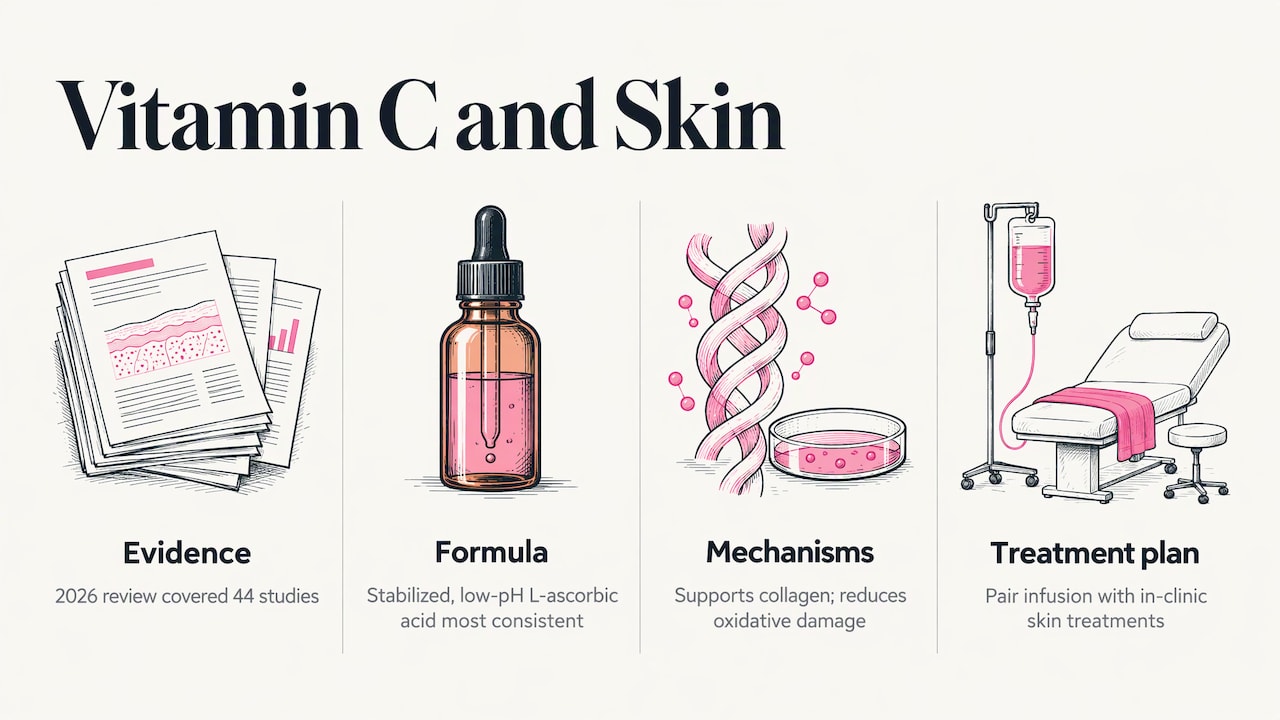
Skin is where vitamin C has its clearest track record. A 2026 systematic review in the Journal of Investigative Dermatology, covering 44 studies, found that L-ascorbic acid in stabilized, low-pH formulas showed the most consistent results for photoaging, hyperpigmentation and healing after procedures. Its authors stress that results depend on the formulation, its stabilization, pH and delivery method, not just on the ingredient name.
A 2025 review adds that vitamin C supports collagen synthesis and reduces oxidative damage, two mechanisms behind its anti-aging reputation.
For your skin goals, that means the delivery method matters. If your concerns are fine lines, uneven tone or dark spots, a plan that pairs an infusion with in-clinic skin treatments, such as those on our skin treatments page, targets the skin directly.
Cancer research
This is the area where most of the serious clinical work on high-dose IV vitamin C is happening, and it is a medical question for oncology teams, not a spa one. In the phase 2 trial of 36 people with stage IV pancreatic cancer, adding vitamin C to chemotherapy was associated with median overall survival of 16 months versus 8.3 months, without added toxicity. The University of Iowa says a larger phase 3 trial is the next step.
The NCI notes that the FDA has not approved high-dose vitamin C as a cancer treatment. If you are in cancer treatment, talk to your oncologist before any infusion.
Who needs screening first, and who should avoid high doses
This is the section to read before booking. Vitamin C is a gentle nutrient at ordinary intake. At infusion levels, a few conditions change the picture.
- G6PD deficiency. This is an inherited enzyme condition. The NCI states that patients with G6PD deficiency should not receive high-dose vitamin C because of the risk of hemolysis, the breakdown of red blood cells. A simple blood test checks for it.
- Kidney disease. The NCI notes kidney failure has been reported in people with existing kidney disorders. The body turns vitamin C into oxalate, which can stress the kidneys.
- History of oxalate kidney stones. The same oxalate pathway is why this history matters, so tell your provider if you have had stones.
- Blood sugar monitoring. A 2026 systematic review lists oxalate kidney injury, hemolysis and interference with fingerstick glucose readings as the main risks. If you have diabetes, say so. Large vitamin C doses can distort some home glucose meters.
- Cancer treatment. The NCI says high doses may interact with some anticancer drugs. Check with your oncology team first.
The same review recommends baseline kidney and G6PD tests, monitoring during infusion by trained staff with emergency response in place. Mayo Clinic Press also lists rare IV-site problems for any vitamin drip, such as bruising, bleeding or infection at the needle site, which is why a licensed clinician places the line.
If you are pregnant, take prescription medication, or have a heart, kidney or blood condition, bring that to your consultation and ask your own doctor whether an infusion suits you.
What the FDA says about injectable vitamin C
There is one FDA-approved injectable ascorbic acid product in the United States, and it is approved for short-term treatment of scurvy when oral intake is not possible. Using IV vitamin C for wellness, skin or other goals is outside that approved use, which is why a provider’s judgment, your health history and a documented plan carry the weight here. In Massachusetts, elective IV therapy is a medical service, so expect an evaluation by a licensed clinician rather than a walk-in drip bar experience.
What a good first visit looks like
You can judge a provider by the first appointment. Here is what a careful visit covers.
- Goal. Energy, recovery, skin glow or something else? The goal shapes the formula.
- Health history. Kidney problems, stones, G6PD status, diabetes, medications and pregnancy all come up.
- Labs when needed. Higher doses call for baseline blood work, as the monitoring guidance above describes.
- Plan and schedule. A single session or a short series, with the reason for each.
- Monitoring. A trained clinician places the line and stays nearby while it runs.
Wear a short-sleeved or loose top, eat beforehand and drink water. Most people return to normal activity right after.
Pairing a drip with a skin plan
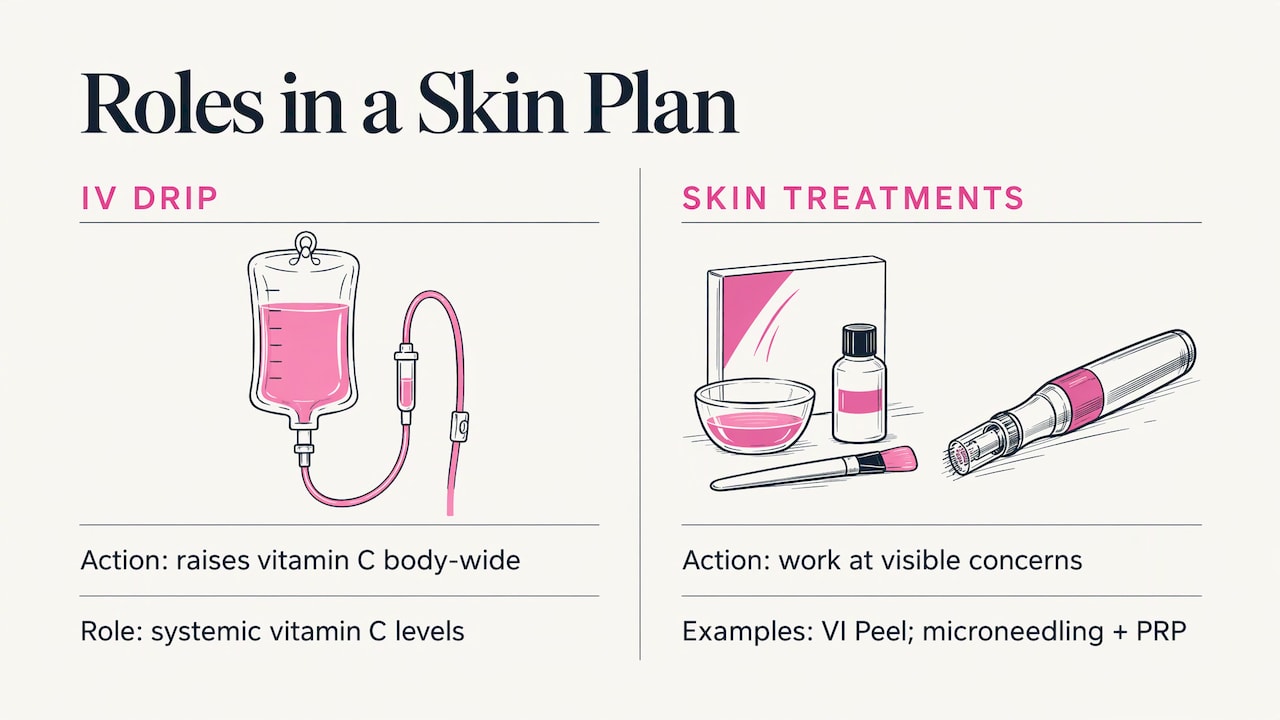
If your reason for searching is skin, think in layers. A drip raises vitamin C levels throughout your body. In-clinic skin treatments work where you can see the concern. Our team can build a plan that combines the two, for example a chemical peel such as the VI Peel for tone and texture, or microneedling with PRP for collagen support. The same JID review points to vitamin C’s role in healing after procedures, which makes the combination logical when you are planning treatments.
For a related question, our guide to hangover IV therapy explains how we think about hydration infusions and when they make sense.
Our approach to IV vitamin C
We think of IV therapy as a medical service that deserves the same care as an injectable or a laser session. Vitamin C is a good example. The science on how it reaches the blood is clear, and so are the screening steps around higher doses. That is why every plan we build starts with a conversation, not a menu.
Our approach is personalized treatment plans, built around your goal and your history. Someone who wants a brighter complexion before an event needs a different plan from someone chasing steady energy, and a good plan might combine an infusion with a peel, a facial or a collagen-building treatment.
With more than 15,000 treatments behind our team, led by founder Natalie NgocTrang, we keep the environment clean and comfortable, and we explain each step before we do it. Our consultations are free, so you can ask every question first.
Chris
Start with a free consultation
Our IV therapy and weight loss program page lists the infusion options we offer at Sudbury Med Spa. The free consultation is where we go over your goals and health history and put together a plan that fits.

If you expect to come back regularly, our SILVER, GOLD and PLATINUM memberships cost $399, $499 and $599 per year. Financing options are available too.
FAQ
How often can you get a vitamin C IV?
It depends on the dose and your health. Monitoring guidance describes high-dose courses anywhere from twice weekly to daily in medical settings, with blood tests along the way. For a wellness plan, your clinician sets the schedule after reviewing your history.
Is a vitamin C drip better than a supplement?
They do different jobs. A supplement is capped by gut absorption, with plasma levels around 220 micromoles per liter at most, while an IV reaches far higher levels. If you want those higher blood levels, an infusion is how you get them.
Does vitamin C IV help skin?
Vitamin C supports collagen production and reduces oxidative damage, and the strongest dermatology evidence is for stabilized topical formulas. Many people combine an infusion with peels, facials or microneedling so the skin is treated from both sides.
Who should not get high-dose vitamin C IV?
People with G6PD deficiency should not receive high doses, and those with kidney disease or a history of oxalate kidney stones need screening and a doctor’s sign-off first, according to the NCI. Tell your provider about diabetes, pregnancy and any cancer treatment too.
How long does a vitamin C IV take?
Sessions generally run from about half an hour for smaller infusions to 60 to 120 minutes for larger ones. Your provider will confirm the timing for your dose.
Sources
- Vitamin C: Health Professional Fact Sheet (NIH Office of Dietary Supplements)
- Intravenous Vitamin C (PDQ) (National Cancer Institute)
- Clinical benefits and risks of high-dose intravenous vitamin C (systematic review)
- A randomized trial of pharmacological ascorbate in pancreatic cancer (Redox Biology, 2024)
- Clinical applications of vitamin C in dermatology (Journal of Investigative Dermatology, 2026)
- To IV or Not to IV: The Science Behind Intravenous Vitamin Therapy (2025)
- Intravenous longevity therapy: a critical review (Acta Dermatovenerol APA, 2026)
- IV Vitamin therapy: Understanding the lack of proven benefit and potential risks (Mayo Clinic Press)
- C To Believe (University of Iowa, Spring 2025)
- Clinical monitoring of high-dose vitamin C IVs (Ubie Doctor’s Note, 2026)
- ASCOR ascorbic acid injection prescribing information


