
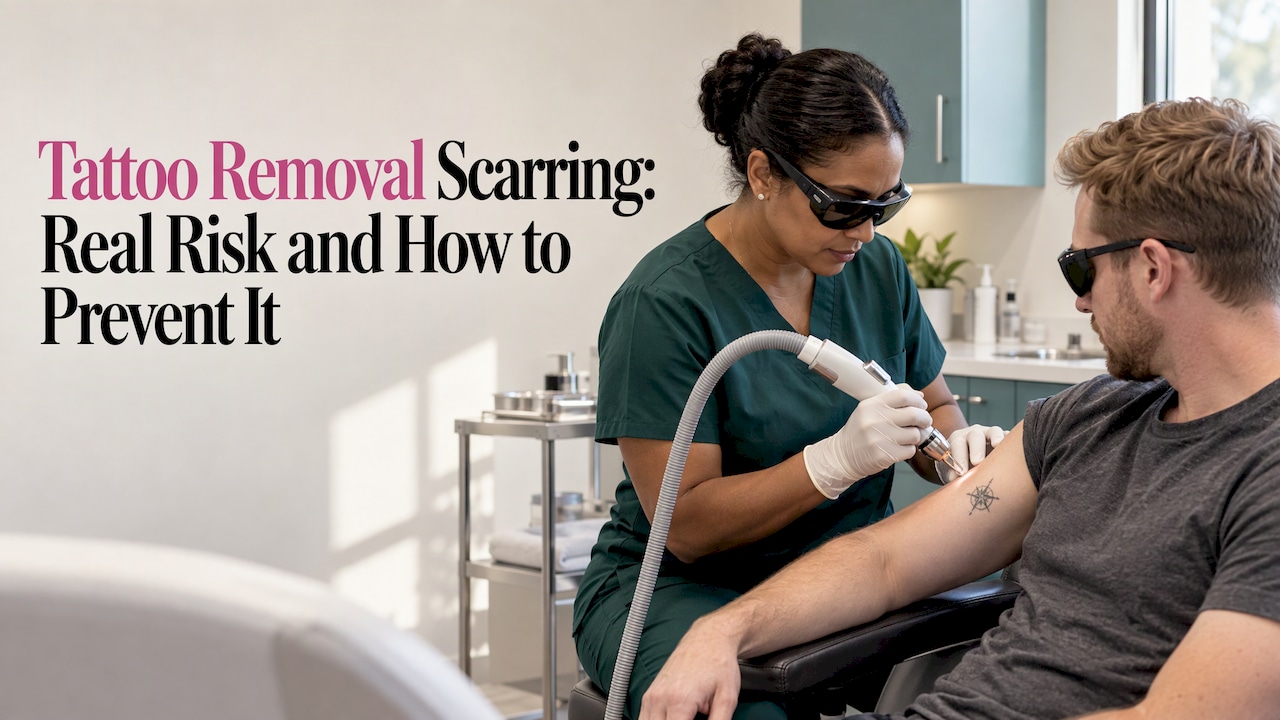

Laser tattoo removal done correctly rarely leaves a scar. In a review of 1,041 patients who each had at least five laser sessions, hypertrophic (raised) scarring showed up in 0.28% of them, and no one developed a keloid. The scars people fear tend to come from the wrong device, an aggressive setting, poor aftercare, or removal methods that wound the skin. As for pain, most people describe a quick snap, and it can be managed. Below, we cover what raises scarring risk, what the pain feels like, and how to heal well.
TL;DR
- Scarring after laser tattoo removal is uncommon: 0.28% of 1,041 patients in one large chart review developed raised scars, and none developed keloids.
- Risk goes up with aggressive settings, untrained operators, darker or tanned skin treated with high energy, and methods that cut or abrade the skin.
- Laser removal is often compared to a rubber band snapping against the skin. Numbing options exist, and soreness afterward should not last long.
- Aftercare decides a lot: keep the area clean and moist, do not pick blisters or scabs, and protect it from the sun for 3 months.
- A consultation before your first session is where skin type, ink colors, and tattoo location get matched to a plan.
Table of Contents
- Does tattoo removal leave scars?
- What raises the risk of scarring
- Why the method matters
- Does tattoo removal hurt?
- Aftercare that protects against scarring
- Who should wait or avoid laser removal
- A realistic timeline
- Our perspective
- Plan your removal with us
- FAQ
- Sources
Does tattoo removal leave scars?
It can, but with laser treatment it is the exception. Three numbers help put it in proportion.
| Finding | Result | Source |
|---|---|---|
| Hypertrophic scarring after 5+ Q-switched Nd:YAG sessions (1,041 patients) | 0.28% (3 patients) | Kirby et al., U.S. chart review |
| Keloids in the same group | 0 patients | Kirby et al. |
| Adverse effects of any kind in a large prospective study | 6.2% of patients, mostly hyperpigmentation (4.8%) | Khunger et al. review |
| Complications per session in a 2026 practitioner survey | 8.1% of sessions, with hypertrophic scarring at 0.2% | Poelhekken et al., 2026 |
The pattern is consistent. Most side effects are temporary skin reactions, such as swelling, blistering, or a change in color. Lasting scars are the smallest slice.
The authors of the chart review noted that stories of scarring often trace back to inappropriate devices, aggressive protocols, poor aftercare, or confusion about what counts as a scar. That last point matters. A temporary light or dark patch is not a scar, and it behaves differently.
Scar or temporary mark?
After treatment you may see redness, blisters, scabbing, and later lighter or darker patches. The American Academy of Dermatology says light or dark spots tend to disappear within 6 to 12 months. A true scar is a change in texture: raised, thick, pitted, or firm tissue that stays after the skin has healed.
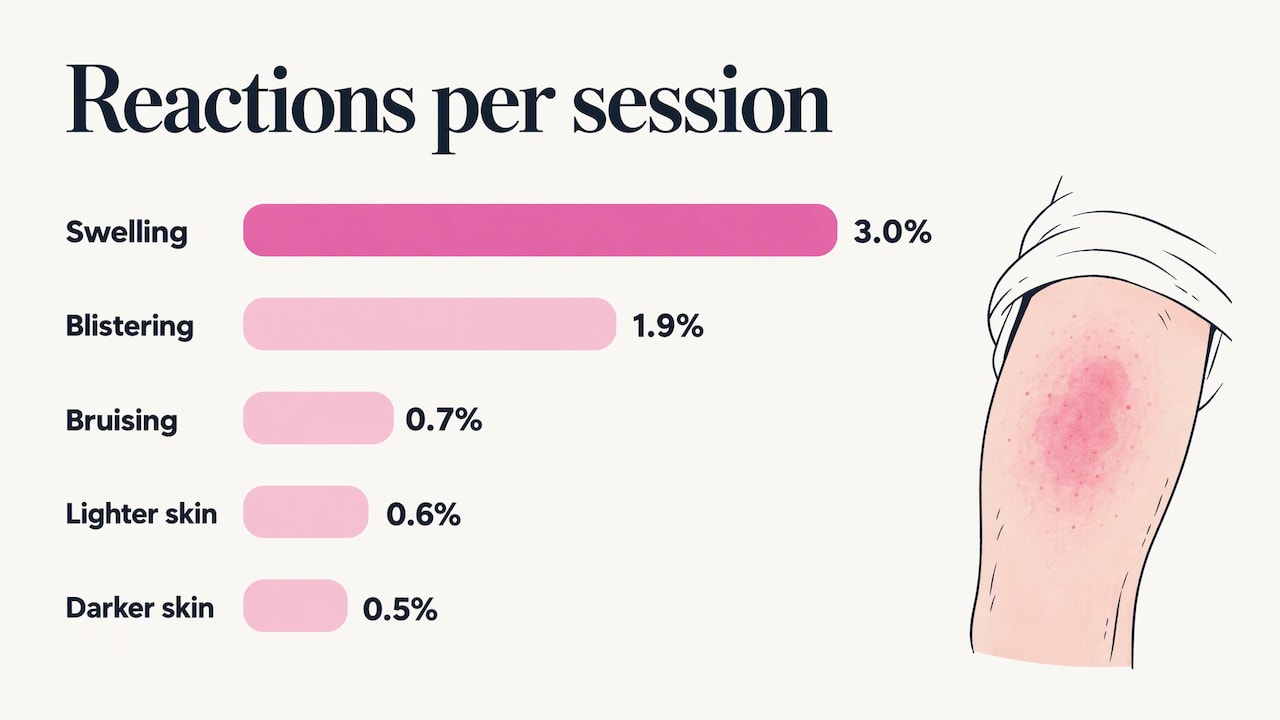
In the practitioner survey, the most common reactions per session were swelling (3.0%), blistering (1.9%), and bruising under the skin (0.7%), followed by lighter skin (0.6%) and darker skin (0.5%). If you want a plain-language list of the less common reactions, this overview of skin reactions after laser tattoo removal is a good companion read.
What raises the risk of scarring
Scarring is not random. Several factors push the odds up or down, and most of them can be discussed before your first session.
Skin type and tanning
Laser energy is absorbed by pigment, including the melanin in your own skin. A review of tattoo complications explains that scarring can occur if high energy is used, particularly in dark or tanned skin, because the skin’s own melanin takes in most of the laser light.
That does not mean darker skin cannot be treated. In the chart review, none of the 38 patients with Fitzpatrick skin types V or VI developed hypertrophic scars or keloids. The Fitzpatrick scale is the six-step system used to describe how skin reacts to sun, from type I (very fair, burns easily) to type VI (deeply pigmented). Practitioners in the 2026 survey did report more complications on higher skin types, partly because those tattoos can need more sessions, which adds up the total exposure. We cover this in more depth in our guide to tattoo removal on dark skin.
A practical step for everyone: stay out of tanning beds and avoid a fresh tan before treatment.
Ink colors, age, and density
The same survey lists skin type, tattoo age, ink color, density or layering, location, and any initial scarring as potential risk factors. Complications were reported more often with colored tattoos and tattoos less than a year old. Dense, layered ink, such as a cover-up on top of an older tattoo, takes more careful planning. Black ink is generally the most straightforward to treat because it absorbs a broad range of laser wavelengths, while some colors respond more slowly.
Location and any existing scar tissue
Thin skin over bone, such as ankles, wrists, and ribs, and areas that stretch or rub against clothing can heal differently from the upper arm or thigh. If the original tattoo already left a raised or textured area, tell the person treating you. That initial scarring is on the list of risk factors.
Who is holding the laser
This is the factor you control most. The AAD notes that scarring, texture changes, and burns are more common when the procedure is done by someone without medical training. In the 2026 survey, 87.2% of laser practitioners had met clients previously treated by untrained providers, and the authors suggest training or certification could improve safety.
Technique and settings count too. Too much energy, sessions spaced too closely, or treating over skin that has not healed all raise the odds of a problem. The FDA states that laser removal needs multiple treatments with a few weeks between them so the skin can heal. Rushing the schedule is not a shortcut.
Why the method matters
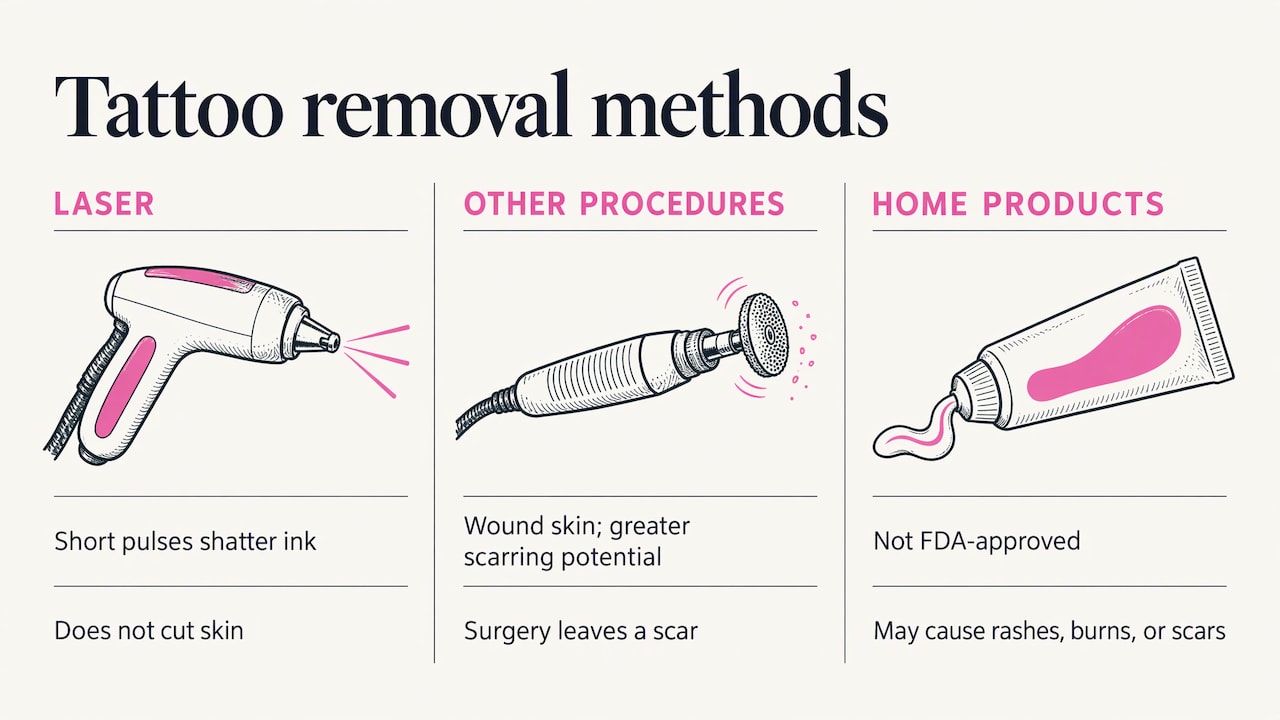
Not every way of removing a tattoo carries the same scarring risk. The FDA says dermabrasion, non-tattoo ablative lasers, and surgical removal wound the skin, give highly variable results, and carry greater potential for scarring than laser treatment. Mayo Clinic adds that surgical removal leaves a scar and is practical mainly for small tattoos.
The FDA also has not approved any tattoo-removal creams, ointments, or do-it-yourself kits, and it warns that they may cause rashes, burns, or scars. Skip anything sold as a home removal product.
Q-switched and picosecond lasers work differently from those methods. They deliver very short pulses that shatter ink into particles your body then clears, without cutting the skin. If you want to know what results to expect, see our page on whether laser tattoo removal works.
Does tattoo removal hurt?
Yes, to a degree, but it is brief and most people find it manageable. The FDA describes the sensation as similar to a thin rubber band snapped against the skin, and says a small amount of numbing cream can be applied beforehand if it is painful.
WebMD notes that pain depends on the tattoo’s location, the type of laser, and other details. Some people say it hurts about the same as getting the tattoo, others say less. As a rule of thumb, bony or thin-skinned areas such as ribs, ankles, and the inner arm feel sharper than the outer thigh or upper arm. Larger or denser designs mean more pulses, so the session feels longer.
What the pain feels like
- During: quick, sharp snaps with a warm, stinging feeling, usually over within minutes for a small piece.
- Right after: soreness and redness similar to a sunburn. The FDA says redness or soreness should not last long.
- Days after: the skin may swell, blister, or scab as it heals.
Ways to manage the discomfort
University of Utah Health explains that a topical numbing compound is applied before removal, and injections or ice can also control pain. The right option depends on the area and your comfort level, so raise it during your consultation.
Be careful with numbing products you buy yourself. Over-the-counter numbing creams are capped at 4% lidocaine. The FDA has taken action against products with far higher strengths, including a 40% gel and a 29.9% cream. High-strength lidocaine can cause an irregular heartbeat, seizures, and breathing problems, especially over large areas, broken skin, or under tight dressings. Use only what your provider recommends, and never wrap a numbed area in plastic on your own.
Aftercare that protects against scarring
What you do in the weeks after a session matters as much as the laser settings. The advice from dermatology and medical sources lines up well:
- Clean gently. Wash the area as instructed and apply antibiotic ointment for a few days, then moisturize and cover it until it has healed, as the AAD advises.
- Keep blisters and scaling skin moist. University of Utah Health suggests petroleum jelly and keeping the area out of the sun.
- Do not pick. WebMD’s aftercare list includes not picking scabs or blisters, along with ice packs for soreness, avoiding soaking, and skipping tight clothing over the area.
- Protect from the sun. The AAD recommends shielding treated skin for 3 months, ideally with clothing that blocks light completely. WebMD adds SPF 30 or higher sunscreen once the skin allows.
- Keep every appointment. Spacing is part of the safety plan.
Our step-by-step tattoo removal aftercare guide goes through each stage of healing.
Signs you need urgent medical care
See a doctor or go to emergency care if you have excessive bleeding, severe pain that does not ease, redness or swelling that spreads quickly, a fever, or red streaks coming from the treated area. University of Utah Health lists these warning signs.
Who should wait or avoid laser removal
The AAD says most people can safely have laser tattoo removal, but those without a healthy immune system, and women who are pregnant or breastfeeding, should not be treated. If you have a history of keloids, a skin condition in the area, or take medications that affect sun sensitivity, mention it before treatment, and ask your doctor if you are unsure.
A realistic timeline
Complete removal can take many treatments, and the FDA notes that in some cases it may not be possible. That is why a plan beats a single session. Expect:
- Weeks between sessions so the skin can heal fully.
- Fading in stages rather than all at once, with lighter ink after each visit.
- Temporary color changes in the skin that usually settle over 6 to 12 months.
If you only want a design lightened so a new piece can go over it, that is a different goal with fewer sessions. See how tattoo lightening for a cover-up works.
Our perspective
We treat scarring as something to plan against from the first conversation, not something to react to afterward. Every tattoo is different: the ink, the depth, the age, the part of the body, and your skin all change how it should be treated.
That is why we start with a free consultation. We look at the tattoo, talk through your skin and your history, and build a treatment plan around you rather than a standard package. Spacing sessions so your skin heals, and giving clear aftercare instructions, are part of how we help you keep results smooth.
Our team, led by founder Natalie NgocTrang, has completed more than 15,000 treatments, and we keep our clinic clean and comfortable because healing starts with a calm, careful environment. If pain is your worry, tell us. We would rather talk it through before you sit down than after.
Chris
Plan your removal with us
If you are in Sudbury or the surrounding Massachusetts area, our laser tattoo removal service starts with a free consultation, where we go over your tattoo, your skin, and a treatment plan made for you. Financing options are available, and our membership plans start at $399 per year for Silver, $499 for Gold, and $599 for Platinum. See the membership page for what each includes.

You can also browse the rest of our non-surgical treatments if you want to plan skin care around your removal.
FAQ
Does tattoo removal leave scars?
It can, but scarring is uncommon with laser treatment done correctly. In a U.S. review of 1,041 patients, 0.28% developed hypertrophic scars and none developed keloids. Temporary blistering or color changes are more common, and they usually fade.
Does tattoo removal hurt more than getting the tattoo?
Experiences vary. WebMD reports that some people say it feels like a rubber band snap, while others say it hurts about the same as or less than getting the tattoo. Location and laser type make a difference, and numbing options are available.
How long does the pain last after a session?
Soreness and redness should not last long, according to the FDA. Blisters or scabs may appear over the following days. Follow your aftercare instructions, and seek urgent care if you develop fever, spreading redness, or severe pain.
Can I do laser tattoo removal every 2 weeks?
No. The FDA says treatments need a few weeks between them so the skin can heal. Treating too soon raises the chance of blistering and scarring, so your provider sets the interval for your skin and tattoo.
Sources
- The Incidence of Hypertrophic Scarring and Keloid Formation After Laser Tattoo Removal
- Practitioner-Reported Complications in Tattoo Removal
- Complications of Tattoos and Tattoo Removal: Stop and Think
- Tattoo Removal: Options and Results, FDA
- Tattoo removal: Lasers outshine other methods, American Academy of Dermatology
- Tattoo removal, Mayo Clinic
- Understanding Laser Tattoo Removal, University of Utah Health
- Laser Tattoo Removal Procedure, Benefits, and Risks, WebMD
- FDA Alert: Unsafe OTC Numbing Products Identified
- Skin reactions after laser tattoo removal


