

CO2 lasers go deeper and tighten more, but they heat the skin more and take longer to heal. Erbium (Er:YAG) lasers work more precisely, heal faster and are gentler on pigment, but they usually change deep wrinkles and scars less. The right one depends on what you want to fix, how much downtime you can take and your skin tone. At Sudbury Med Spa we offer both CO2RE and an erbium laser, and a free consultation is where you match the laser to your skin.
TL;DR
- CO2 is the stronger choice for deeper wrinkles, acne scars and more advanced sun damage. Expect more heat, a longer recovery and usually one treatment.
- Erbium suits mild-to-moderate lines, texture and sensitive areas. It has less residual heat, quicker healing and a lower risk of lightening the skin, but it often takes more than one session.
- Skin tone matters more than the brand name of the laser. Darker skin carries a higher risk of pigment changes with both, so settings and sun protection decide the outcome.
- Morpheus8 is a different category (radiofrequency microneedling) with far less surface damage, so it is worth discussing if downtime is your main worry.
- Aftercare is half the result. Ointment, gentle cleansing and daily sunscreen protect the new skin.
Table of Contents
- How the two lasers work
- CO2 vs. erbium at a glance
- Which one fits which skin concern
- Healing timeline: what to expect
- CO2 laser aftercare
- Risks and skin tone
- Morpheus8 vs. CO2: a different approach
- How to choose: five questions for your consultation
- Our point of view
- Book a free consultation in Sudbury
- FAQ
- Sources
How the two lasers work
Both are “ablative” lasers. That means they remove thin layers of damaged skin so new, smoother skin and fresh collagen (the protein that keeps skin firm) can form. The difference is the wavelength, and what each wavelength does to water in your skin.
A CO2 laser delivers more heat to the tissue around the treated spot. That heat is why it tightens skin so well. A 2021 review explains that erbium light is absorbed by water roughly ten times more strongly, so it removes tissue more efficiently with only 5 to 10 micrometers of residual thermal damage. Less leftover heat means less swelling and a gentler recovery.
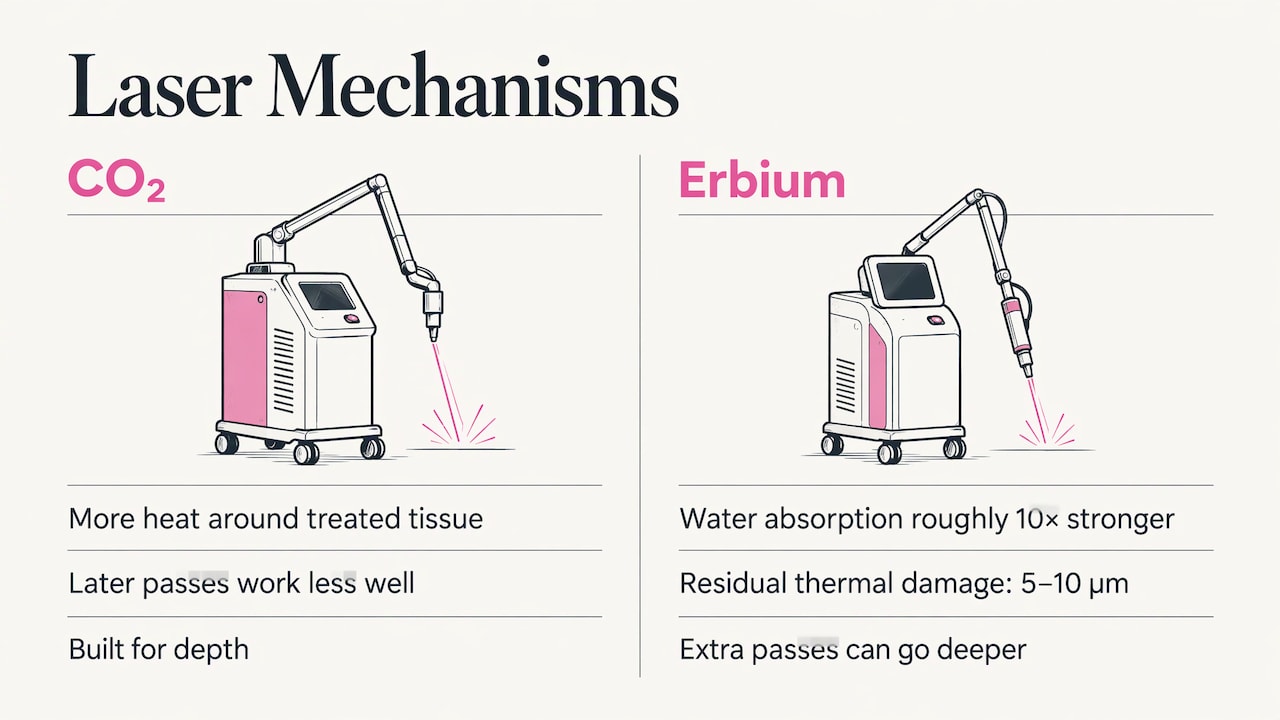
That same review notes that with erbium, extra passes can go deeper without piling on heat damage. With CO2, tissue dries out after the first pass, so later passes work less well. This is why an erbium laser can be adjusted from a light refresh to a fairly deep treatment, while CO2 is built for depth.
Most modern treatments are also “fractional.” The laser treats a grid of tiny columns and leaves the skin between them intact, which speeds healing compared with older full-surface resurfacing.
CO2 vs. erbium at a glance
| CO2 laser | Erbium (Er:YAG) laser | |
|---|---|---|
| Depth and heat | Deeper, more heat | More superficial, less heat |
| Skin tightening | Stronger | Milder |
| Best for | Deep wrinkles, acne scars, advanced sun damage | Fine lines, mild-to-moderate wrinkles, texture, sensitive areas |
| Typical sessions | Often one | Often 2 to 4 for fractional or non-ablative approaches |
| Healing | New skin in about 7 to 10 days, full recovery at least a month | Generally quicker, though still days of peeling and redness |
| Pigment risk | Higher, especially lightening in darker skin | Lower, but not zero |
The session counts and healing window come from Mayo Clinic’s laser resurfacing overview. The treatment itself usually takes 30 minutes to 2 hours.
Which one fits which skin concern
Deep wrinkles, scars and heavy sun damage
Johns Hopkins Medicine says CO2 lasers effectively treat scars, burns and signs of aging, especially deep wrinkles. Erbium can improve mild-to-moderate facial wrinkles but does less for deeper ones. If your main goal is a visible change in deep lines or acne scarring, CO2 is the stronger tool.
Fine lines, texture and sensitive areas
For lighter concerns, erbium is often the better trade. A 2024 review in the Journal of Cosmetic Dermatology notes that Er:YAG lasers act more superficially and so lower the risk of complications such as hyperpigmentation and prolonged redness. That makes them a sensible fit around the eyes, neck and other thin or delicate skin, where heat is harder to control.
What a head-to-head study found
In a small Italian study of 19 women, both fractional CO2 and a hybrid erbium laser significantly improved fine lines, roughness and mottled pigmentation. CO2 scored higher on improvement but brought longer healing and more complications, and patients were more satisfied with the hybrid laser. The takeaway is not that one wins. The stronger result comes with a heavier recovery, and many people prefer a smaller change they can live through comfortably.
Is CO2 outdated?
No. Fractional versions are still used for moderate-to-advanced aging. A 2024 expert consensus on fractional ablative CO2 describes the typical candidate as aged 40 to 60 with light skin (Fitzpatrick I to II), thin-to-moderate skin and moderate-to-advanced wrinkles. The Fitzpatrick scale sorts skin from I (always burns, very fair) to VI (deeply pigmented) by how it reacts to sun. The same panel found 94% of experts expect a moderate improvement, and 81% recommend add-on treatments such as neuromodulators like Botox, IPL or fillers. In other words, resurfacing is often one part of a plan.
Healing timeline: what to expect
Here is the realistic arc for ablative resurfacing, based on Mayo Clinic’s description.
- Days 1 to 3: The skin is raw, red and swollen. You may use thick ointment, a protective dressing, ice packs and pain relievers.
- Days 7 to 10: New skin usually covers the treated area. Peeling and crusting settle.
- Weeks 3 to 6: Pinkness fades gradually. One review of erbium resurfacing describes 7 to 10 days to re-form the skin surface and 3 to 6 weeks of redness after a deeper full-field treatment.
- About a month and beyond: Mayo Clinic says full recovery takes at least a month, and collagen keeps rebuilding for months after.
Lighter erbium or fractional settings shorten this. A 2010 review of fractional technology puts erbium downtime at around 5 to 7 days, and fully ablative CO2 at a week or more. When you can go back to work or social events depends on the depth we choose, so plan your calendar around the consultation, not the other way round.
CO2 laser aftercare
Aftercare is where good results are protected. The guidance below follows Johns Hopkins Medicine and the 2024 expert consensus. Always follow the written instructions you are given for your own treatment.
- Clean gently as directed, and apply ointment for 7 to 10 days. In the consensus, 57% of experts recommended petrolatum for 4 to 7 days, then a regular moisturizer.
- Take any prescribed medications exactly as instructed.
- Avoid sun exposure and use sunscreen every day. Fresh skin burns and pigments easily.
- Restart active skincare slowly. 76% of the panel resumed active ingredients gradually between day 8 and day 42.
- Do not pick or peel crusts. That raises the risk of scarring.
- Call your provider or doctor for fever, bleeding or excessive pain, which Johns Hopkins lists as reasons to seek medical advice.
Erbium aftercare follows the same principles with a shorter timeline.
Risks and skin tone
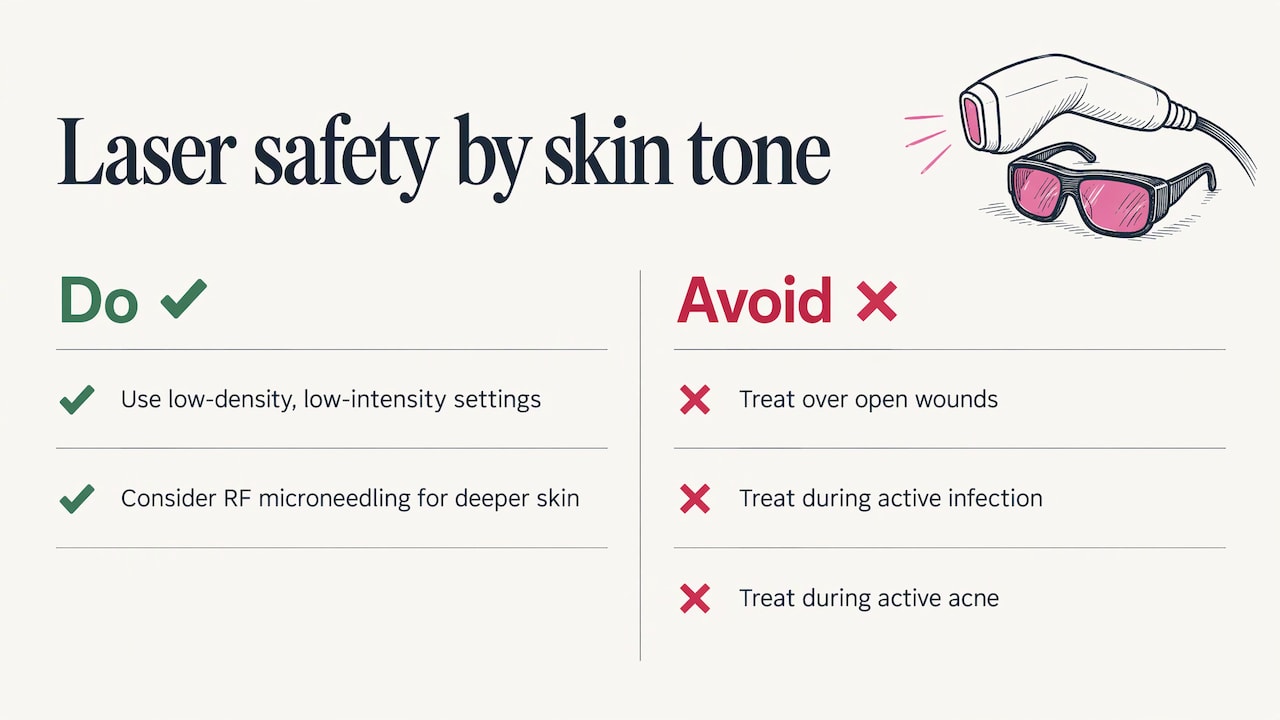
Johns Hopkins lists the general risks of laser resurfacing: infection, itching or pain, peeling, redness and swelling, scarring, hyperpigmentation or hypopigmentation (darker or lighter patches), and weeping or crusting. It also advises against treatment over open wounds, active infection or active acne.
Skin tone changes how you weigh these risks. A Johns Hopkins summary says CO2 can cause lightening, particularly in darker skin, so it is most often recommended for lighter tones, while erbium is less likely to cause it. Post-inflammatory hyperpigmentation, meaning dark marks left after skin is irritated or injured, is the most common complication in Fitzpatrick IV to VI skin. Its rate rises with both energy and density, so clinicians use conservative, low-density, low-intensity settings on skin of color.
If you have medium to deep skin, the conversation is less about CO2 versus erbium and more about whether ablative resurfacing is the right category at all. Mayo Clinic points out that radiofrequency microneedling is less likely than ablative lasers to cause pigment changes. Our guide to tattoo removal on dark skin explains how we think about laser safety for deeper tones.
Morpheus8 vs. CO2: a different approach
Morpheus8 combines microneedling with radiofrequency energy. Fine needles deliver heat below the surface, so the top layer is largely left intact rather than vaporized. The aim is collagen remodeling and firming with a lighter recovery than ablative resurfacing.
A practical way to compare them:
- Choose CO2 when the goal is visible resurfacing of deep lines, scars or sun-damaged surface texture and you can accept a longer recovery.
- Choose Morpheus8 when the priority is firmness and texture with less downtime, or when your skin tone makes surface-ablating lasers a worry.
- Choose erbium when you want a true laser resurfacing for lighter concerns with a milder recovery.
They are not rivals in every case. Many plans combine an energy treatment with injectables or skincare. You can read about Morpheus8 and microneedling with PRP on our treatment page.
How to choose: five questions for your consultation
- What bothers you most? Deep folds and scars point toward CO2. Fine lines and uneven texture point toward erbium or Morpheus8.
- How much downtime can you take? Count the days you are willing to look red and flaky, not just the days off work.
- What is your skin tone and tanning history? This sets how conservative the settings need to be.
- Are you tan, or do you have active acne or open skin? Treatment is usually postponed until skin is calm.
- Do you want one stronger treatment or several lighter ones? CO2 often means one deeper session, while erbium or fractional approaches may be spread over several.
Our point of view
Most people who ask us about CO2 versus erbium are really asking, “How much change can I get for how much recovery?” That is the right question, and no laser answers it before someone has looked at your skin.
We keep the whole range available so the plan follows your skin and your calendar, not the other way round. CO2RE when depth and tightening are the goal, erbium when you want precision and a gentler recovery, Morpheus8 when firming with less surface disruption is the better fit.
Our team, led by founder Natalie NgocTrang, builds a personalized treatment plan for every client. With more than 15,000 treatments behind us, we pay close attention to the details that decide results: your skin tone, your sun exposure and your aftercare.
Resurfacing works best as part of a plan. We often pair it with injectables or a skincare routine so results last.
Chris
Book a free consultation in Sudbury
If you are weighing CO2 against erbium, the quickest route to a clear answer is a consultation. We offer free consultations and personalized treatment plans, with financing options available, so you can understand the plan before you commit. You can look at CO2RE, our erbium laser and the full services menu, or start at our home page to book.
If you also want a lighter option for pigment or redness, our photorejuvenation treatment is another place to start.
FAQ
Is erbium laser worth it for wrinkles?
For fine lines and mild-to-moderate wrinkles, yes. Johns Hopkins Medicine says erbium can improve them, with a lower risk of lightening the skin than CO2. For deeper wrinkles, CO2 generally gives a stronger change, so the answer depends on how deep your lines are.
What is the most effective laser for aging skin?
For advanced aging, such as deep wrinkles and heavy sun damage, CO2 is generally the most effective ablative option. It also brings more downtime. For earlier signs of aging, erbium, Morpheus8 or a lighter laser may deliver what you want with less recovery.
Can erbium and CO2 be combined?
Some clinicians use erbium and CO2 wavelengths together, and hybrid lasers exist, as in the Italian study above. Whether that suits you depends on your skin concern and tone, so raise it at your consultation.
How many treatments will I need?
Mayo Clinic says ablative resurfacing usually needs one treatment. Fractional or non-ablative erbium approaches typically need 2 to 4 treatments over weeks or months. Your plan will depend on the depth and your goals.
Sources
- Laser resurfacing of the aging face (Pozner et al., 2021)
- Advancements in laser technologies for skin rejuvenation (Journal of Cosmetic Dermatology, 2024)
- Laser Skin Resurfacing and Other Rejuvenation Treatments (Johns Hopkins Medicine)
- Expert Consensus on Clinical Recommendations for Fractional Ablative CO2 Laser (2024)
- Laser resurfacing (Mayo Clinic)
- Laser Resurfacing Pearls (PMC)
- Update on Fractional Laser Technology (PMC)
- Hybrid fractional laser treatment for photodamaged facial skin (PubMed)


