


Neither Botox nor Dysport is universally better: the right choice depends on the area you want treated, your injector’s technique, and how your own muscles respond. Dysport often shows visible softening a bit sooner and can spread more through tissue, while Botox tends to stay more localized and carries broader FDA-approved cosmetic labeling. The most reliable path is an in-person consultation where a trained injector matches the product to your face.
TL;DR:
- For broad forehead coverage, injectors may favor Dysport’s wider spread, while Botox’s more localized effect suits crow’s feet and other precision zones.
- Dysport may show visible change sooner, but both products generally last about three to four months, and trials found measurable improvement at 150 days.
- Because their units are not interchangeable, compare the total cost for your treatment area rather than per unit, and get the quote in writing.
- Treatment is generally not recommended during pregnancy or breastfeeding, and people with neuromuscular conditions should disclose them to the injector before treatment.
- If results weaken after years of repeated treatment, tell your injector, who may adjust dosing or timing or consider switching formulations.
Table of Contents
- Understanding Botox and Dysport: ingredients, mechanism, and approvals
- Comparing results: onset, duration, spread, and dosing implications
- Treatment areas and suitability: matching product traits to facial zones
- Safety, side effects, contraindications, and aftercare
- How to choose: a practical checklist for your consultation
- Sudbury Med Spa perspective: our experience and what to expect from a consultation
- Patient satisfaction and real-world effectiveness
- How antibody formation can affect your treatment choice
- Formulation additives and why they matter clinically
- Typical re-treatment intervals and maintenance scheduling
- What this comparison actually tells you
- Schedule a consultation with Sudbury Med Spa
- FAQ
- Sources
Understanding Botox and Dysport: ingredients, mechanism, and approvals
Both treatments are forms of botulinum toxin type A, though they go by different generic names: Botox is onabotulinumtoxinA, and Dysport is abobotulinumtoxinA. Despite the different branding, they work the same basic way: they block the release of acetylcholine at the nerve-muscle junction, which relaxes the targeted muscle and softens the wrinkle it creates.
Where they differ is in labeling and formulation detail rather than core mechanism. Each product has its own FDA prescribing information outlining approved cosmetic indications, dosing, and safety data, and injectors frequently use either product off-label for areas not specifically listed. One detail matters more than most patients realize when comparing prices: potency units are not interchangeable between products, so a “unit” of Dysport is not equivalent to a “unit” of Botox.
- Both products relax muscle activity by interrupting nerve signals, which is why wrinkles caused by repeated muscle movement soften.
- Dosing is calculated separately for each product because unit systems are not directly convertible.
- Both carry boxed warnings about the potential for the toxin’s effect to spread beyond the injection site.
- Treatment should only happen in a clinical setting with a trained injector, per labeling guidance.
Both Botox and Dysport labeling carry a boxed warning about distant spread of toxin effect, and the FDA explicitly notes that potency units are product-specific, not interchangeable, a detail that should shape how you compare price quotes between clinics.
Comparing results: onset, duration, spread, and dosing implications
The practical differences between these two treatments show up in three places: how fast you see results, how long results last, and how the product moves through tissue.
On onset, a 2013 triple-blind randomized internally controlled study found that abobotulinumtoxinA tended to produce visible softening a little sooner than onabotulinumtoxinA, with progressive improvement tracked over the following one to two weeks. In practice, most clinics evaluate the final result at that one-to-two-week mark regardless of which product was used, so the head start tends to even out by the time you judge the outcome.
On duration, a randomized trial of 53 patients found no statistically significant difference in how long results lasted, with both agents showing measurable upper-face improvement at 150 days. Broadly, duration runs about three to four months at comparable dosing for either product, though your own metabolism, muscle strength, and the dose used will shift that window in either direction.
Diffusion is where the products genuinely diverge. Dysport’s formulation tends to spread further from the injection point, which can be an advantage across a broad, flat area like the forehead but a disadvantage near small, precise muscles where you want the effect contained. Botox’s more localized action is often preferred for fine, targeted work.
- Onset: Dysport often shows early change within a few days; Botox typically shows change within days to a week.
- Duration: both average a few months at matched dosing, with meaningful person-to-person variation.
- Spread: Dysport diffuses more; this helps on large surfaces and requires more caution near small muscle groups.
- Pricing: comparing cost per unit is misleading since units are not equivalent between products.
Pro Tip: Ask your injector for the total treatment cost for your specific areas rather than a per-unit price, since unit counts between Botox and Dysport cannot be compared directly.
Treatment areas and suitability: matching product traits to facial zones
Where you want to be treated often matters more than which brand you prefer walking in the door. Experienced injectors choose the product based on anatomy, muscle size, and how much spread is desirable in that specific zone.
- Glabellar lines (the “11s” between the brows): both products are commonly and effectively used here, with the injector adjusting dose and injection pattern rather than relying on brand alone.
- Forehead and other large, flat surfaces: Dysport’s tendency to diffuse more broadly can mean fewer injection points for even coverage.
- Crow’s feet and other precision zones: Botox’s more contained action is often favored to avoid affecting nearby muscles involved in smiling or eyelid support.
- Chin, platysma bands, and neck: both products are used, but these areas demand closer attention to dose and placement, since nearby muscles control functions like swallowing and lip movement.
Your facial anatomy, the strength of the muscle being treated, and your injector’s own clinical judgment all factor into which product makes sense for you, which is exactly why this decision belongs in a consultation rather than a product comparison chart.
Safety, side effects, contraindications, and aftercare
Most reactions to either product are minor and short-lived. Bruising, swelling, redness at the injection site, and mild headache are the most commonly reported effects, and they typically resolve within days.
Less common but more serious is the possibility of the toxin’s effect spreading beyond the treated area, which can cause temporary weakness in nearby muscles, such as a drooping eyelid when the forehead or brow area is treated. Both FDA labels require a boxed warning on this distant spread of toxin effect, which is why treatment should always happen in a clinical setting with a trained provider who can recognize and manage it.
Neuromodulators are generally not recommended during pregnancy or breastfeeding, and people with certain neuromuscular disorders need to disclose that history before treatment, consistent with ASPS guidance on administering these injections.
At your consultation, disclose:
- Current medications, especially muscle relaxants or blood thinners.
- Any history of neuromuscular conditions or previous reactions to botulinum toxin.
- Pregnancy, breastfeeding, or plans to become pregnant.
- Known allergies to any injectable ingredients.
Afterward, avoid rubbing the treated area and strenuous exercise for the rest of the day. Seek prompt medical attention for difficulty breathing, swallowing, or speaking after treatment, as these are signs that warrant urgent evaluation.
How to choose: a practical checklist for your consultation
The decision between these two products is best made face to face, with someone trained to evaluate your muscles and your goals. A short checklist helps you walk in prepared.
- Confirm your injector’s credentials and training specifically in neuromodulator injections.
- Ask which product they recommend for your specific area and why.
- Ask how many units they plan to use and how that translates into expected cost.
- Ask what timeline you should expect to see results and how long they typically last for that area.
- Ask about their follow-up policy if you’re unhappy with symmetry or coverage.
- Ask what their protocol is if a complication arises.
Look for a clean clinical setting, visible informed consent process, and a willingness to show you real before-and-after examples. Reputable providers quote your total treatment cost upfront rather than a vague per-unit figure, and they’ll tell you plainly what a reasonable touch-up window looks like for your treatment area.
Pro Tip: Get your total quoted cost, expected timeline, and follow-up policy in writing before your first injection.
Sudbury Med Spa perspective: our experience and what to expect from a consultation
We have significant experience with treatments addressing fine lines, wrinkles, skin restoration, and hyperpigmentation, and that experience shapes how we approach every Botox consultation. We don’t push one product over another before we’ve looked at your face.
- We build a personalized treatment plan around your specific lines, muscle strength, and goals, starting with a free consultation.
- We offer financing options to help clients access treatment plans that fit their needs.
- We maintain a clean, comfortable clinical environment and a team focused on individualized care rather than a one-size-fits-all protocol.
- Our practice is built around client rejuvenation and consistent, effective results.
Patient satisfaction and real-world effectiveness
Clinical trial data gives us averages, but satisfaction in practice tends to track something less measurable: whether the result matches what the patient actually wanted. Randomized comparisons have generally found comparable efficacy between the two products when dosing is properly adjusted, though the same body of research notes conflicting findings on exact duration and potency ratios across different studies.
That inconsistency in the research is itself informative: it suggests the product name matters less than the dose, the injection pattern, and the skill applied to your specific face. Two patients treated with the same product at the same clinic can report different satisfaction levels purely based on muscle anatomy and expectations set before treatment.
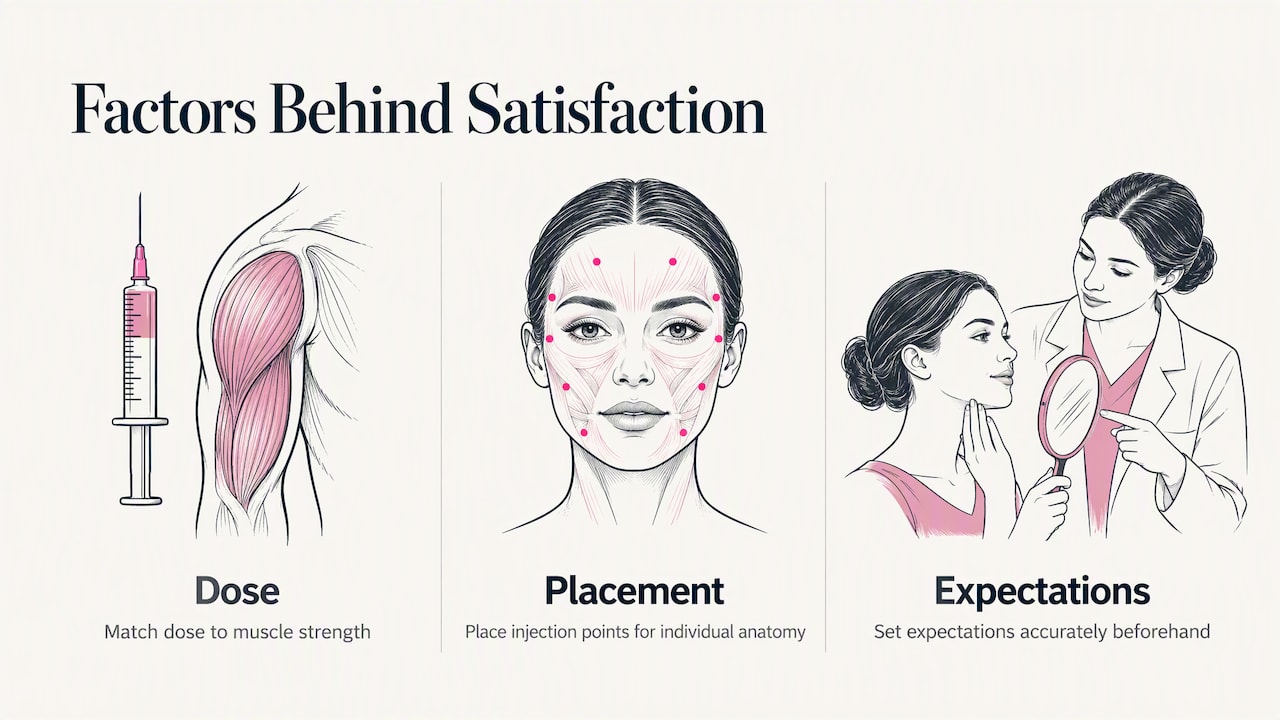
In practice, real-world effectiveness tends to hinge on three things that have nothing to do with brand: whether the dose matched the muscle strength, whether the injection points were placed correctly for that patient’s anatomy, and whether expectations were set accurately beforehand. Cleveland Clinic’s comparison of the two products echoes this, noting that onset and duration differences are usually small enough that technique and treatment planning tend to drive satisfaction more than the specific product chosen.
How antibody formation can affect your treatment choice
A small but real consideration in long-term neuromodulator use is the potential for the body to develop antibodies against the toxin protein over repeated treatments, which can reduce how well future injections work. This is more relevant to patients who’ve had many treatments over years, often at higher doses, than to someone just starting out.
If you notice that a product that used to work well for you seems to be having less effect over time, that’s worth raising directly at your next consultation. An experienced injector may suggest adjusting the dose, spacing out treatments differently, or trying the other product, since antibody response to one botulinum toxin formulation doesn’t automatically predict the same response to another.
This is one of the few scenarios where switching between Botox and Dysport has a clear clinical rationale beyond preference, and it’s a good example of why an ongoing relationship with the same injector matters: they’re the one who’ll notice a pattern of diminishing results and know how to respond to it.
Formulation additives and why they matter clinically
Beyond the active toxin, each product includes different stabilizing proteins and excipients in its formulation, which is part of why they aren’t simply interchangeable at a one-to-one dose. These additive differences can influence how the product diffuses through tissue and, in rare cases, how an individual’s immune system responds to it.
For most patients, these formulation differences don’t translate into a noticeable difference in day-to-day experience. They matter more at the clinical decision-making level, where your injector is weighing which formulation suits a particular muscle group or a patient with a specific treatment history. This is also part of why FDA labeling for both products explicitly states that units are not interchangeable between formulations: the dosing math isn’t just a pricing quirk, it reflects real differences in how each formulation behaves once injected.
Typical re-treatment intervals and maintenance scheduling
Because both products average roughly three to four months of effect at comparable dosing, most patients return for maintenance treatment on a similar cadence, adjusting based on how their own muscles respond. Areas with stronger muscles, like the glabellar region in some patients, may need slightly more frequent touch-ups than areas with finer muscle activity.
A reasonable approach is to schedule your next appointment as the effect starts to visibly fade rather than waiting until it’s fully gone, since consistent maintenance tends to preserve a smoother result over time. Your injector will typically ask you to come back for a follow-up check within the first couple of weeks after your initial treatment to confirm symmetry and coverage before setting your longer-term schedule.
What this comparison actually tells you
The honest takeaway from the research is that the Botox-versus-Dysport debate is overrated as a standalone decision. The randomized trials we have show broadly similar duration and only modest onset differences, and the Cleveland Clinic’s own comparison lands on the same point: technique and treatment planning tend to matter more than brand.
Where conventional advice falls short is treating this like a product choice you make before walking into a clinic, the way you’d pick a skincare brand off a shelf. It isn’t. It’s a clinical decision that depends on your muscle anatomy, your injector’s experience with a given product, and how your body has responded to treatment before. Patients who ask injectors to decide based on their face, rather than asking the injector to defend a product they already picked online, tend to end up happier with the result.
If you take one thing from this, prioritize the injector’s experience and your own consultation conversation over any brand preference you brought in the door.
— Chris
Schedule a consultation with Sudbury Med Spa
We offer a free consultation to review your goals and history before recommending anything, so you’re never guessing which product fits your face. From there, we build a treatment plan around your specific lines and muscle response.

- Book a free consultation to discuss your goals and get a tailored recommendation.
- Ask about our SILVER, GOLD, and PLATINUM membership plans, priced at $399, $499, and $599 per year, which can lower your per-treatment cost over time.
- Flexible financing options are available if you’d rather spread out the cost of your plan.
- Visit our Botox service page for details on what to expect and how to book your first appointment.
This article is general information, not a substitute for advice from a qualified doctor. Consult a qualified healthcare professional about your own circumstances before acting on anything here.
FAQ
What looks better, Botox or Dysport?
Neither product is categorically better looking; both soften muscle-driven wrinkles through the same mechanism, and clinical comparisons generally find comparable efficacy when dosing is properly adjusted. The better-looking result usually comes down to injector technique and dose matching your specific muscles, not the brand itself.
Why do injectors prefer Dysport over Botox for some treatments?
Some injectors prefer Dysport for larger, flatter areas like the forehead because its formulation tends to diffuse more broadly through tissue, which can mean more even coverage with fewer injection points. For smaller, more precise areas, many injectors still favor Botox’s more contained action instead.
Why is Dysport sometimes priced lower than Botox?
Dysport is often quoted at a lower price per unit, but this is misleading on its own because the two products use different, non-interchangeable unit systems, as FDA labeling for both products confirms. Comparing total treatment cost for your specific area is more useful than comparing per-unit price between the two.
What should I check before choosing between Botox and Dysport?
Before choosing, confirm your injector’s training and ask which product they recommend for your specific treatment area and why. You should also get the total cost, expected timeline, and follow-up policy in writing rather than relying on brand name alone to make the decision.
Sources
- Cleveland Clinic: Dysport vs Botox explainer
- Randomized study reporting similar duration (PubMed ID 22231417)
- BOTOX Cosmetic prescribing information (FDA)
- ASPS position statement on administration of botulinum toxin neuromodulators


