


Radiesse generally fits goals that call for immediate structure, like jawline definition or deep folds, while Sculptra fits gradual, collagen-driven volume across the cheeks and temples. Radiesse delivers visible lift at the appointment and typically lasts around 12 to 18 months, while Sculptra builds results over several months through a staged series. The right pick depends on the area you want treated, how patient you are willing to be, and whether you prefer one session or a planned course of them.
TL;DR:
- Radiesse results commonly last up to 18 months, while Sculptra may last 18 to 24 months, depending on regimen, product amount, and metabolism.
- Sculptra typically requires two to three appointments spaced four to six weeks apart, followed by directed massage to lower the risk of nodules.
- Radiesse is commonly used for jawline contouring, deep folds, and hand volume, but its structural effect does not suit thin skin around the eyes.
- Both products require trained, licensed injectors; ask about experience with the specific filler, the treatment protocol, and how complications are handled before committing.
Table of Contents
- Radiesse vs Sculptra at a glance
- Why CaHA and PLLA behave so differently
- When you’ll see results and how long they last
- Best areas and goals for each filler
- What to expect: sessions, discomfort, and aftercare
- Safety profile and what the FDA label covers
- How to decide between Radiesse and Sculptra
- How we approach Radiesse and Sculptra in practice
- What most comparisons get wrong
- Get a personalized filler recommendation
- FAQ
- Sources
Radiesse vs Sculptra at a glance
Radiesse works as a calcium hydroxylapatite (CaHA) scaffold suspended in a carrier gel. It restores contour the moment it’s injected, then stimulates your own collagen over the following weeks. We typically see it used for jawline contouring, deep nasolabial folds, and hand volume loss, with results commonly lasting up to 18 months.
Sculptra is a poly-L-lactic acid (PLLA) implant that works differently: it has almost no immediate filling effect and instead triggers your body to rebuild collagen gradually. That means a staged series, usually spaced weeks apart, is standard rather than optional. Sculptra tends to suit diffuse volume loss across the cheeks, temples, and broader facial planes, with effects that build slowly and can last 18 to 24 months depending on the regimen and your own metabolism.
A quick way to sort your goal:
- Want visible change at your appointment? Radiesse suits immediate contour work like jawline shaping or hand rejuvenation.
- Comfortable with a multi-visit plan for subtler, longer-building volume? Sculptra suits broad facial volumization and skin-quality improvement.
- Treating deep static folds? Radiesse’s structural support tends to address those more directly.
- Looking for a natural, gradual replenishment rather than an instant change? Sculptra’s slow collagen buildup is designed for that.
Why CaHA and PLLA behave so differently
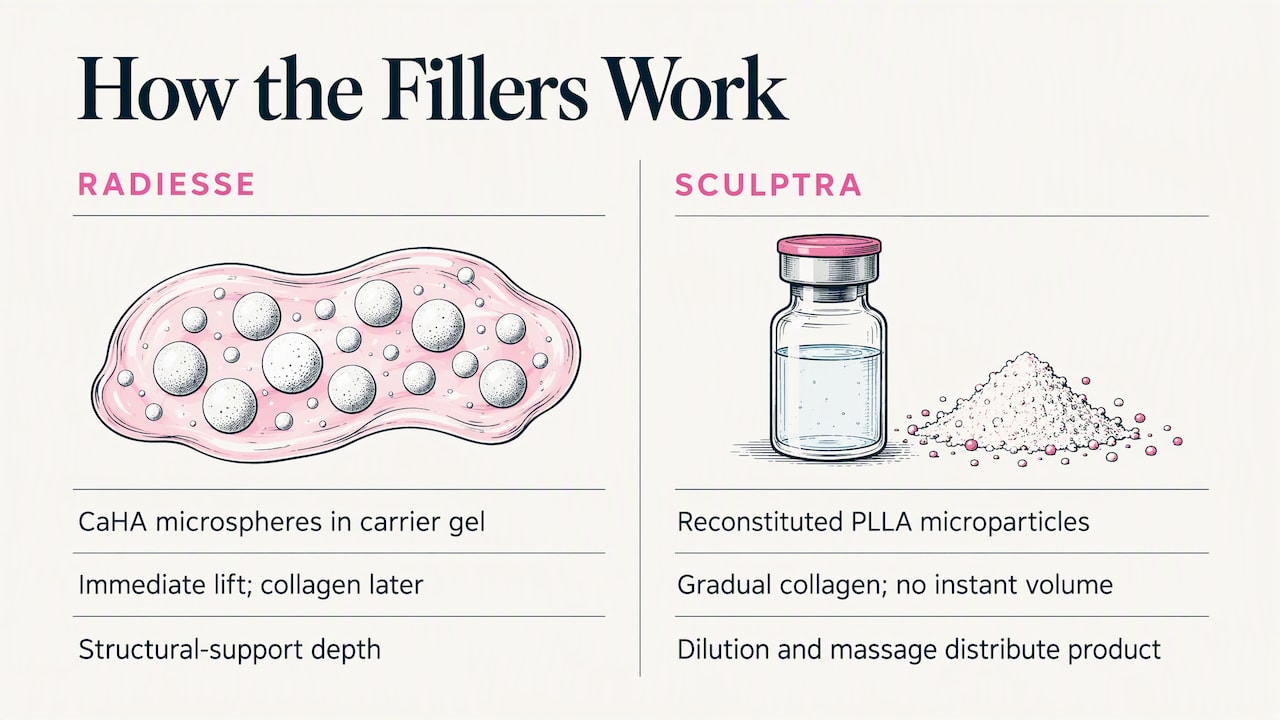
The difference between these two fillers comes down to the particles themselves. Radiesse suspends calcium hydroxylapatite microspheres in a carrier gel that acts as an immediate scaffold under the skin, lifting and smoothing right away while the surrounding tissue responds to the microspheres by generating new collagen over time. The gel carrier is eventually absorbed, leaving the collagen response behind.
Sculptra works through poly-L-lactic acid microparticles that must be reconstituted with sterile water before injection, per its FDA labeling. PLLA has no real volumizing effect on its own. Instead, it triggers a gradual inflammatory response that prompts your body to lay down new collagen over weeks to months, which is why Sculptra is approved for correcting nasolabial fold contour deficiencies and cheek-region fine lines in immune-competent patients, not for instant volumizing.
Injection depth and technique differ too: Radiesse is typically placed at the level needed for structural support, while Sculptra’s technique relies heavily on correct dilution and post-injection massage to distribute the product evenly and avoid clumping.
When you’ll see results and how long they last
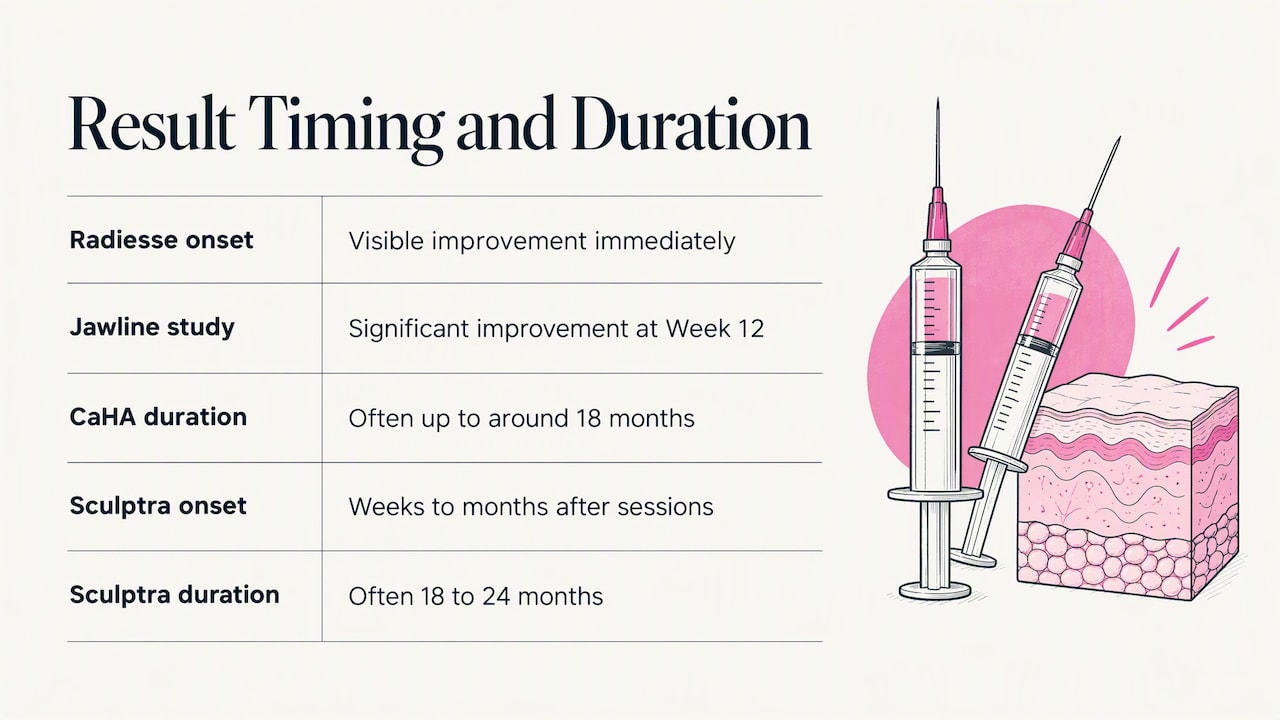
Radiesse shows visible improvement immediately, with the collagen-stimulating phase adding further refinement over the following weeks. For jawline work specifically, the Radiesse (+) studies supporting its FDA PMA supplement approval documented statistically significant improvement in jawline contour at Week 12, with defined responder rates in that trial.
A systematic review of CaHA fillers reports volumizing effects commonly lasting up to around 18 months in many patients, with adverse events mostly described as transient.
Sculptra follows a slower curve. Because PLLA relies on your own collagen production, visible change typically unfolds over weeks to months after each session in the series rather than at the appointment itself. Durability often runs 18 to 24 months, though this varies by regimen, the number of vials used, and individual metabolism; FDA post-approval materials note limitations in long-term data beyond the initial study window.
Several factors shorten or extend results for either filler: the area treated, how much product was used, your metabolic rate, and whether you return for touch-up sessions.
Best areas and goals for each filler
Radiesse’s structural strength makes it well suited to areas where you want defined, immediate lift. We see it most often requested for jawline contouring, deep nasolabial and marionette folds, and hand volume restoration, where the scaffold effect provides shape that softer fillers can’t match. Our Radiesse jawline work reflects that structural focus.
Sculptra’s gradual buildup suits broader, softer goals: restoring volume across the temples and cheeks, smoothing fine lines through improved skin quality, and replenishing areas with diffuse, age-related volume loss rather than one deep fold.
- A patient wanting a sharper jawline before an event in a few weeks is a better match for Radiesse.
- A patient wanting hollow temples and flattened cheeks to fill in naturally over a few months is a better match for Sculptra.
- A patient with deep static folds benefits from Radiesse’s immediate structural correction.
- A patient focused on overall skin quality and gradual, undetectable volume often prefers Sculptra’s slow collagen response.
What to expect: sessions, discomfort, and aftercare
- Radiesse is usually completed in a single session per area, sometimes with a touch-up visit, while Sculptra typically requires two to three sessions spaced about four to six weeks apart.
- Both products commonly include lidocaine in the formulation or are paired with topical anesthetic, and most patients describe the discomfort as brief pressure or pinching rather than sharp pain.
- Expect mild bruising and swelling for a few days after either treatment, which typically resolves within a week.
- Sculptra requires specific aftercare: massaging the treated area as directed (often the “rule of five,” five minutes, five times a day, for five days) to distribute the product evenly and reduce the chance of nodules.
- Most people return to normal activity the same day or the next, though strenuous exercise and sun exposure are usually limited for 24 to 48 hours, and any unusual lumps, prolonged redness, or signs of infection should be reported to your provider.
Safety profile and what the FDA label covers
Both fillers share a similar early side-effect profile: bruising, swelling, redness, and tenderness at the injection sites, which usually resolve within days. Delayed effects differ slightly by product.
- Sculptra’s label specifically notes the possibility of delayed-onset nodules and papules under the skin, which is part of why injection depth and massage technique matter.
- Radiesse carries risk of similar injection-related reactions, with most events in clinical data described as transient rather than lasting.
- A systematic review of CaHA fillers found generally favorable safety profiles alongside strong patient satisfaction outcomes, supporting CaHA’s standing as a well-tolerated option when properly administered.
- Both products are regulated as prescription medical devices under FDA PMA pathways, meaning they’re intended for use by trained, licensed injectors rather than general sale.
As with any injectable, choosing a provider trained specifically in the device’s protocol matters for reducing complications, and knowing a reversal option exists for hyaluronic acid-based products (not CaHA or PLLA) is a useful part of understanding your overall filler options.
How to decide between Radiesse and Sculptra
Start with your primary goal, your timeline, and your appetite for multiple visits. A short checklist helps:
- Is your goal immediate structure (jawline, deep folds) or gradual volume (cheeks, temples)?
- Do you need results before a specific date, or can you wait months for full effect?
- Are you comfortable returning for two to three sessions, or do you prefer one visit?
- What’s your prior experience with fillers, and what’s your budget for the full course versus a single syringe?
When you meet with an injector, ask about their experience with the specific product, their recommended protocol for your area, how they handle complications, and how many syringes or sessions your goal realistically requires.
Pro Tip: Bring reference photos of the look you want (not just the area you dislike) so your injector can map your goal to the right product and technique.
Some patients benefit from a staged or combined approach, using Radiesse for structural areas and Sculptra for broader volumization, which is one more reason an in-person assessment tends to beat guessing from a list of pros and cons.
How we approach Radiesse and Sculptra in practice
We have developed our Radiesse and injectable protocols around matching the product to the area rather than defaulting to one filler for every request. For jawline contouring, we follow a structured assessment of bone support and skin laxity before recommending Radiesse, and our deep fold correction work reflects that same structural-first approach.
When a staged regimen makes more sense, such as broader cheek or temple volumization, patients are walked through the full session timeline up front so there are no surprises about pacing or the number of visits needed. Every plan starts with a consultation where anatomy, goals, and history are reviewed before recommending a specific product or combination.
What most comparisons get wrong
Most Radiesse versus Sculptra comparisons treat the decision like picking a winner, when the better question is almost always which collagen response fits your timeline. Radiesse gets praised for instant gratification and Sculptra for being “more natural,” but that framing undersells how much injection technique and realistic session planning matter more than the product name alone.
The biggest gap we see is expectation mismatch: patients choosing Sculptra while expecting Radiesse-like results at the appointment, or choosing Radiesse for a goal that really needed Sculptra’s gradual, diffuse volumization. Neither filler is more advanced than the other; they’re built for different jobs.
If you take one thing from this comparison, prioritize matching the filler to your actual timeline and area over chasing whichever product is trending. A jawline that needs definition this month and a cheek area that needs gentle, gradual lift over the next year call for two different approaches, sometimes from the same consultation.
— Chris
Get a personalized filler recommendation
Choosing between Radiesse and Sculptra is easier with an in-person assessment, and free consultations are offered to walk through your goals, anatomy, and timeline before recommending a specific plan. Financing options are also available, which make a staged Sculptra regimen or a combined filler approach more manageable.

- Explore our Radiesse treatment page for details on what to expect during your visit.
- Browse our full dermal filler services to see how injectables fit into a broader treatment plan.
- Ask about our membership plans, including SILVER at $399 per year, GOLD at $499 per year, and PLATINUM at $599 per year, which can support ongoing aesthetic care.
Book a consultation to find out which filler fits your goals, not someone else’s.
This article is general information, not a substitute for advice from a qualified doctor. Consult a qualified healthcare professional about your own circumstances before acting on anything here.
FAQ
What is the downside of Radiesse?
Radiesse’s main limitation is that it’s a structural filler, so it’s not ideal for very thin, delicate skin areas like the under-eyes, and its effects, while long-lasting, are not permanent. Most reported issues are transient bruising and swelling, with a systematic review describing the overall safety profile as generally favorable.
Why do some doctors not like Sculptra?
Some injectors are cautious about Sculptra because it requires precise reconstitution, correct injection depth, and consistent post-treatment massage to avoid delayed nodules, and results take months to fully appear rather than showing at the appointment. Patients who expect instant volume sometimes find the waiting period frustrating, which is a technique and expectation issue rather than a flaw in the product itself.
Is Sculptra or Radiesse better for jowls?
Radiesse’s immediate structural support tends to suit jowl and jawline contouring better, since it provides lift and definition right away in an area that often needs firmer support. Sculptra can contribute to overall volume in the lower face over time but is generally better suited to broader, gradual restoration than targeted jowl correction.
Which is more painful, Radiesse or Sculptra?
Both fillers are generally well tolerated, and many formulations include lidocaine or are paired with topical numbing to minimize discomfort during injection. Most patients describe the sensation as pressure or mild pinching rather than significant pain, with any soreness typically resolving within a few days for either product.
Sources
- Instructions for Use Sculptra Aesthetic US
- Adverse events and satisfaction outcomes with calcium hydroxyapatite and polycaprolactone fillers in facial aesthetics: A systematic review


