
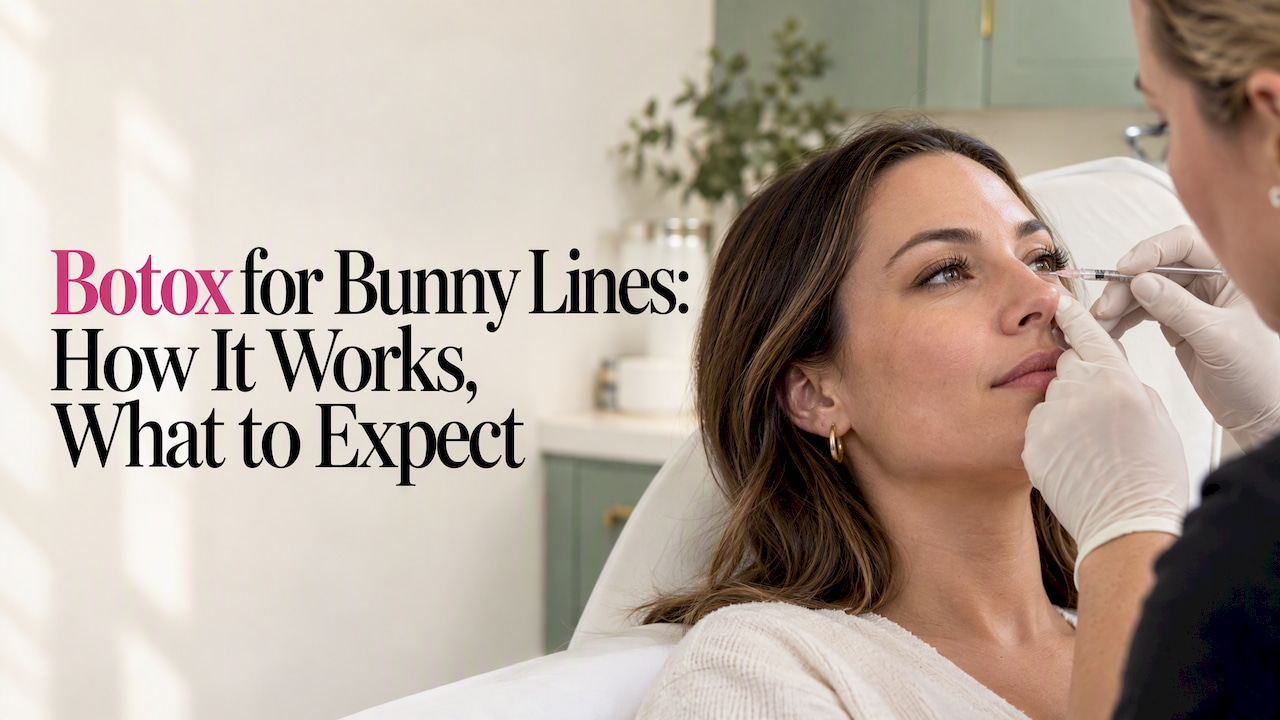

Botox softens bunny lines by relaxing the small nasalis muscle on the side of the nose, the muscle that scrunches the skin when you smile, laugh or wrinkle your nose. The dose is tiny, the treatment takes minutes, and results are temporary. The part that decides how well it works is where the injector places it, not the product itself.
This guide covers what bunny lines are, how the treatment is done, what units and timelines are typical, the risks worth knowing, and when a different approach makes more sense. If you are near Sudbury, Massachusetts, it also explains how we handle it.
TL;DR
- Bunny lines are diagonal creases on the sides of the nose, caused by repeated scrunching. Botox relaxes the muscle behind them.
- Typical doses are small, about 2 to 8 units of onabotulinumtoxinA per side, and results usually last 3 to 4 months.
- Newer anatomical research suggests injecting the borders of the muscles, not the crease itself, for better safety and results.
- Lines that stay visible at rest may need a little filler on top of muscle relaxation.
- Choose a trained medical injector, and skip nose massage for several hours afterward.
Table of Contents
- What bunny lines are and why they form
- How Botox treats bunny lines
- What to expect, step by step
- Risks and how to lower them
- When Botox is not enough
- Our perspective
- Book a free consultation in Sudbury
- How to prepare for your appointment
- Do bunny lines go away on their own?
- FAQ
- Sources
What bunny lines are and why they form
Bunny lines are the fine diagonal or vertical wrinkles that appear on the sides of the nose when you smile, laugh or scrunch. Byrdie’s guide describes them simply as the wrinkles that show up when you crinkle your nose. Some people barely notice theirs. Others see them in every photo.
The cause is repeated muscle movement. Each time the nasalis contracts, the skin folds in the same place. Over years the skin loses elasticity and the fold starts to stay. That is why bunny lines often show up in people who are expressive, who squint a lot, or who have already had other areas treated.
That last point matters. Bunny lines can become more prominent after you treat the frown lines between the brows or the crow’s feet, because the nasalis muscle starts doing extra work to compensate. If your lines seem to have appeared suddenly after other injections, this is a likely reason, and it is easy to address with a full treatment plan.
Dynamic versus static lines
It helps to sort your lines into two types before you decide what to do:
- Dynamic lines show only when the muscle moves. Relaxing the muscle is the right fix.
- Static lines are visible even with a relaxed face. Muscle relaxation alone will soften them, but it may not erase them.
A simple test: look in the mirror with a neutral face, then scrunch your nose. If the crease disappears at rest, you are mostly dealing with dynamic lines.
How Botox treats bunny lines
Botox blocks the nerve signal that tells a muscle to contract. With less contraction, the skin folds less, and the lines soften. The goal is to weaken the muscle, not freeze it. Dermatologists stress natural expressions and say the injector’s skill matters more than the product.
Where the injection goes
For years, the common method was to inject right into the wrinkle. A 2026 paper in the Journal of Cosmetic Dermatology argues this is not ideal: injecting the crease targets connective tissue and relies on passive diffusion, which makes results unpredictable. The authors describe a “bunny triangle” between muscles and suggest aiming at the borders of the nasalis and the neighboring LLSAN muscle instead.
What this means for you in plain terms:
- The best injection point may not be where the line is.
- A precise, shallow placement on a small number of points usually beats a generous dose spread around.
- An injector who can explain the anatomy behind their placement is a good sign.
An earlier anatomical study of the nose region reached a similar conclusion: the area is small and crowded with muscles, and a detailed understanding is needed to treat it well.
How many units
Doses are small. Published guidance for the midface lists 2 to 8 units of onabotulinumtoxinA per side, or 10 to 20 units of abobotulinumtoxinA. Your exact dose depends on how strongly your muscle pulls, how deep the lines are, and your other treatments.
This is also why the cost of bunny line Botox is usually modest compared with a full upper-face session. Many clinics add it to a visit rather than book it alone. We do not publish a per-unit Botox price, so we quote it after a consultation. You can also see our published price booklet.
What to expect, step by step
- Consultation. We look at your face at rest and in motion, and ask what bothers you. We also check your other treatment areas for compensation risks.
- Cleansing and marking. The skin is cleaned and injection points are planned.
- Injection. A few tiny injections on each side of the nose. It takes only minutes, and most people describe a quick pinch.
- Aftercare. You go back to normal activities, with a few simple rules (below).
- Review. Results come in over days, so a check-in is part of the plan.
Timeline of results
Per the American Society of Plastic Surgeons’ position statement, effects typically appear in 3 to 7 days and last 3 to 4 months, with a re-evaluation around 2 weeks to see if small adjustments are needed. Do not judge the result on day two.
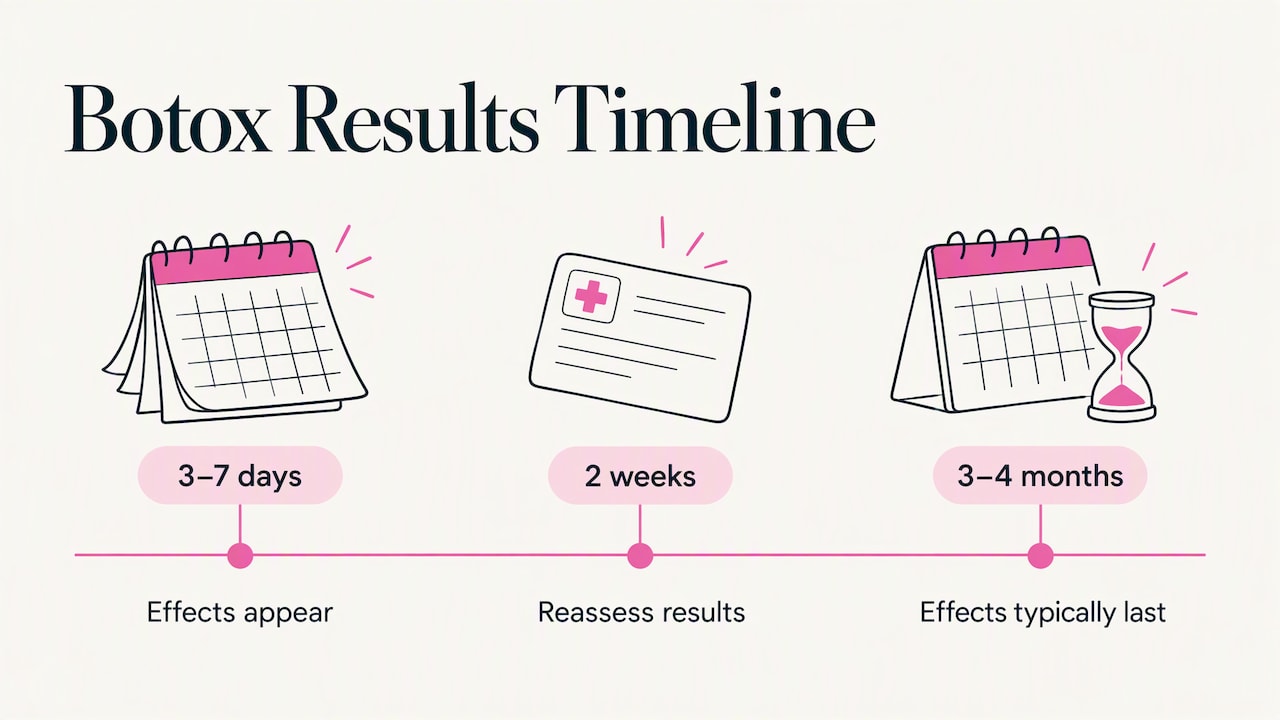
If you treat the nose regularly, the effect can build. Experts note that repeated treatment can thin the muscle, which may make results last longer for some people. It is still not permanent.
Aftercare that actually matters
The most useful rule is to leave your nose alone. Avoid massaging the nose or nearby area for several hours, because pressure can move the toxin and cause unwanted weakness, such as upper-lip drooping or eyelid ptosis. Ask your injector for their exact timeline and any other restrictions, such as exercise or lying flat.
Risks and how to lower them
The nose sits close to muscles that lift the upper lip and shape your smile. That is the reason precision matters. The possible problems include:
- An uneven or heavy smile if the toxin spreads to nearby muscles
- Upper-lip drooping or eyelid ptosis from migration
- Bruising or small swelling at injection points
- Little or no effect if the placement misses the target muscle
Most of these are avoidable with the right provider. The American Academy of Dermatology advises that injections happen in a medical office, performed by board-certified dermatologists or appropriately trained clinical staff under on-site supervision, partly because of counterfeit product risks. The AAD also warns that buying botulinum toxin online puts your health at risk.
If you are pregnant or breastfeeding, have a neuromuscular condition, or take medications that affect muscle function or bleeding, tell your provider before any injection and ask your physician first. Botox for the nose is typically considered an off-label use, so ask your injector how often they do it and what they would do differently from the forehead.
When Botox is not enough
Botox is the standard first step for movement-driven lines. But some situations call for something else, or something extra.
Lines that show at rest
Experts note that people with static wrinkles may benefit from a tiny amount of dermal filler as an add-on, though it is secondary to relaxing the muscle. A clinical review of the midface likewise says that combining toxin with fillers gives the best results and greater patient satisfaction, while neuromodulators alone can still be useful. If you want to read about our filler options, start with our dermal filler page or our article on Juvederm for lines and wrinkles.
Skin texture and sun damage
Botox does nothing for crepey texture, pigment or sun damage. For those concerns, skin-focused treatments such as microneedling with PRP or Morpheus8 work on the skin itself rather than the muscle.
Comparing your options
| Concern | Best fit | Why |
|---|---|---|
| Lines appear only when you scrunch | Botox | Relaxes the muscle that creates the fold |
| Lines visible at rest | Botox plus a small amount of filler | Muscle relaxation plus volume in the crease |
| Lines appeared after other Botox treatments | Botox with a full-face plan | Addresses compensation from nearby muscles |
| Rough texture or uneven tone | Skin treatments | Targets the skin, not the muscle |
Our perspective
We see bunny lines on a regular basis, and they are a good example of why we do not treat a face as a list of separate wrinkles. When someone asks about their nose, we look first at what else is going on: the brow, the eyes, the way they smile. A small area deserves a careful plan.
Three things guide how we approach it:
- Less is more here. The nasalis is small, and the muscles around it shape your smile. A light, targeted dose gives a refreshed look without a stiff expression.
- The injector matters more than the brand. We have written about this in our piece on why your injector matters more than the product, and it applies even more strongly to the nose.
- Plan the whole face. If you are treating the frown lines or crow’s feet, we talk about the nose in the same visit so the lines do not show up somewhere else.
Sudbury Med Spa was built around personalized plans and free consultations, led by our founder Natalie NgocTrang. Our team has completed over 15,000 treatments, and we keep the space clean and comfortable so you can ask every question you have. If we think Botox is not the right answer for your nose, we will say so.
— Chris
Book a free consultation in Sudbury
If you want to know whether bunny line Botox suits you, we offer free consultations at our Sudbury, MA clinic. We will look at your lines in motion and at rest, explain what we would do and why, and give you a clear quote. See our Botox page for details, look at Botox before and after photos, or browse the full services list.
If you plan to come back for regular touch-ups, our membership plans are Silver at $399 per year, Gold at $499 per year and Platinum at $599 per year. Financing options are available as well. For related reading, see our guide to targeting fine lines with Botox.

How to prepare for your appointment
A few habits make the visit smoother:
- Bring photos of the lines that bother you, taken from the front and in a smile.
- List your medications and supplements, and mention any recent injections elsewhere.
- Say what you want to keep. Many people want to keep their natural nose scrunch, and your injector can aim for that.
- Ask about the follow-up. A check at around two weeks is common, so book it at the same time.
- Plan the date. If you have an event, allow at least a couple of weeks for the full effect and any touch-up.
If you want guidance on how to choose a provider, the AAD offers a page of questions to ask before treatment.
Do bunny lines go away on their own?
Not really. Lines caused by repeated movement usually stay or deepen over time, since the skin keeps folding the same way. Sun protection and good skin care help the skin hold up, but they do not stop the muscle from pulling. Relaxing the muscle is what reduces new creasing and lets existing lines soften.
FAQ
What does Botox in the bunny lines do?
It relaxes the nasalis muscle that wrinkles the side of your nose. With less movement, the skin folds less and the diagonal lines soften. The effect is temporary, usually 3 to 4 months.
How much does Botox for bunny lines cost?
Cost depends on the units used and the clinic’s pricing, and the dose for this area is small. We do not publish a Botox price, so we give you a quote at a free consultation. Your total will also depend on whether you treat other areas at the same visit.
Is bunny line Botox worth it?
It is worth it if the lines bother you and they come from movement. It is less useful if your main issue is skin texture or deep lines at rest, where filler or skin treatments may do more. A consultation will tell you which group you are in.
Why did my bunny lines get worse after Botox elsewhere?
When the muscles between the brows or around the eyes are relaxed, the nasalis can take over and work harder. That is called compensatory muscle recruitment. Treating the nose in the same plan usually prevents it.
Sources
- Where Should We Inject Botulinum Toxin for the Bunny Lines? (Journal of Cosmetic Dermatology, 2026)
- Novel Anatomical Guidelines on Botulinum Neurotoxin Injection for Wrinkles in the Nose Region
- Treatment of the midface with botulinum toxin
- ASPS Position Statement on Administration of Botulinum Toxin Neuromodulators
- AAD: Botulinum toxin therapy FAQs
- AAD statement on counterfeit injectables
- AAD: Botulinum toxin therapy preparation
- Byrdie: The Complete Guide to Bunny Lines


