

You can sometimes get laser hair removal with a tan, but a fresh tan is the single most common reason a provider will postpone your session. A tan means more melanin in the top layer of skin. The laser aims for melanin in the hair, so tanned skin competes with the target and raises the risk of burns and lasting color changes. The safe route is to let the tan fade, protect your skin, and book with a provider who can assess your skin tone in person.
TL;DR
- A tan, from the sun, a tanning bed, or a spray or lotion, can make laser hair removal less effective and less safe.
- Mayo Clinic guidance points to avoiding sun and tanning beds for roughly 2 to 4 weeks before a session, and being strict about sun protection afterward.
- Some lasers, such as 1064 nm Nd:YAG devices, are less absorbed by surface melanin and are often chosen for tanned or darker skin. The provider’s skill matters more than the device name.
- Fall and winter are the easiest seasons to build a series, but summer sessions work with planning and diligent SPF.
- If your skin is tanned and you’re unsure, book a consultation instead of guessing. We offer free consultations at Sudbury Med Spa.
Table of Contents
- Why a tan changes how the laser behaves
- Does the kind of tan matter?
- How long to stay out of the sun before treatment
- What to do after treatment
- Laser hair removal in summer: can you still do it?
- Technology and technique: what a good provider adjusts
- Warning signs: tanned skin and the wrong provider
- Our perspective
- A simple plan if you have a tan right now
- Book your skin check at Sudbury Med Spa
- FAQ
- Sources
Why a tan changes how the laser behaves
Laser hair removal works by sending a focused beam of light into the skin. Mayo Clinic explains that the laser targets the pigment in the hair, called melanin. The light turns into heat, and the heat damages the follicle so it grows less hair.
The method relies on contrast: dark hair, lighter skin. The American Academy of Dermatology describes this as selective targeting of pigment, and warns that in inexperienced hands the treatment can cause burns, permanent changes in skin color, and scars.
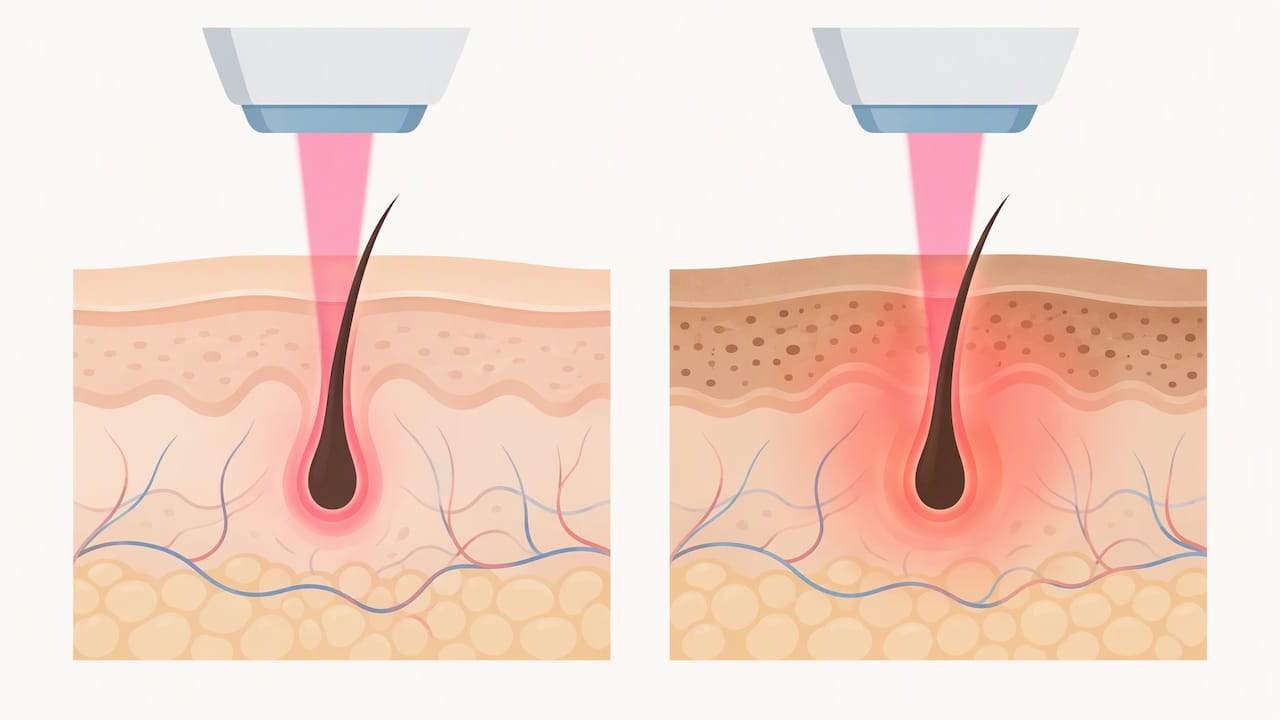
Tanning removes the contrast. When you tan, your skin makes more melanin as a defense against UV light. Now the beam finds pigment in two places: the hair, where you want it, and the skin surface, where you don’t. Cleveland Clinic notes that naturally or artificially tanned skin can make laser hair removal less effective and increase side effects.
That has two practical consequences:
- Safety. Heat that lands in the skin instead of the follicle can cause burns, blisters, or post-inflammatory hyperpigmentation (dark patches) or hypopigmentation (light patches).
- Results. To stay safe on tanned skin, a provider has to turn the energy down. Lower energy can mean less follicle damage, which can mean more sessions. A review of laser treatment in hirsutism notes that with a diode laser, fluences of 30 to 35 J/cm² suit skin types II to III, while lower fluences of 20 to 24 J/cm² are used for darker skin types.
A tan is not a lesser problem because it is temporary. It is a problem exactly because the pigment is in the skin on the day of treatment.
Does the kind of tan matter?
Yes, but not in a way that gives you a loophole.
| Type of tan | What it does | Practical advice |
|---|---|---|
| Outdoor sun tan | Real melanin increase in the skin | Wait for it to fade; avoid further exposure |
| Tanning bed | Same melanin response, often more uneven | Stop well before treatment, ideally for the full window your provider sets |
| Sunburn | Inflamed, damaged skin | Wait until fully healed; a burn is a clear reason to postpone |
| Spray tan or self-tanner | Surface color, not melanin from UV | Still interferes with the way the device reads your skin; remove it and tell your provider |
| Naturally deeper skin tone | Constitutive melanin, not a tan | Treatable with the right wavelength and settings by a skilled provider |
The American Academy of Dermatology’s guidance, as summarized in our research, treats tanning in any form as something that interferes with how the laser works. That includes sunless products. If you’ve used one, say so at the appointment. Honest information is the cheapest safety tool you have.
A natural deeper skin tone is a different case from a recent tan. The AAD notes that a laser originally developed for tattoo removal, the Nd:YAG, is commonly used for hair removal on darker skin, where many other lasers may be unsafe. We cover how that works in our guide to 1064 nm laser hair removal for dark skin.
How long to stay out of the sun before treatment
There is no single number every clinic uses, and you should follow the protocol of the provider who will treat you. The common ranges are:
- Before a session: Mayo Clinic guidance as summarized in our research points to avoiding tanning beds and direct sun for about 2 to 4 weeks before each treatment.
- After a sunburn: wait until the skin has completely healed. A burn means inflamed skin that should not be lasered.
- During the whole series: a series is not one appointment. The American Society of Plastic Surgeons says six to eight sessions is usual, varying with hair thickness and density, skin type, and hair color. Treat the entire series as a sun-careful period.
The point is not to hide indoors for months. It is to keep the treated area from picking up new color between sessions. Cover up, use shade, and wear sunscreen daily on any area you plan to treat.
You can read more about timing in our post on laser hair removal and sun exposure.
What to do after treatment
Treated skin is more sensitive for a while. Mayo Clinic guidance, as summarized in our research, says to avoid direct sun for at least two weeks, with some protocols extending to six weeks, and to use a broad-spectrum, water-resistant sunscreen of SPF 30 or higher. Ask your provider which window applies to you.
Sensible aftercare looks like this:
- Apply sunscreen every morning to the treated area, and reapply if you’re outdoors.
- Wear loose clothing over treated areas at the beach, on a boat, or on a hike.
- Skip tanning beds and self-tanner until your provider says the skin has settled.
- Hold off on hot tubs, saunas and intense workouts if your provider advises it for the first days.
- Call the clinic if you see blistering, unusual color changes, or pain that is not settling.
It’s tempting to treat a laser appointment as a pre-vacation project. Reverse it. Finish your treatment before the trip, or time it so the sun-heavy part of the vacation comes after your skin has recovered.
Laser hair removal in summer: can you still do it?
Yes, with conditions. Plenty of people start in summer because they want smooth skin for swimsuit season. But the sun is the whole problem, so summer takes more planning:
- Treat covered areas. Underarms, bikini line and legs often see less sun than the face and arms, especially if you wear long clothes.
- Be strict about sunscreen. Daily SPF 30 or higher, applied to the treated area.
- Expect delays. If you come in with a fresh tan or a burn, a responsible provider will reschedule instead of treating you.
- Think about the series, not the single session. Starting in early fall means a series of spaced sessions through the lowest-sun months, when your skin is naturally lighter.
If you want the best conditions, fall is often an easier starting point because the tan fades and sun exposure drops. That is one clinic’s guidance from Poland and not a rule, but it matches the logic of the biology. In New England, where our clients live and work, winter sessions are common for the same reason.
Technology and technique: what a good provider adjusts
The device matters, but so do the settings and the person using them. The AAD says that choosing a provider who understands how to adjust wavelengths and pulse durations for your skin type is a key factor in preventing burns and pigment problems. Dermatologists describe skin using the Fitzpatrick scale, from I (very fair) to VI (very deep).
What a careful provider does with tanned or deeper skin:
- Assesses your skin that day. Skin type is not fixed. A tan moves you, temporarily, to a darker category.
- Chooses the wavelength. The 1064 nm Nd:YAG wavelength is frequently cited as the preferred choice for tanned or darker skin because it is less absorbed by surface melanin.
- Adjusts energy and pulse length. Lower energy protects the skin and may require more sessions.
- Uses test pulses. A small test area shows how your skin responds before the full session. See our write-up on test pulses and cooling.
- Cools the skin. Cooling protects the surface while the energy reaches the follicle.
Even the best settings do not make tanned skin risk-free. “Safe” in dermatology means managed risk, not zero risk.
Warning signs: tanned skin and the wrong provider
The AAD cautions that laser hair removal is a serious procedure that should be done by a medical professional, and it lists burns, permanent color change and scars as possible problems in inexperienced hands. Red flags include:
- No questions about recent sun, tanning beds or self-tanner.
- No skin assessment or patch test before treating you.
- A promise that anyone, with any tan, can be treated at full strength.
- Pressure to book a large package before you have been seen.
- Treatment on visibly sunburned skin.
At-home devices deserve a mention too. Dermatologists list home laser use among the unsafe skin care trends to avoid. A tan makes a handheld device riskier, not easier.
Our perspective
At Sudbury Med Spa, the tan question comes up all year, and it comes up most in late spring when people want fast results. Our answer is rarely a flat yes or no.
We look at your skin on the day. We ask about sun, tanning beds, and self-tanner. We then decide whether to treat, treat with adjusted settings, or wait. If waiting is the safe move, we say so and help you plan a schedule that fits around vacations and seasons.
That is why we start with a free consultation and a personalized treatment plan. We have completed more than 15,000 treatments, and what we have learned is that patience at the start protects both your skin and your results. A rushed session on tanned skin can leave a mark that lasts longer than the tan would have.
If you are not sure whether your skin is ready, come in and let us look. You will leave with a clear answer and a plan.
— Chris
A simple plan if you have a tan right now
- Stop adding color. No tanning beds, no sunbathing, no self-tanner on the area you want treated.
- Protect what you have. Daily SPF 30 or higher, plus clothing coverage.
- Let it fade. Wait the window your provider recommends. If you were burned, wait for full healing first.
- Book a consultation. Bring a list of products you use, including any sunless tanners, and any medications you take.
- Plan the series. Most people need several sessions, so schedule them around travel and sun-heavy weeks.
- Keep protecting between sessions. The skin color you carry into each appointment shapes how safely the laser can work.
If you are in the Sudbury area, you can read about laser hair removal at Sudbury Med Spa, and see what to expect in our guide to laser hair removal pain and four clinician tips.
Book your skin check at Sudbury Med Spa
If you want laser hair removal and you are worried about a tan, the first step is a free consultation. We assess your skin, explain the options, and build a personalized plan before any treatment starts. See our laser hair removal page to learn more, or visit sudburymedspa.com to get in touch. We also offer financing options, and our membership plans are listed at $399 (Silver), $499 (Gold) and $599 (Platinum) per year.
FAQ
What happens if I get laser hair removal with a tan?
The laser can absorb energy in the pigment in your skin as well as in the hair. That raises the chance of burns, blisters, and lasting dark or light patches, and it can reduce how well the treatment works. A careful provider will usually postpone or adjust the settings instead of treating at full strength.
How long after laser hair removal should I wait to tan?
Mayo Clinic guidance, as summarized in our research, says to avoid direct sun for at least two weeks after treatment, and some protocols go up to six weeks. Use SPF 30 or higher on the area throughout. Ask your provider which window fits your skin and settings.
Is laser hair removal safe for tan or darker skin?
It can be, when the provider chooses the right wavelength and settings. The 1064 nm Nd:YAG wavelength is frequently used for tanned and darker skin types, per a published review. Safe does not mean risk-free, so a skin assessment and test pulses matter.
Can I use self-tanner or a spray tan before laser hair removal?
It is best not to. Sunless tanners change the color the device sees on the surface of your skin, so dermatologists treat them as interference, like a real tan. If you have used one, tell your provider and wait until it has fully faded.
Can I get laser hair removal in summer?
Yes, if you keep the treated area out of the sun, use sunscreen daily, and accept that a fresh tan or burn may mean a rescheduled visit. Many people find it easier to start in fall, when the sun is weaker and tans fade.
Sources
- Laser hair removal, Mayo Clinic
- Laser hair removal: How it works and what to expect, Cleveland Clinic
- Laser hair removal: FAQs, American Academy of Dermatology
- Skin conditions that lasers can treat, American Academy of Dermatology
- Five unsafe skin care trends to avoid, American Academy of Dermatology
- Laser treatment in hirsutism: an update, PMC
- Getting ready for summer with laser hair removal, American Society of Plastic Surgeons
- How long to wait for laser therapy after tanning, Ambasada Urody


