

Filler can soften marionette lines, the creases that run from the corners of your mouth down toward your chin. It works best on mild to moderate lines, results show right away, and they typically last 1 to 2 years depending on the product. Deeper lines often need more than one approach, and the skill of the injector matters more than the brand on the syringe. This guide explains how filler works in this area, what it costs, what the risks are and how to decide whether it is right for you.
TL;DR
- Dermal fillers temporarily add volume and may help mild to moderate marionette lines. Deeper folds may need a combination plan or surgery.
- Results appear immediately, and most treated areas hold for 1 to 2 years, depending on the filler.
- In the US, fillers usually run $500 to $900 per syringe. How many syringes you need depends on your face, not a fixed formula.
- Choose an experienced, qualified injector who knows facial anatomy. Never inject yourself or buy filler online.
Table of Contents
- What marionette lines are and why they form
- Do fillers work for marionette lines?
- Is filler right for you? A quick self-check
- What happens at the appointment
- How long marionette line filler lasts
- What marionette line filler costs
- Risks and side effects
- Choosing who injects you
- Our perspective
- Other ways to treat marionette lines
- Book a free consultation at Sudbury Med Spa
- FAQ
- Sources
What marionette lines are and why they form
Marionette lines, also called melomental folds, are creases that extend from the corners of the mouth to the chin. They get their name from the lines on a puppet’s jaw, and they can make a face look tired or stern even when you feel fine.
They rarely have a single cause. Cleveland Clinic lists the usual contributors: natural loss of collagen and elastin with age, family history, sun exposure and not wearing sunscreen, pursing the lips, severe stress and smoking. Anatomy matters too. Research on the structure of the lower face notes that anatomical predispositions differ among ethnicities, which is one reason two people with similar-looking lines can need very different treatment.
The practical point: a marionette line is often not just a wrinkle in the skin. It is a fold where the skin, the fat and the support underneath have shifted. That is why treating only the crease itself sometimes disappoints.
Do fillers work for marionette lines?
Yes, for many people. Dermal fillers temporarily add volume to the face to smooth lines and wrinkles, and they can help mild to moderate marionette lines in particular.
There is no single “best” filler for everyone. Published guidance on facial fillers stresses that products and injection techniques should be tailored to the patient’s desired effect and the anatomic target. In practice that means your injector looks at where you have lost support, how deep the fold is, how thick your skin is and how much movement the area has when you talk and smile.
How filler is used in this area
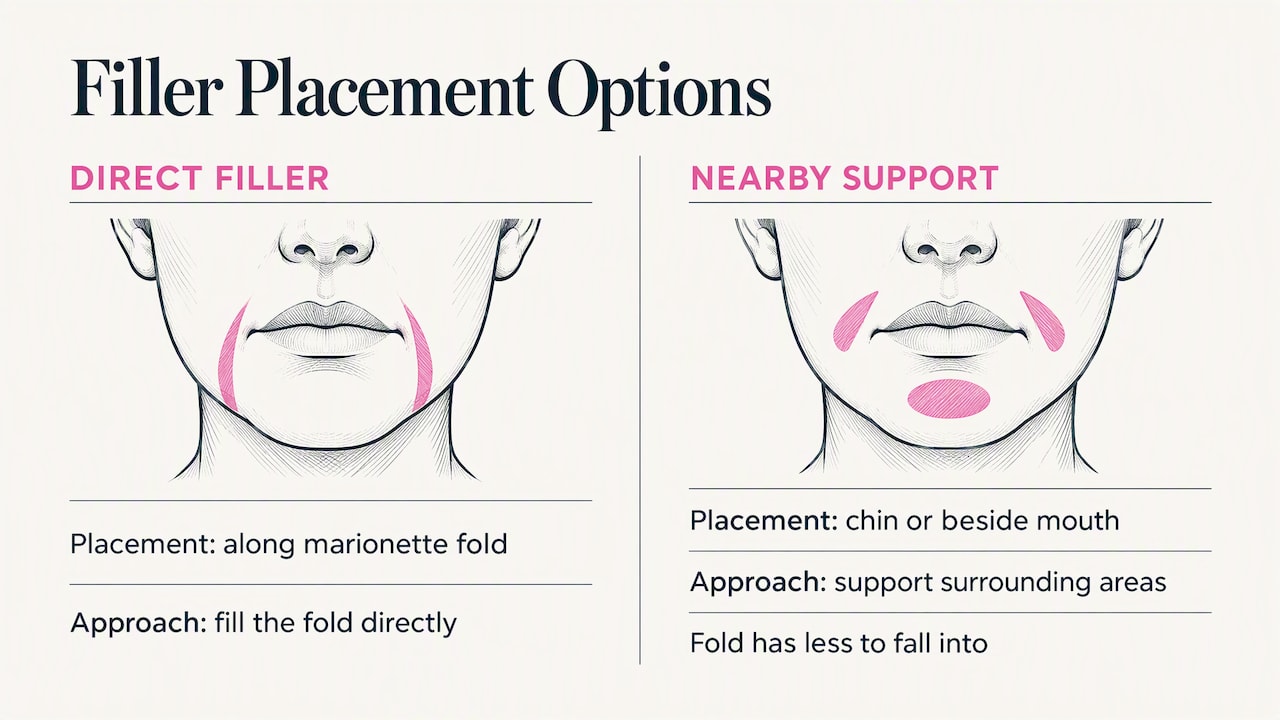
Sometimes filler goes directly along the fold. Often, though, a good plan adds support to the surrounding areas, such as the chin or the area beside the mouth, so the fold has less to “fall into.” This is the kind of judgment call that separates a natural result from a heavy or overfilled lower face. It is also why we ask to see you in person before suggesting a syringe count.
Filler types you will hear about
Most marionette line plans use one of two families of product:
- Hyaluronic acid (HA) fillers, such as Juvéderm and Restylane. They come in different thicknesses, from softer gels for fine creases to firmer gels for structure. Our team can walk you through the options on our Juvéderm page and our dermal filler overview.
- Calcium hydroxylapatite fillers, such as Radiesse, which give firmer support in deeper areas. If you are weighing it against a collagen-stimulating option, see our comparison of Radiesse vs Sculptra.
The right choice is not a ranking. A softer product can look beautiful on a fine line and disappear into a deep fold, while a firmer one can lift a deep fold and look stiff on a thin one.
Is filler right for you? A quick self-check
Filler is usually a good fit when:
- Your lines are mild to moderate and visible even when your face is relaxed.
- You want a temporary, adjustable result rather than surgery.
- You are comfortable with maintenance every year or two.
- You have no medical condition or allergy that your provider flags as a concern.
Filler is less likely to be enough when the skin is very loose, the jowls are significant or the fold is deep. Cleveland Clinic notes that a full or mini-facelift may be recommended for deeper marionette lines. A good provider will tell you that honestly rather than sell you syringes that will not get you there. If you are curious about a less invasive lift, you can read about our NovaLift facelift.
What happens at the appointment
A typical visit follows a simple order:
- Consultation. You talk through what bothers you, your medical history and any drug allergies. ASPS materials say patients should discuss medical conditions and drug allergies during the consultation.
- Assessment and plan. Your injector examines the whole lower face, not just the line, and agrees a plan with you.
- Treatment. Injection itself is quick. The same ASPS material describes it as a few seconds per site and a few minutes for a course of treatment. Appointments run longer because of prep, mapping and review.
- Aftercare. You get instructions for the hours and days after, and a follow-up plan if you want adjustments.
Before-and-after photos help you and your provider judge the change honestly. If you are wondering how clinics should handle your images and paperwork, this guide to consent and before-and-after photos explains what good documentation looks like.
How long marionette line filler lasts
Results are visible immediately. According to ASPS, most regions treated with filler keep their results for 1 to 2 years, depending on the product used.
A few things shape your own timeline:
- The product. Thicker, more structural gels tend to be chosen for deeper areas, and different products are built to last different lengths of time.
- The area. The mouth region moves constantly, so your own experience may differ from the average.
- Your habits. Sun exposure and smoking are among the factors linked to marionette lines in the first place, and they work against any treatment.
- Your plan. Small top-ups on a schedule your injector recommends often look more natural than waiting until every trace has faded.
What marionette line filler costs
For the United States, ASPS says dermal fillers usually range from $500 to $900 per syringe, with hyaluronic acid fillers averaging close to $700 per syringe. That figure comes from a 2019 ASPS post, so treat it as a ballpark and expect local pricing to differ.
What moves the total:
- Number of syringes. Mild lines may need little; a plan that also supports the chin or the mouth corners needs more.
- Product choice. Different fillers are priced differently.
- Injector experience and location.
- Maintenance. Budget for a refresh within the 1 to 2 year window.
We do not publish per-syringe prices for fillers on our site, so we quote after a free consultation, once we know what your face needs. Our price booklet is also available, and if you plan to come in for several treatments across the year, our memberships are listed at $399 (Silver), $499 (Gold) and $599 (Platinum) per year. We also offer financing options.
Risks and side effects
Filler is a medical procedure, and the lower face has its own risks. ASPS lists common, short-lived effects: mild swelling, bruising, numbness or redness that improve within hours or a few days. Less common risks include infection, allergic reactions, migration of the product, granulomas and ischemia, which is reduced blood flow to the skin.
What to do about it:
- Tell your injector about every medical condition and drug allergy before treatment.
- Ask which filler is being used and read its patient labeling. The FDA says it continues to monitor approved fillers and that patients should discuss the labeling for their specific filler with their doctor.
- Do not inject yourself and do not buy filler online. The FDA recommends against both.
- If you notice severe pain, unusual color change, blanching or vision changes after an injection, contact your injector or seek urgent medical care right away. Do not wait to see if it settles.
If you already have filler you are unhappy with, there is a way back. We offer ultrasound-guided filler reversal for hyaluronic acid products.
Choosing who injects you
Results depend largely on the person holding the syringe. The American Academy of Dermatology advises choosing a board-certified dermatologist because outcomes rely on the skills and knowledge of whoever performs the treatment. ASPS likewise recommends a physician with specialized training and a thorough understanding of facial anatomy, as the facial filler review notes.
Before you book anywhere, ask:
- Who will actually perform my injections, and what is their training?
- How many marionette line and lower face cases do you treat?
- Which products do you use, and why this one for me?
- What happens if I am not happy, or if there is a complication?
- Can I see photos of results on people with similar concerns?
A clear, patient answer to all five is a better sign than a discount.
Our perspective
We see marionette lines every week, and the most common mistake is treating them as an isolated crease. When someone comes in asking for filler “in the lines,” we usually look first at the chin, the mouth corners and the support of the cheeks. A modest amount of product placed with that whole picture in mind tends to look better than a lot of product pushed into the fold.
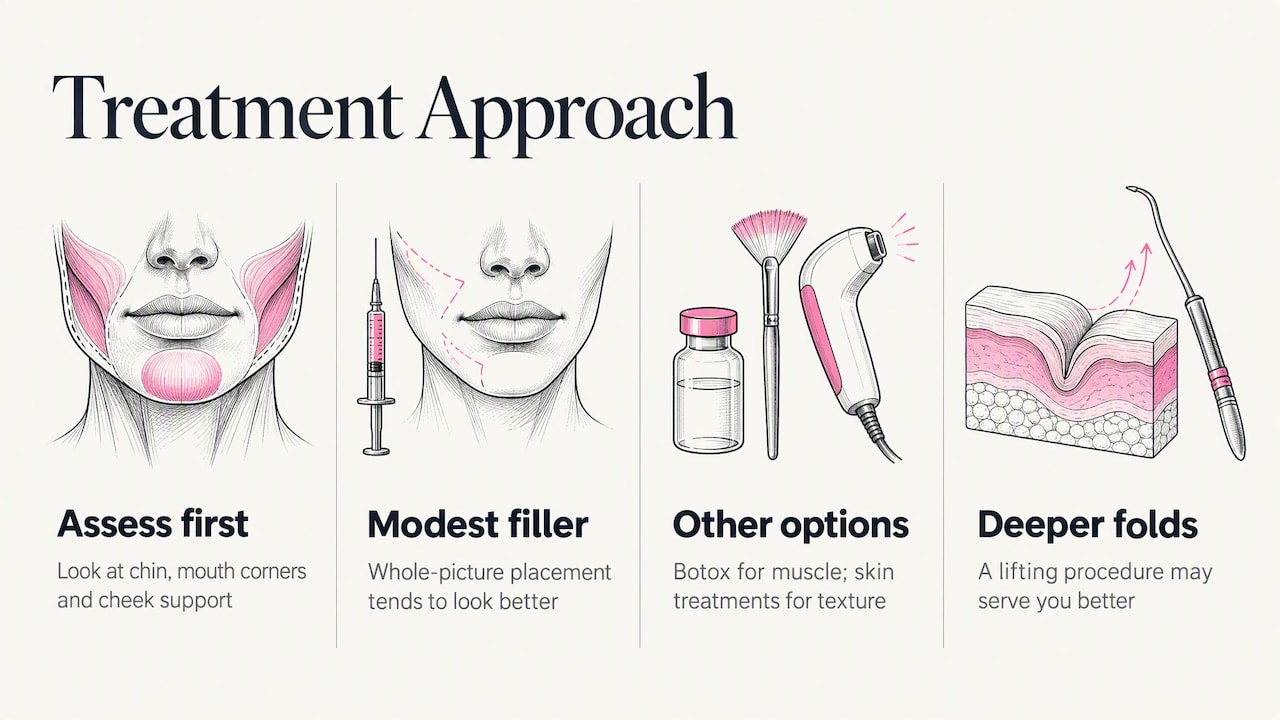
We also believe in telling people when filler is not the answer. Some lines respond better to a mix: filler for volume, Botox for the muscle pulling the mouth down, skin treatments such as peels, microneedling or laser resurfacing for texture. Cleveland Clinic lists all of these among the options. And for deeper folds, we will say plainly that a lifting procedure may serve you better.
Our approach is simple: a free consultation, a personalized plan, a clear explanation of the products and the number of treatments, and a clean, comfortable setting. With over 15,000 treatments completed under founder Natalie NgocTrang, we would rather you leave looking like yourself, rested, than looking “done.”
— Chris
Other ways to treat marionette lines
Filler is one tool. Cleveland Clinic lists Botox, chemical peels, fillers, laser skin resurfacing, microneedling and thread lifts as options. How they fit together:
| Approach | What it does | Best for |
|---|---|---|
| Dermal filler | Adds volume and support | Mild to moderate folds, lost volume |
| Botox | Relaxes muscles that pull the mouth corners | Downturned mouth, paired with filler |
| Peels, laser resurfacing, microneedling | Improve skin texture and quality | Fine crepey lines around the fold |
| Thread lift | Lifts tissue | Mild sagging |
| Facelift or mini-facelift | Repositions deeper tissue | Deeper folds with significant laxity |
If you would like to know how Botox can complement filler, see our pages on Botox for fine lines and Botox for chin dimpling. For skin quality, our microneedling with PRP and Morpheus 8 treatments are an option.
Book a free consultation at Sudbury Med Spa
If you are considering filler for marionette lines in the Sudbury, MA area, we start with a free consultation. We look at your face in motion, talk through your goals and medical history, and build a plan with the right product, a realistic number of syringes and a maintenance schedule.

See our full range of injectables and laser treatments, or visit sudburymedspa.com to book.
FAQ
Do fillers work for marionette lines?
Yes, especially for mild to moderate lines. Fillers temporarily add volume, which smooths the fold. Deeper lines often need a combined plan or a lifting procedure.
How long do marionette line fillers last?
Most treated regions keep their results for 1 to 2 years, depending on the product used. Your own timeline varies with the filler, your anatomy and your habits.
How much does filler for marionette lines cost?
In the US, fillers usually range from $500 to $900 per syringe, per a 2019 ASPS post. Your total depends on how many syringes your face needs. We quote after a free consultation.
What is the best procedure to get rid of marionette lines?
There is no single best one. Options include filler, Botox, peels, laser resurfacing, microneedling, thread lifts and facelifts. The right one depends on how deep the fold is and how much volume or laxity is behind it.
Sources
- Marionette Lines: What They Are, Causes, Filler, & Treatment (Cleveland Clinic)
- Why do marionette lines appear? Exploring the anatomical factors (PMC)
- Facial fillers: Relevant anatomy, injection techniques, and complications (PMC)
- Dermal Fillers patient guide (ASPS)
- Taking the mystery out of Botox and dermal fillers (ASPS)
- Dermal Fillers (Soft Tissue Fillers) (FDA)
- Start the new year off with a fresh start (and skin) (AAD)
- Digital Consent & Before/After Photos: Compliance Guide