

PicoWay and PicoSure are both picosecond lasers, and both can remove tattoos and treat unwanted pigment. The real differences are the wavelengths each platform offers, which ink colors and skin tones those wavelengths suit, and how much the operator’s skill and settings matter. Neither device is simply better. The right one depends on your tattoo, your skin type and what you want to treat.
This guide explains the technology in plain terms, compares the two side by side, and lists what to ask before you book.
TL;DR
- Both are true picosecond lasers. PicoWay is made by Candela and PicoSure by Cynosure.
- PicoWay’s platform can include 532, 785 and 1064 nm handpieces, and the exact set depends on the clinic’s configuration. PicoSure is built around 755 nm, with 532 and 1064 nm as optional add-ons.
- The FDA-cleared 1064 nm PicoWay wavelength covers Fitzpatrick skin types I to VI for dark tattoo inks. PicoSure’s 755 nm system is cleared for tattoos and pigmented lesions, and for acne scars and wrinkles in skin types I to IV.
- Wavelength match and operator experience matter as much as the brand name on the machine.
- Expect several sessions either way. No laser guarantees full clearance.
Table of Contents
- What picosecond lasers actually do
- PicoWay vs PicoSure at a glance
- Wavelengths: the heart of the comparison
- Skin tone and risk
- Beyond tattoos: pigment and skin texture
- Sessions, results and what the evidence says
- Comfort, side effects and aftercare
- How much does picosecond treatment cost?
- How to choose: a short decision guide
- Our perspective
- Book a consultation in Sudbury
- FAQ
- Sources
What picosecond lasers actually do
A picosecond is a trillionth of a second. Older Q-switched tattoo lasers fire in nanoseconds, which is a thousand times longer. The idea behind the picosecond pulse is that it shatters ink or pigment into very fine fragments while putting less heat into the surrounding skin. Your body’s immune system then clears those fragments over the following weeks.
The two manufacturers describe the effect a little differently. Candela says PicoWay’s ultra-short pulses create a photoacoustic effect that minimizes thermal damage to nearby tissue. Cynosure says PicoSure creates an intense photothermal impact in trillionths of a second while sparing the skin from high thermal damage. The FDA’s 2015 review of PicoWay noted that the device and its predicates share the same or similar operating principles, described as selective photothermolysis of pigment particles. In practice, both break up pigment with very short bursts of light, and the marketing language is where they diverge most.
PicoWay vs PicoSure at a glance
| PicoWay (Candela) | PicoSure (Cynosure) | |
|---|---|---|
| Core technology | Nd:YAG based, 532 and 1064 nm, plus additional handpieces | 755 nm alexandrite core |
| Other wavelengths | 730 and 785 nm handpieces on expanded platforms | 532 and 1064 nm add-ons on PicoSure Pro |
| Strongest match | Wide range of ink colors, deeper pigment | Black, blue and green ink, plus skin rejuvenation |
| Darker skin tones | 1064 nm cleared for Fitzpatrick I to VI | 755 nm cleared for skin rejuvenation in types I to IV |
| Skin texture | Resolve micro-beam options | Focus Lens Array |
Treat this as a map, not a verdict. Clinics configure these platforms differently, so what matters is what the specific machine in the room can do.
Wavelengths: the heart of the comparison
Wavelength decides which pigment absorbs the light, and how deep the light travels.
PicoWay
Candela’s current product page lists full-beam 532 and 1064 nm delivery, separate 730 nm and 785 nm handpieces, and Resolve micro-beam configurations at 532 and 1064 nm. The company’s 2023 announcement describes the expanded platform as having four true picosecond wavelengths: 532, 730, 785 and 1064 nm. Because these arrive as separate handpieces, a clinic may own only some of them. Ask which ones.
The FDA summary for the original PicoWay clearance gives the practical split. The 532 nm wavelength is indicated for red, yellow and orange ink in Fitzpatrick types I to III. The 1064 nm wavelength is indicated for black, brown, green, blue and purple ink across Fitzpatrick types I to VI.
PicoSure
PicoSure’s heart is a 755 nm alexandrite laser. Cynosure’s page for the newer system describes a core 755 nm picosecond system with optional 532 and 1064 nm add-ons for tattoo removal. It assigns 755 nm mainly to black, blue and green ink, 532 nm to red, yellow and orange ink, and 1064 nm to black ink in darker skin types.
The FDA’s 2021 summary for the PicoSure workstation says the 755 nm system is indicated for tattoo and benign pigmented lesion removal. With the 2 mm and 6 mm handpieces and the Focus Array, it is also indicated for acne scars and wrinkles in skin types I to IV.
A peer-reviewed review in the Journal of Clinical and Aesthetic Dermatology describes PicoSure’s alexandrite system working at roughly 550 to 750 picoseconds, while PicoWay’s Nd:YAG treatments run at roughly 350 to 450 picoseconds. Shorter is not automatically better for every patient. Pulse length is one variable among several.
What that means for ink colors
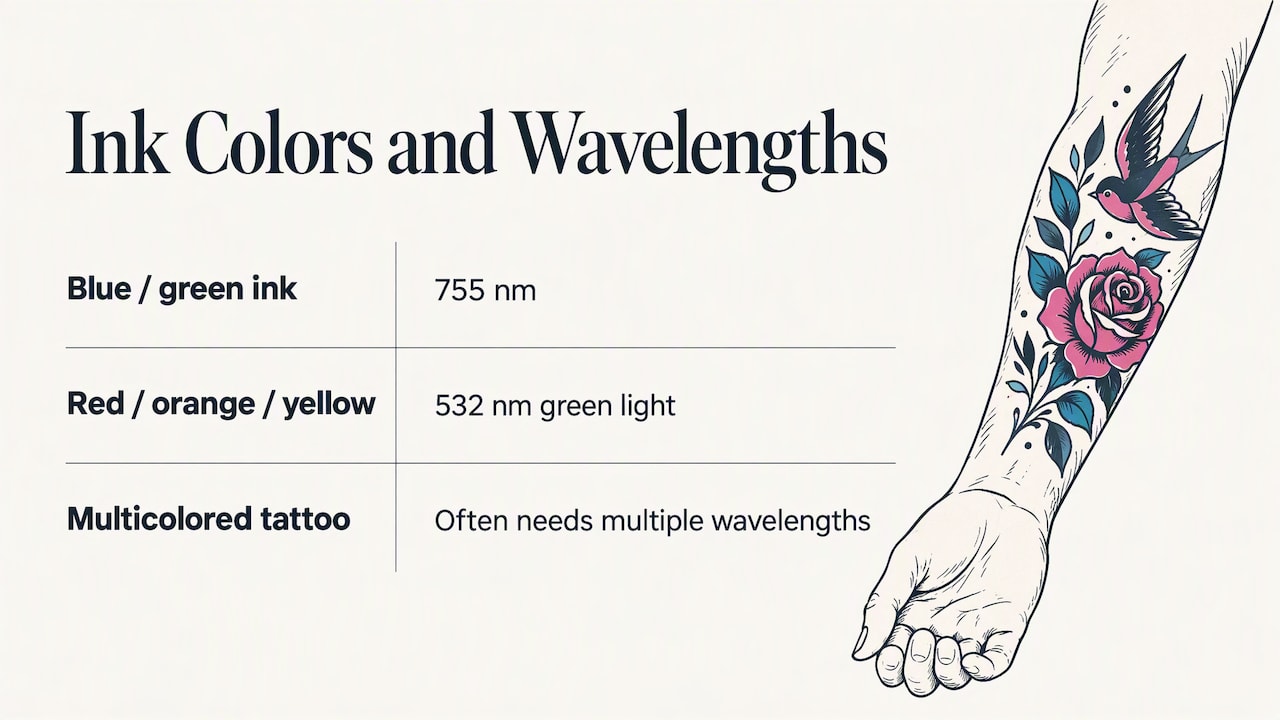
Black ink is the easy case for nearly every modern laser. The harder colors are the ones that sit outside the absorption range of the wavelength being used. Greens and blues respond to the longer red and near-infrared wavelengths such as 755 nm, while reds, oranges and yellows respond to green light at 532 nm. A multicolored piece often needs more than one wavelength, so a platform that offers several is useful. A single-wavelength setup can still do excellent work on a single-color tattoo.
A caution on pastel inks, white, and flesh-toned pigments: they can be stubborn with any laser, and cosmetic tattoos such as eyebrows may react unexpectedly. If you have microblading or similar, read why laser can darken brow pigment before you book anything.
Skin tone and risk
Skin type is the biggest safety question in this comparison. Melanin in the top layer of skin absorbs laser light too, so a wavelength that targets ink can also heat the skin itself. In darker skin this raises the risk of lightening, darkening or scarring.
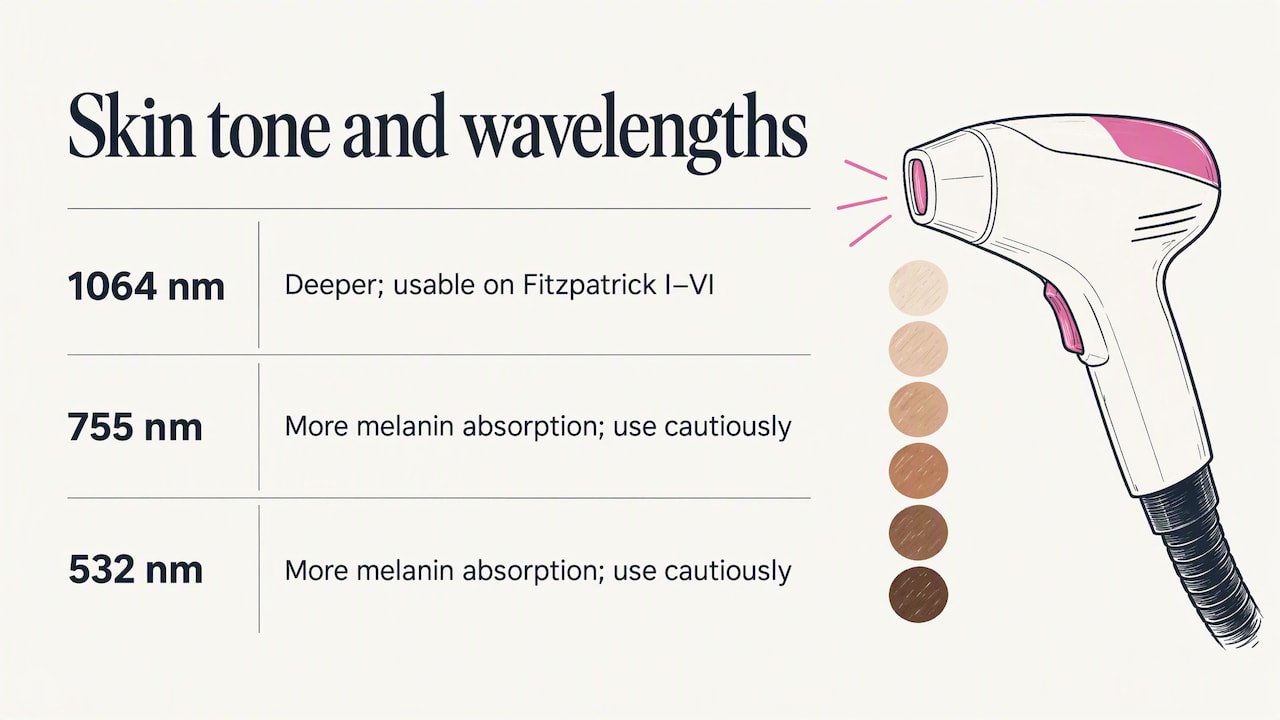
Practical Dermatology’s treatment guidelines note that PicoWay’s 1064 nm wavelength penetrates deeper and can be used on Fitzpatrick skin types I to VI. That is why 1064 nm is the usual choice for dark ink on deeper skin tones, on either platform. The shorter 755 nm and 532 nm wavelengths are absorbed more by melanin, so providers use them more cautiously, or not at all, on darker skin.
So the honest summary is not that one brand is safe and the other is not. It is that wavelength, settings and test spots matter. If you have a deeper skin tone, ask any provider how they would treat you with 1064 nm, and whether they do a test patch first. We make the same point about hair removal in our guide to 1064 nm laser on dark skin: the wavelength and the cooling matter more than the logo.
Beyond tattoos: pigment and skin texture
Both platforms are marketed for more than tattoo removal.
- Sun spots and other pigmentation. Both target pigment, and PicoSure’s FDA clearance includes benign pigmented lesions.
- Acne scars and fine lines. PicoSure’s Focus Lens Array is cleared for acne scars and wrinkles in skin types I to IV. Cynosure describes it as creating microscopic photomechanical reactions in the epidermis that signal the dermis. PicoWay offers Resolve micro-beam configurations for similar goals. ClinicalTrials.gov lists a study comparing 1064 nm PicoWay and 755 nm PicoSure diffractive-lens-array treatments for facial skin quality, a sign that head-to-head evidence is still being built.
- Melasma. Candela’s 2023 announcement specifically targeted melasma for PicoWay, but melasma is a condition that often relapses, so a provider experienced with it matters more than the device.
If your main goal is smoother texture or scarring rather than pigment, look at our laser treatment for acne scars and photorejuvenation pages. The best option may not be a picosecond laser at all.
Sessions, results and what the evidence says
Both platforms have a solid research base. One professional comparison counts 50+ published studies for PicoWay and 60+ for PicoSure Pro, and it notes that the choice often comes down to a practice’s patient mix, since both have established clinical evidence.
In the PicoWay trial summarized for the FDA, an independent database entry reports that 86% of tattoos reached at least 50% clearance after up to three treatments. That is clearance of half, not complete removal, and it came from a study population, not a promise to you.
Real-world planning looks like this:
- Dark, professionally applied tattoos usually need multiple sessions. Amateur tattoos often clear faster.
- Sessions are spaced weeks apart so your body can clear the fragments.
- Colors, ink depth, location and your own immune response all change the count.
A medical reference on picosecond treatment is blunt about this: several sessions may be needed, and the technology does not guarantee complete clearance or freedom from burns or pigment changes. Be wary of any clinic that promises a fixed number of sessions before it has examined the tattoo. Our page on whether laser tattoo removal works walks through what to expect.
Comfort, side effects and aftercare
Expect a snapping sensation, often compared to a rubber band, along with warmth. Numbing cream or cooling air is common. In the FDA-reviewed PicoWay study, treatment was generally considered low pain, no device-related serious adverse events occurred, and three non-severe adverse events in two subjects resolved or improved during the study.
Typical after-effects for either device include redness, swelling, pinpoint bleeding or blistering on tattooed skin, and a crust or scab over the next days. Your provider’s aftercare sheet should cover:
- Keep the area clean and covered as directed.
- Do not pick scabs or blisters.
- Protect the area from sun exposure, since fresh skin pigments easily.
- Call the clinic if you see signs of infection such as spreading redness, pus or fever.
If you have a history of keloids, active skin infection in the area, or are taking medication that affects healing or light sensitivity, tell your provider before treatment. That is a conversation for a licensed clinician, not a web page.
How much does picosecond treatment cost?
Per-session pricing for tattoo removal on both platforms is reported at $200 to $800 as a general range. The same source puts new machine prices at roughly $165,000 to $220,000 for PicoSure Pro and $150,000 to $210,000 for PicoWay. Those figures explain why clinics price sessions the way they do, and why the brand on the machine rarely changes your bill much. Size, color, location and the number of sessions matter far more.
We do not publish a fixed price for picosecond treatments, because the cost depends on the tattoo or the concern. Our free consultation is where you get a figure based on your actual skin.
How to choose: a short decision guide
Use these questions in order.
- What are you treating? Single-color black tattoo, multicolor piece, sun spots, or texture.
- What is your skin type? Deeper skin tones need a provider who is confident with 1064 nm and test spots.
- Which wavelengths does the clinic actually have? Ask for the specific handpieces or add-ons, not just the brand.
- Who runs the laser? Ask about their training and how many cases like yours they have treated. Wavelength match and operator skill may matter more than pulse duration alone.
- Will they assess before quoting? A good clinic looks at the tattoo, asks about your history and explains the plan before taking a deposit.
When PicoWay-type platforms tend to shine
Multicolored tattoos, a need for several wavelengths in one session, and deeper skin tones needing 1064 nm for dark ink.
When PicoSure-type platforms tend to shine
Black, blue and green ink, pigmented lesions, and patients who want a laser also cleared for acne scars and fine lines in skin types I to IV.
Our perspective
We get this question often, and our answer is usually a little unglamorous: the machine is the smaller half of the decision. After more than 15,000 treatments across our services, what we see is that results follow from a careful assessment, realistic expectations and a plan matched to the person’s skin, not from a brand name.
Our approach is to start with a free consultation. We look at the tattoo or the skin concern, talk through your skin tone and history, and explain what a sensible number of sessions looks like. If a laser treatment is not the right tool, such as with certain cosmetic tattoos, we say so. You can read about our laser tattoo removal and PICO laser treatments before you come in. Bring photos of the tattoo, any records from the original artist if you have them, and your questions.
— Chris
Book a consultation in Sudbury
If you are comparing picosecond lasers for a tattoo, pigment or skin texture, we would rather look at your skin than debate model numbers. We offer free consultations, personalized treatment plans and financing options at our Sudbury, MA clinic.

Members also get ongoing access to our care at set annual rates: SILVER is $399 per year, GOLD is $499 per year and PLATINUM is $599 per year. See the membership options or browse our full services list. To start, visit our laser tattoo removal page and request your consultation.
FAQ
Is PicoWay better than PicoSure?
Neither is better across the board. PicoWay’s platform offers a broader set of wavelengths, which helps with multicolored tattoos, while PicoSure is built around 755 nm and is cleared for acne scars and wrinkles in skin types I to IV. A provider’s experience and settings usually shape results more than the brand.
Which is safer for darker skin?
The key is the 1064 nm wavelength, which penetrates deeper and is cleared for Fitzpatrick types I to VI on PicoWay. PicoSure Pro also offers 1064 nm as an add-on. Ask your provider whether they will use it, and whether they do a test patch first.
How many sessions will I need?
It depends on ink colors, depth, location and your body’s response. Several sessions are common, and no laser can guarantee complete clearance. A trustworthy provider estimates after examining the tattoo, not before.
Can a picosecond laser remove cosmetic tattoos like microblading?
Sometimes, but not always. Some cosmetic pigments can darken when lasered, so they need a careful assessment and often a test spot. Ask for a consultation before any treatment on brows, lips or liner.
Sources
- PicoWay laser, Candela
- PicoWay platform and melasma announcement, Candela
- PicoSure, Cynosure
- PicoSure Pro, Cynosure
- FDA 510(k) summary for PicoWay, 2015
- FDA 510(k) summary for PicoSure workstation, 2021
- Lasers in tattoo and pigmentation control, Journal of Clinical and Aesthetic Dermatology
- Treatment guidelines for the PicoWay laser in skin of color, Practical Dermatology
- Laser treatment to improve skin quality, ClinicalTrials.gov
- PicoSure Pro vs PicoWay, The Device Pulse
- PicoWay laser system K153527, Innolitics
- Picosecond laser overview, Dermapedia